Lost pub · English Street
The Carlisle Arms
- Built
- Rebuilt or altered in 1858 to a design by John Hodgson; extended about 1885 into the former Pine Apple Inn next door
- Gone
- Closed September 1930 and demolished for road improvements
- There now
- Shops. Woolworths was built on part of the site in 1932
- Address
- 41-43 English Street
- Where exactly
- Placed from the Ordnance Survey grid reference, NY4016955699, in Historic England's gazetteer of the scheme's premises. The building has since been demolished.
Everyone called it the Gaol Tap, because it stood next door to the city gaol, at 41-42 English Street, on the island of property at the foot of the street, with a back way through to Blackfriars Street. The gaol had once kept a tap of its own. The prison reformer John Howard found two rooms over the felons' wards 'which have been used as tap rooms', but by 1794 Hutchinson's History of Cumberland could report that 'no ale nor spirits are now sold in the gaol'. The directories listed it under its owners, as a wine and spirit merchant's, and the formal names, the City Arms and the Carlisle Arms, barely registered with the town. As late as September 1897 the city's licensing bench still listed it as the Gaol Tap.
Next door, at 43, stood the Pine Apple Inn, traceable to 1810 under Mr H. Dennison. Edward Bowman had it in 1819 and Eleanor Bowman in 1829, and Robert Dixon from 1834, who advertised it as 'well adapted for a Commercial House; there are good Beds, excellent Stabling'. The Pine Apple had its own part in the city's first council election, in December 1835: a public meeting there settled the list of Botchergate candidates, which caused a quarrel in the ward on polling day. Charles Dickens and Wilkie Collins, visiting Carlisle in 1857, are said to have gone into the Pineapple.
In the 1830s it was a meeting place for the city's Irish and Catholics. The plans for a new Catholic chapel at Wigton could be seen there in 1836; that September a Dr Morgan lectured there on Ireland, 'any respectable Conservative' being 'privileged to reply'; and after the East Cumberland election of 1837 a meeting of Irishmen there sent the electors an address of thanks. In the 1840s it was the home of the Freemasons' Union Lodge, No. 389, whose St John's day dinner in December 1848 did credit to 'the worthy host and hostess, Mr. and Mrs. Loftus'. A wrestler's £5 challenge stake was 'ready at the Pine Apple' in 1840.
Robert Bell of the Pine Apple died in May 1846, aged 42, and Christiana Bell, presumably his widow, kept it until 1849. Then she moved up English Street to the old Dog and Bull in Peascod's Lane and 'had it transferred to the Sign of the PINE APPLE INN'. For a year or so Carlisle had two Pine Apples, because Thomas Loftus kept the name on English Street; the Dog and Bull had its own name back by 1867.
Elizabeth Bell came to the Pine Apple from the George and Dragon in Rickergate in March 1856 and kept it into the late 1860s. Under her it was a railwaymen's house. About sixty men from the railways into Carlisle held their benefit society dinner there on New Year's night 1858; that May the enginemen and firemen gave their treasurer, John Tuff, a testimonial there before he left for Egypt; and in May 1860 five Lancaster and Carlisle engine-drivers had a farewell supper there before sailing for Calcutta and 'the Indian railroads'. In February 1867 an E. Bell signed the innkeepers' memorial against earlier closing for the Pine Apple, printed 'Fine Apple'.
In 1847 the corner house was not an inn. Mannix and Whellan's directory of that year lists no public house at 41 or 42 English Street: number 41 was a confectioner's, and number 42 was the business of Joseph Addison, wine and spirit merchant. The Post Office directory of June 1858 still has a wine and spirit merchant at 42, John Jordan, and still no inn. A spirit merchant's vaults on the corner would explain the Spirit Vaults lettering it carried to the end, and the City Vaults name one record gives it from 1851.
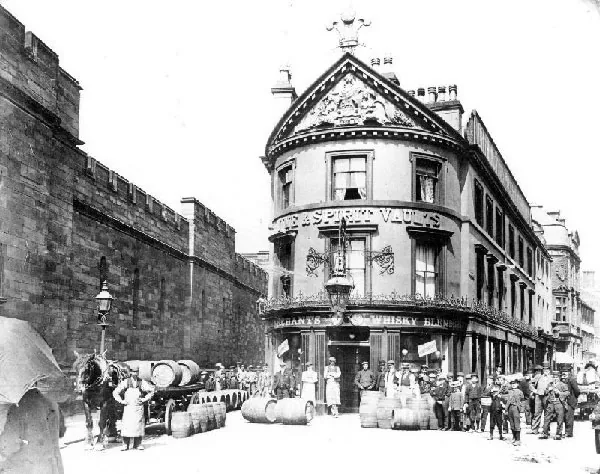
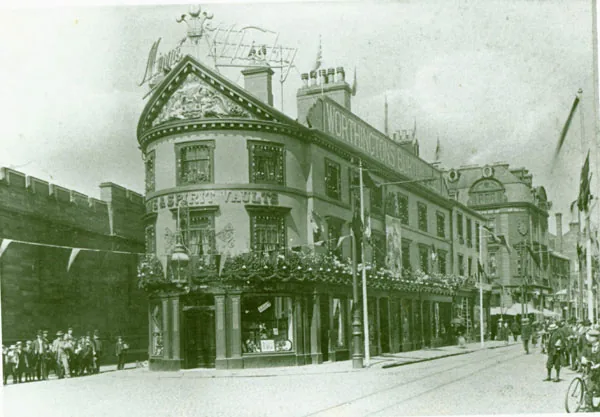
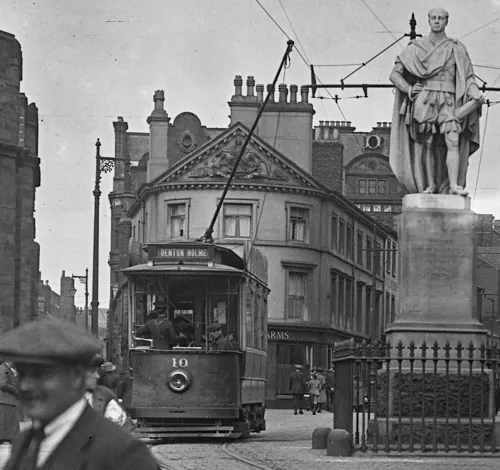
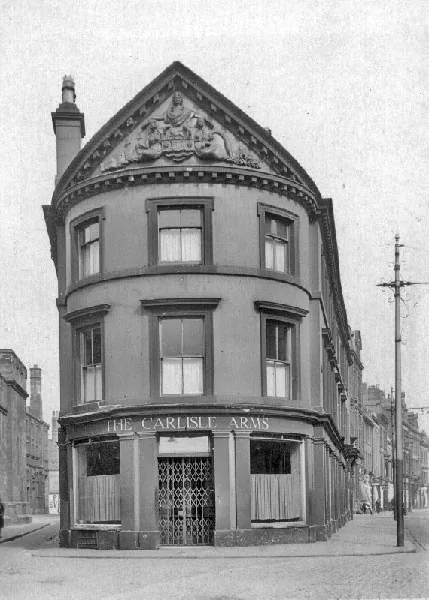
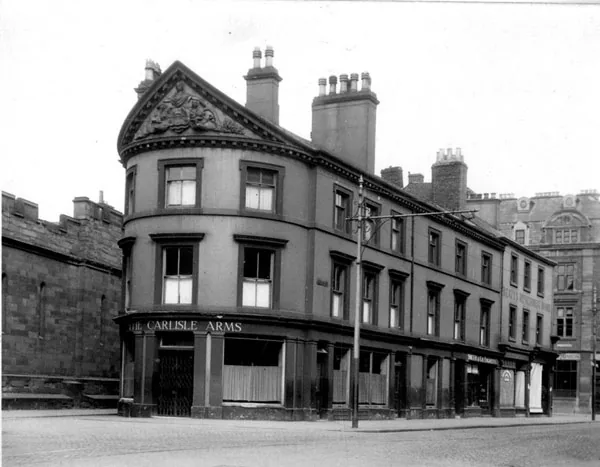
In 1858 the corner house was rebuilt, or altered, to the design of John Hodgson. Until then it had been only two storeys; the rebuilding added a third, a curved entrance, and a pediment carrying the city arms, carved by the sculptor John Kirkbride. One record has it as the City Arms from about 1853, but with a wine merchant still listed there in 1858, the name more likely came with the carved arms.
The directories never call the corner house the City Arms. By 1873 the street had been renumbered, and the Post Office directory lists its last houses before the gaol as 98, a confectioner's; 100, the Pine Apple hotel, still Mrs Bell's; and 102 and 104, Halstead and Pearson's Wine Stores. That Pearson is very likely the Mr Pearson whose house a veteran remembered in 1922. In Kelly's directory of 1894 the Pine Apple has gone: 100 is a grocer's, and 100, 102 and 104 are John Reay's wine and spirit vaults, the last address before Blackfriars Street and the prison.
The name City Arms had been used before. Carlisle's earlier City Arms, John Martin's house, listed on English Street in 1829 and later in St Cuthbert's Lane, had become the Shakespeare Tavern by 1855, so the sign was free if the English Street house took it up.
The two houses came together under one man. In September 1884 the licensing bench transferred the 'Spirit stores, English Street, and Pine Apple, in English Street, from John Pearson to John Reay'. About 1885, or 1888 by one record, the corner house was knocked through into the Pine Apple, and the house was known as the Pineapple too. When the Carlisle Patriot reprinted the 1829 list in September 1891, it marked the Pine Apple as gone or renamed. One record dates the name Carlisle Arms from 1894.
That probably explains the names. The corner was a wine merchant's stores, not an inn, and no directory lists it as one; the public house licence belonged to the Pine Apple next door. Once one owner held both and knocked them together, the Gaol Tap traded on the Pine Apple's licence, which would be why the Cumberland News in 1991 remembered it as originally the Pineapple.
By 1897 it was in the hands of T. and J. Minns, the wine and spirit merchants who also had the Wellington, almost opposite. In 1899 the staff of the County Hotel, out for a Sunday walk, 'had a drink at Minns's, and then another across the road at the Wellington'. In June 1897 the Minns laid plans before the magistrates for 'the improvement of an objectionable part of the premises in Blackfriars Street', and the work was done that year. The directories kept the old name alive: Bulmer's of 1901 lists the 'Pine Apple Vaults, 104 English street', under the Minns, Kelly's of 1910 the 'Pine Apple', and Kelly's of 1914 the 'Pineries', William F. Carnley.
In May 1898 their cellarman, Charles Forester, a Staffordshire man, fell on 'a flight of stone steps leading to the cellar at the Gaol Tap' and died of his injuries; the barmen Robert Fawkes and Charles Bateman gave evidence at the inquest. In 1899 a labourer got six months' hard labour for breaking the plate-glass window, £13 10s of damage.
It turns up in the police court reports of the time as the place everyone went. A mill worker from Dalston, robbed on his way home in January 1889, admitted under cross-examination that 'he began at the gaol tap with twopennyworth of whiskey, not rum'. In February 1891 Thomas Bradley, labourer, fined for trying to gaff salmon in the Eden at Botcherby, did not answer when his name was called; the police sergeant went outside to call it again and came back to report that the man 'had gone to the "Gaol Tap." (Laughter.)' That November a man charged with being drunk on polling day pleaded that he 'was quite able to walk home from the "Gaol Tap."'
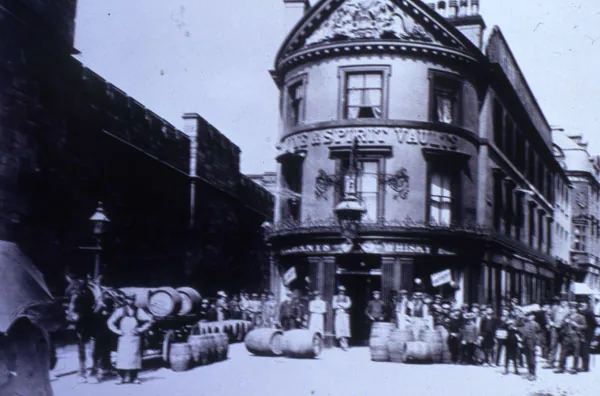
By then it was a big pub for the city. There were six entrances and serving areas on the ground floor, and two large smoke rooms upstairs with massive marble fireplaces; the mixed room, whose windows looked out over the Courts and the top of Botchergate, was said to be particularly fine. It was very popular and was packed on football days, when it might have a whole brewing of beer in the cellar to meet the demand. The photographs show its corner lettered Spirit Vaults and its long side painted for Worthington's ales.
It had its characters. A veteran writing in December 1922 remembered it under a Mr Pearson, who lived upstairs and ran it as a model house. Regulars were expected to behave and helped him enforce his rules, one of which was that gentlemen did not smoke until the town clocks had struck six, 'an illustration of "control" vastly different from the "control" that obtains to-day'. Pearson retired to Bankdale Park at Wreay and rode to the foxhounds with his groom mounted behind him.
Out on the pavement, the city's street bard, Jimmy Dyer, whose father had kept the Drove Inn at Stanwix, sang 'in front of the Gaol Tap' in his square-brimmed felt hat, with the music tied to the front of his cigar-box fiddle, which in 1928 was about to be presented to Tullie House.
The State Management Scheme came in 1916. The Carlisle Arms is number six on the scheme's 1920 roll, though Historic England's gazetteer says the Board took only the lease, in November 1916, and that the house was shut by 1921 and later reopened. It was certainly open in January 1918, when a woman from Drovers Lane was fined 10s for being drunk in the bar after the barmaids refused to serve her.
In 1919 its owners were claiming £3,958 in compensation, and the Board had agreed informally to buy the reversion from a Mr Reay, presumably the John Reay of the 1894 directory. In November 1922 the chairman of the Advisory Committee named it among seven houses, the Caledonian and the Earl Grey among them, that Colonel Lowther had complained were 'taken away' but which, he said, were still licensed under the scheme. A photograph of 1928 shows it with all its advertising stripped off, the scheme's usual treatment.
The end came from the road, not the scheme. Moves to clear the gaol and the island of property around the pub had been discussed in the city council for years, and in 1928 the Corporation bought the Carlisle Arms for the express purpose of knocking it down, along with the gaol, to widen English Street and put up shops. It paid £25,000 for the pub, £7,350 for the rest of the island and £16,750 for the gaol, an outlay of £67,000 with other items, and the government gave £13,700 towards the road improvement on condition that the whole island came down. The gaol site itself was split, the larger part going to the city council and the rest to Cumberland County Council.
The scheme planned for the pub's regulars. Its annual reports for 1929 and 1930 say that rebuilding the Cumberland on Botchergate and replacing the Lord Brougham with what became the Crescent were both undertaken partly to provide for the Carlisle Arms' customers. The last manager was Matthew Steadman, a wrestler and a son of the local wrestling champion George Steadman.
On 27 September 1930 the Cumberland News reported that the new Cumberland Inn would open on Monday 29 September, and that its opening would 'correspond with the closing of the Carlisle Arms, on the island site outside the Gaol, which is to be demolished to make room for the big English Street improvement'. One record gives the closing as 28 October. The building was level by the end of the year, and Woolworths went up on part of the site in 1932. An aerial photograph taken in September 1925 shows it on its island beside the gaol, five years before the clearance.
It was not forgotten. The Cumberland News ran illustrated retrospectives on it on 7 August 1964, on 3, 17, 24 and 25 April 1970, and again on 7 June 1991, and the accounts do not all agree.
The Carlisle Encyclopaedia puts the names the other way round, with the Carlisle Arms as the original house on the block, later extended into what became the City Arms. The 1991 column says it was originally the Pineapple, the name it bore for most of its life, from at least 1820, with Eleanor Bowman as licensee that year, until after the First World War, and wonders whether the name Carlisle Arms came in with the patriotic feeling that followed. It also says the pub escaped the scheme's wartime takeover, and that it finally closed in 1932, which the report of September 1930 does not bear out.
Mike Tuer's pub database gives the corner house a spell as the City Vaults, from 1851 to 1894. The name suits Joseph Addison's spirit vaults, but the City Vaults that appears in the Carlisle papers of those years is a different house, the City Vaults at the head of Fisher Street, so the newspapers do not confirm it for the Gaol Tap.
Photograph
Sources 50
- cumberlandscarrow.com
- Carlisle Encyclopaedia
- S. Davidson, Carlisle Breweries and Public Houses 1894-1916, pp82-3, 123, 125, 8
- CARLISLE_PUBS_Ver_3.xls (Mike Tuer's pub database)
- Brewery History Society: the 1920 roll of Carlisle & District State Management Scheme pubs
- Historic England, Countering the 'deadliest of foes': public houses of the Central Control Board and the State Management Scheme, 1916-73 (Clare Howard, Research Report 89-2018): Appendix C, gazetteer of scheme premises
- The State Management Story documents: State Management Districts annual report, year to 31 March 1929
- The State Management Story documents: State Management Districts annual report, year to 31 March 1930
- The State Management Story documents: Central Control Board memo on outstanding compensation, 1919
- The Cumberland News, 18 November 1922, p. 9: G. A. Rimington's letter, 'Control in Carlisle' (via newspapers.com)
- The Cumberland News, 2 December 1922, p. 9: 'A Veteran's Reminiscences' (via newspapers.com)
- The Cumberland News, 19 May 1928, p. 10: A. C. Astor, 'Cumbrians abroad' (via newspapers.com)
- The Cumberland News, 7 June 1991, p. 4: 'Pubs of yesteryear', Carlisle Arms (Gaol Tap), English Street (via newspapers.com)
- Carlisle Patriot, 2 January 1836, p. 4: 'The New Corporation: Election of Councillors' (via British Newspaper Archive)
- Carlisle Patriot, 22 February 1867, p. 7: 'Carlisle Town Council: the Public House Closing Act', with the innkeepers' memorial (via British Newspaper Archive)
- The Cumberland News, 27 September 1930, p. 10: 'Carlisle's New Model Tavern' (via newspapers.com)
- W. Hutchinson, The History of the County of Cumberland, vol. II (Carlisle: F. Jollie, 1794), pp. 680-681: the county gaol, quoting John Howard
- Carlisle Journal, 19 February 1889, p. 2: assizes, robbery with violence at Dalston (via British Newspaper Archive)
- North Cumberland Reformer, 19 February 1891, p. 2: 'Gone to the "Gaol Tap"' (via British Newspaper Archive)
- Carlisle Express and Examiner, 7 November 1891, p. 8: 'Yesterday's police news' (via British Newspaper Archive)
- Carlisle Journal, 15 June 1897, p. 3: petty sessions, proposed alterations to licensed premises (via British Newspaper Archive)
- North Cumberland Reformer, 11 September 1897, p. 7: renewal of existing licences (via British Newspaper Archive)
- Carlisle Journal, 17 May 1898, p. 2: 'Fatal fall into a cellar' (via British Newspaper Archive)
- Carlisle Journal, 4 August 1899, p. 6: 'The bathing fatality in the Eden' (via British Newspaper Archive)
- Carlisle Journal, 20 October 1899, p. 6: 'Breaking the Gaol Tap window' (via British Newspaper Archive)
- Cumberland Evening News, 4 February 1918, p. 2: 'Woman drunk in a bar' (via British Newspaper Archive)
- Britain from Above, EPW014374: The City Centre, Carlisle, September 1925 (aerial photograph)
- Mannix and Whellan, History, Gazetteer and Directory of Cumberland (Beverley, 1847), Carlisle directory, pp. 161-162 (hotels, inns and taverns) and wine and spirit merchants (University of Leicester digital copy)
- Post Office Directory of Cumberland (London: Kelly and Co., 1858), Carlisle: commercial list and inns (University of Leicester digital copy)
- Post Office Directory of Durham, with the principal towns of Northumberland, Cumberland and Westmorland (London: Kelly and Co., 1873), Carlisle: English Street (University of Leicester digital copy)
- Kelly's Directory of Cumberland (London: Kelly and Co., 1894), Carlisle: English Street (University of Leicester digital copy)
- Carlisle Patriot, 15 May 1819, p. 2: 'Ten guineas reward', applications to Mr Edward Bowman, Pine Apple (via British Newspaper Archive)
- Carlisle Journal, 14 February 1835, p. 2: Pine Apple Inn, Robert Dixon (via British Newspaper Archive)
- Carlisle Journal, 4 June 1836, p. 2: Catholic chapel at Wigton, plans at the Pine Apple (via British Newspaper Archive)
- Carlisle Journal, 17 September 1836, p. 2: lecture by Dr Morgan at the Pine Apple (via British Newspaper Archive)
- Carlisle Journal, 12 August 1837, p. 3: 'Ireland and her wrongs', letter from Arthur Augustine Magee (via British Newspaper Archive)
- Carlisle Patriot, 21 November 1840, p. 2: wrestling (via British Newspaper Archive)
- Carlisle Journal, 23 December 1843, p. 1: Freemasonry, Union Lodge No. 389 (via British Newspaper Archive)
- Carlisle Journal, 9 May 1846, p. 3: deaths (via British Newspaper Archive)
- Carlisle Journal, 29 December 1848, p. 2: Freemasonry, Union Lodge No. 389 (via British Newspaper Archive)
- Carlisle Journal, 1 June 1849, p. 2: Pine Apple Inn, Peascod's Lane, Mrs C. Bell (via British Newspaper Archive)
- Carlisle Journal, 14 March 1856, p. 1: Elizabeth Bell removed to the Pine Apple (via British Newspaper Archive)
- Carlisle Patriot, 16 January 1858, p. 8: railway benefit society dinner (via British Newspaper Archive)
- Carlisle Patriot, 8 May 1858, p. 8: presentation to John Tuff (via British Newspaper Archive)
- Carlisle Patriot, 5 May 1860, p. 7: farewell supper to engine-drivers (via British Newspaper Archive)
- Carlisle Express and Examiner, 27 September 1884, p. 5: licensing day, transfers (via British Newspaper Archive)
- Carlisle Patriot, 25 September 1891, p. 6: 'Public houses in Carlisle sixty years ago' (via British Newspaper Archive)
- Bulmer's History, Topography and Directory of Cumberland (1901), Carlisle: trades and alphabetical directory (University of Leicester digital copy)
- Kelly's Directory of Cumberland (London: Kelly and Co., 1910), Carlisle: street directory and public houses (University of Leicester digital copy)
- Kelly's Directory of Cumberland and Westmorland (London: Kelly and Co., 1914), Carlisle: street directory and public houses (University of Leicester digital copy)
Open question
A date we can't pin down
When did the Carlisle Arms name come in? The directories still call the house the Pine Apple in 1910 and the Pineries in 1914, and the papers call it the Carlisle Arms by January 1918, so probably when the scheme took the lease in 1916. The Cumberland News of 7 June 1991 also gives both September 1930 and 1932 for the closing.
If you know the answer, or where it might be found (an old photograph, a family story, a document), tell us and it goes into the story above.
Also lost on English Street
- The Liverpool Arms
- The String of Horses Inn
- The White Lion Inn
- The Royal Hotel
- The White Hart Hotel
- The White Swan Inn
- The Grey Goat Hotel
- The Kings Arms Inn
- The Angel Inn
- The Wellington Inn
- The White Horse Inn
- The Bush Hotel
- The Victoria Hotel
- Yates Wine Lodge
- Outrageous
- The Bull Dog Inn
- The Citadel Tavern
- The Cross Keys
- The Crown & Anchor
- The Pack Horse Inn
- The Skinners Arms
63 other lost pubs stood within 250 m of here. See them on the map
Still serving, near where it stood
-
20 maway
-
50 maway
-
60 maway
-
70 maway