History · 1794
Carlisle's inns in 1794
In 1794 a Carlisle printer, Francis Jollie, published the second volume of William Hutchinson's History of the County of Cumberland. Its account of the city was written by a Carlisle man, R. Longrigg, and it is a rare early account of the city's inns and drinking: which houses the coaches used, what the ale cost, how the publicans took on the corporation and won, and how the town first took to brewery beer. The book came with a plan of the city, laid over today's streets below.
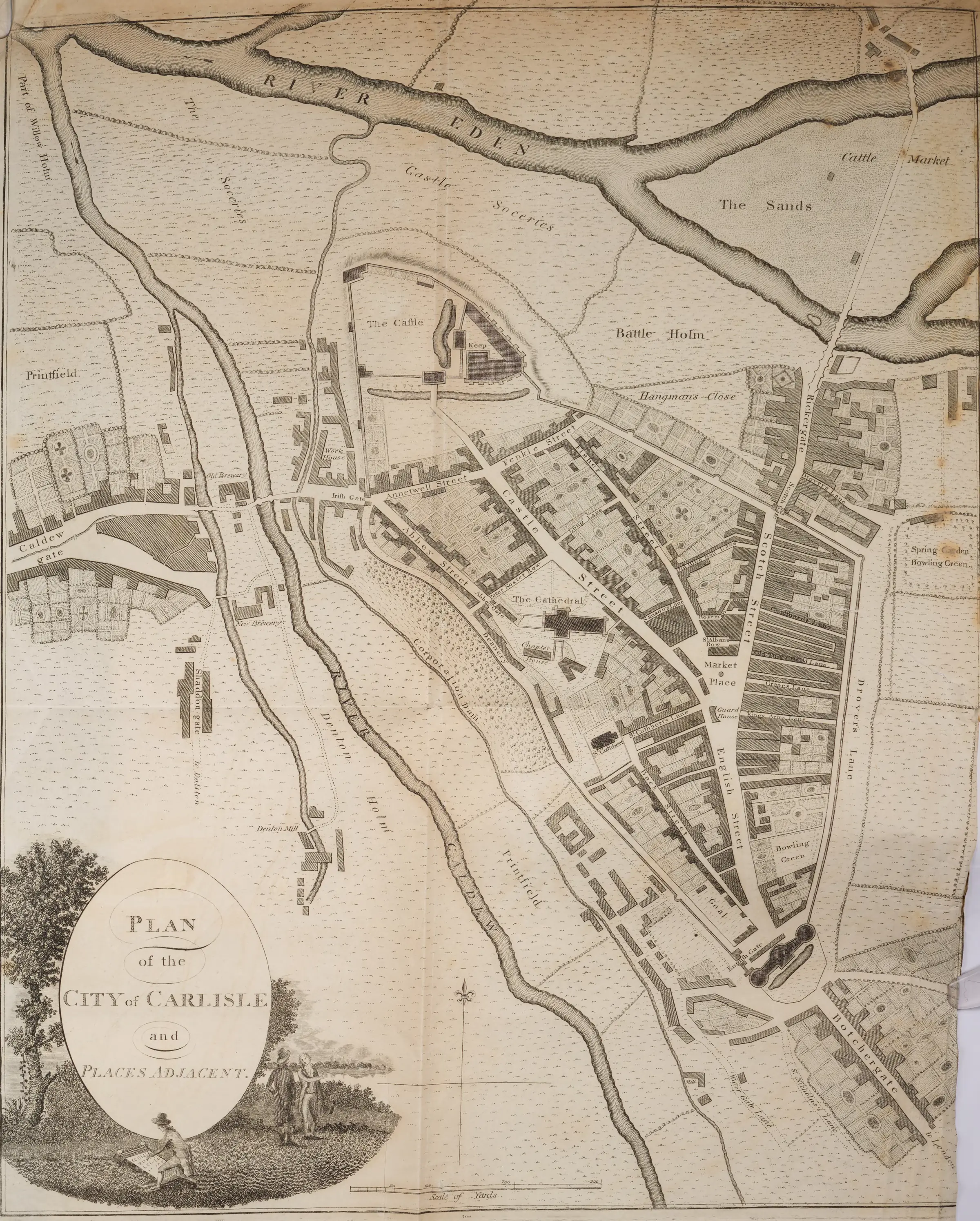
The 1794 plan over today's map
The plan shows the city as it was then: walled, with the castle at the top, the cathedral in the middle and the three gates, English, Scotch and Irish. Slide the plan away to see what stands there now. The pins are the inns the History names, and the lanes on the plan that carried inn names.
The plan was fitted to seven buildings that are still there: the cathedral, the castle keep, the Fratry, St Cuthbert's church, the market cross and the two Citadel towers. In the old city it sits within about 10 to 15 metres of where things are now; out by the rivers it is less sure, since the plan was engraved, not surveyed, and the paper has moved since. See the plan as printed.
The inns the coaches used
Public inns here have good accommodation, both in rooms and stabling. The Bush-Inn, English-street, and Crown and Mitre, Castle-street, are the houses the mail coaches put up at: the King's Arms, Grapes, Blue Bell, and Duke's Head, are also much resorted to by travellers: there are several other good inns, both in the city and suburbs.
- The Bush, English Street. Moved there from Scotch Street in 1783; pulled down for the Victoria Viaduct in the 1870s, and its successor building is the NatWest bank.
- The Crown and Mitre, Castle Street. The old coffee house of the Jacobite years; rebuilt as today's hotel in 1903 to 1905.
- The King's Arms, at the head of English Street, by the lane that still has its name. It lost its licence in 1891.
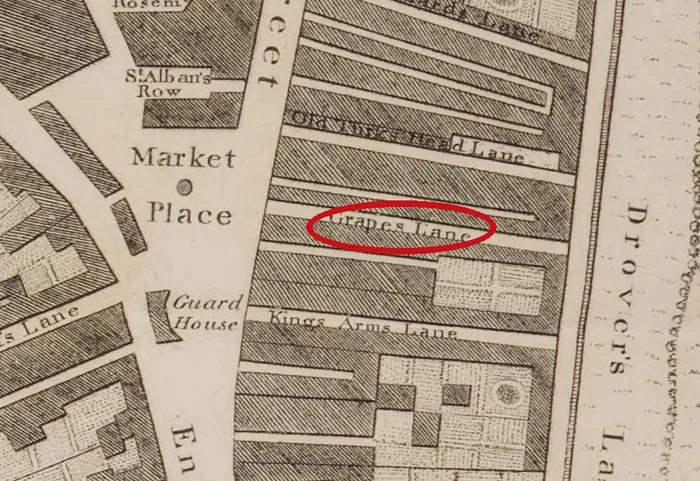
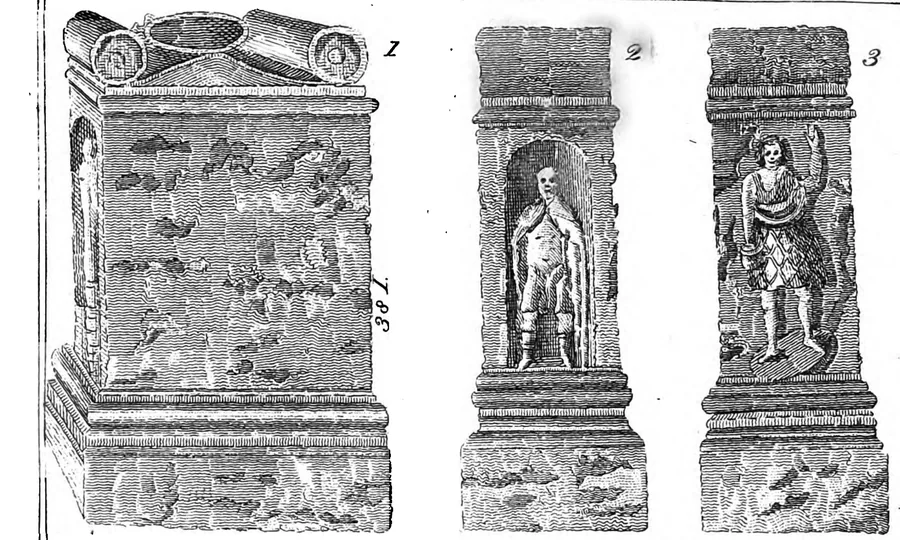
- The Grapes, facing the Market Place, where a Roman altar came out of the cellar. Gone from the directories after 1894.
- The Blue Bell, almost certainly the coaching inn on Scotch Street, which lasted until 1973.
- The Duke's Head, Scotch Street, recorded from 1746 and gone from the directories after 1848.
The coaches ran from these inns. Two mail coaches set out every morning for London, one by Manchester and the other by Boroughbridge, and a heavy coach went to London on Mondays, Wednesdays and Fridays. A mail coach left every afternoon for Glasgow, with a mail diligence to Dumfries at the same time. Diligences ran to Edinburgh on Mondays, Wednesdays and Fridays, to Newcastle on Sundays, Tuesdays, Wednesdays and Fridays, and to Whitehaven on Saturdays. Goods came the same way: above two hundred horses worked the waggons and carts, and the goods stood in the streets on market days until the carriers began building warehouses of their own.
It had not been like that for long. Until 1759 there was no post chaise to be had in Carlisle at all. Then the city filled with French prisoners on parole and a militia with money in its pockets, 'four wheeled carriages began to run from the different inns', and an assembly room was built, because until then 'when any gave a ball it was chiefly at the Bush Inn'.
Threepence a quart
Longrigg looked back half a century, to the years before the 1745 rising, when the city was small, poor and green with grass in the streets. 'The victuallers brewed their own ale, of a good quality, and sold it for threepence a quart, full measure. And (such was the custom of the place) seldom did a company call for the second pot, without the landlord or landlady presenting them with the fare of the house to relish their liquor. Spirituous liquors were very seldom made use of.'
That changed within a few years. By about 1750 'British spirits, viz. Brandy, Gin, Cinnamon, and Anniseed Waters, were now so plenty and cheap, that there was scarcely a gingerbread stall but sold them.' And the pubs did another job besides: with no garrison kept in the city, 'the military who may be stationed in the town for a time, are quartered upon the public houses in the city and suburbs.'
The publicans against the corporation
The publicans still brewed their own ale and most of them made their own malt, and the corporation had long made them grind it at the corporation's mills and pay the miller's toll, called multure. Around 1750 many of them bought small hand mills and stopped. The corporation, 'irritated at this breach of what they deemed their right, refused to grant licences to the refractory inn-keepers.' The publicans went to law, the case was tried at York, and they won. It cost the corporation its multure and a heavy bill besides.
Longrigg's explanation of why the corporation lost is the best line in the book: 'It seems the corporation did not keep a horse, a bull, and a boar, to substantiate their right to compulsive multure. This, the lord bishop of the diocese, and the dean and chapter of Carlisle, always perform at their service mills.' Nearly two centuries before the state took the pubs over, Carlisle had already tried to bring its publicans to heel by refusing licences, and lost.
The Woolpack and the runaway manufacturer
Soon after the '45 a company of Hamburg merchants set up a woollen manufactory in Carlisle under two brothers called Dewlicher. It failed within a few years, and the surviving brother hid in Scotland. Coming back late one evening, he called at the Woolpack, 'a house much resorted to by the workmen', where the widow who kept it, Mary Carlyle, put him up for several days and sent him off with 'something handsome' in his pocket. Nobody now knows where the inn stood. The whole story, and the question it leaves.
Factory drink
'In the year 1756, a brewery commenced in the suburbs of the city, without the Irish Gates, under the firm of Atkinson and Co. But the inhabitants of Carlisle and the neighbourhood, having been long accustomed to home brewed ale, did not relish this factory drink, so that it was sometime before this public brewery met with much encouragement.' After a few years the prejudice wore off. A second brewery opened near it, Pattrickson and Co.'s; Daniel Pattinson built a third, and Mr Haugh had just built a fourth. The first three paid over £6,000 a year in duty between them.
The plan marks the Old Brewery just over the Caldew from the Irish Gate, and a New Brewery further south towards Shaddon Gate. The Old Brewery of 1756 is the one the state kept brewing when it took over Carlisle's drink trade in 1916; the history page has that story, and the Globe Inn stood just below it on Bridge Street.
The gaol tap
The county gaol stood on English Street beside the English Gate, and it had kept a tap of its own. The prison reformer John Howard found two rooms over the felons' wards 'which have been used as tap rooms', and a window 'through which spirituous liquors, and tools for mischief, might be easily conveyed', since bricked up. By 1794 'no ale nor spirits are now sold in the gaol'. The pub next door, trading by 1810, was known as the Gaol Tap.
Lanes named after inns
The plan has no pubs on it, but the lanes give some away. Off the east side of Scotch Street, facing the Market Place, are Old Turk's Head Lane, Grapes Lane and Kings Arms Lane. Off the west side is Old Blue Bell Lane, already old in 1794. And outside the wall beyond Drovers Lane is the Spring Garden Bowling Green, the green of the later Bowling Green Hotel, before Lowther Street existed.
A Roman altar from the Grapes cellar
Out in the parishes
The History counted the public houses in some of the parishes round the city, which gives a rare census of village drinking at the end of the eighteenth century.
- Dalston: eight ale-houses in the parish. The Blue Bell is the one still open on the square.
- Chalkfoot, in Dalston parish: 'the public-house at Choke-foot', very likely the house later called the Masons' Arms.
- Burgh by Sands: four public houses and two maltsters. The Greyhound in the village and the Highland Laddie at Glasson still trade.
- Great Orton: 'only one public-house in this parish, at Woodhouses, half way between Carlisle and Wigton.' Its name is not recorded; the Wellington came in 1823.
- Longtown: 'as commodious an inn as any in the north of England, built by the late Dr. Graham', almost certainly the Graham Arms.
- Brampton, from the first volume: twenty-three ale-houses in the parish, eighteen of them in the town itself.
Where this comes from
William Hutchinson, The History of the County of Cumberland, two volumes (Carlisle: F. Jollie, 1794). The city's modern state is volume II, pages 658 to 668; the inns and coaches are on page 666, the multure case and the Woolpack on pages 660 to 661, the breweries on pages 662 and 664, the gaol on pages 680 to 681, and the Grapes altar on page 652 and its plate. The parishes are on pages 444 and 453 (Dalston), 508 (Burgh), 516 (Orton) and 548 (Arthuret), and Brampton is volume I, page 130. The plan of the city faces page 585.
The editors credit the account of the city to 'Mr. R. Longrigg, a native of this city', so the memories of 'half a century ago' are his. Quotations keep the book's spelling, with a modern s for its long one. Both volumes can be read free at the Internet Archive; the plan here is from a fuller copy scanned by Google Books.
More: Carlisle pubs through the years, which now starts in the 1790s and can show this plan too, and the lost pubs.