City Centre, Carlisle
The Andalusian
Built 1932 by Harry Redfern for the scheme, and the most flamboyant thing he ever designed.
Sold as the Crescent Inn to Scottish & Newcastle as part of Group 1, handed over on 17 April 1973. Who bought the rest
Redfern's most extravagant building, a Hispano-Moresque pub of 1932 in terracotta with a Moorish balcony, now a tapas bar and restaurant. Closed Tuesdays and Wednesdays.
- Today
- See opening hours
- Address
- The White House, 6 Warwick Road, Carlisle CA1 1DN
- Phone
- 01228 539665
Also known as The Crescent Inn, The White House, Prezzo
History
Opened 1932
- Built
- 1932, by Harry Redfern
- Style
- Hispano-Moresque
- Listed
- Grade II
- Replaced
- The Lord Brougham, across the road
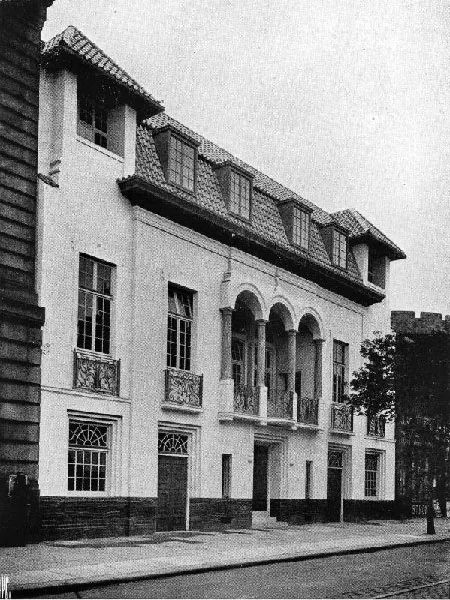
A Moorish palace on Warwick Road. Harry Redfern built a great many sober Arts and Crafts pubs for the State Management Scheme, and then in 1932 he built this. It replaced the Lord Brougham across the road, the same pattern as the Apple Tree, the Crown Inn and the Horse & Farrier. It is not to be confused with the Crescent Bar, a separate venue about thirty metres away on The Crescent with a confusingly similar history of names.
His plans of January 1931 put two big rooms either side of a central servery on each floor. Downstairs were a mixed second class smoking room and a men-only public bar, each with its own street door; upstairs, a mixed first class room opening onto the balcony and a men's first class room. Redfern called it 'publichouse planning reduced to its simplest terms', forced by a small site lit only from front and back. A cellar above the first floor, so the beer could come down by gravity, was discussed and dropped. There was no women's bar, 'a feature of some of the taverns which has led to considerable criticism'.
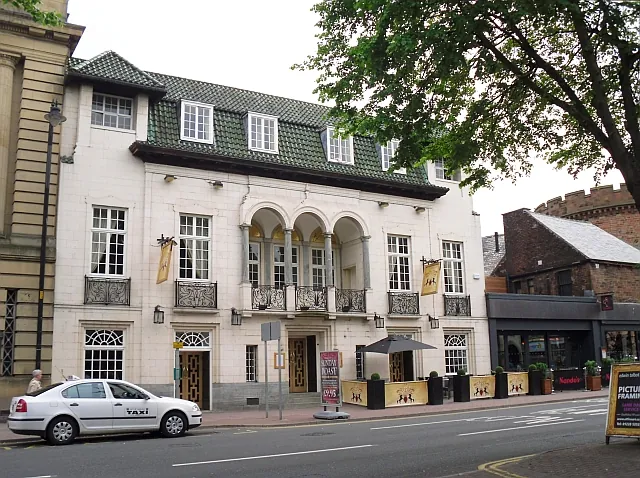
It looks like terracotta but is faced in ivory-tinted Biancola, a marble composition, over concrete and steel, on a banded volcanic ashlar plinth, with pilasters, an eaves cornice and a mansard roof of green glazed pantiles from Adlard's of London. Two doorways under radial fanlights lead into the ground-floor bars. A central pair of panelled doors under a hoodmould goes straight upstairs, the same trick as the Cumberland Inn on Botchergate, so the two classes never met coming in; the doors survive though the rooms they served have gone. Above them a three-arched recessed balcony sits on banded volcanic columns.
Inside, the lustre tiles upstairs and Conrad Dressler tiles downstairs were the last stock of a maker gone out of business, so the scheme could not be repeated, and with the murals they gave 'a note of bright colour to a scheme which is very restrained and which might otherwise have been a trifle dull'. The fireplaces were Hopton Wood stone, the woodwork Tobasco mahogany with 'secret' doors to the cloakrooms, and there was no fixed seating. Each upper room had a music gallery over the servery.
John Laing and Son built it, and it opened as the Crescent Inn on Monday 3 October 1932. Redfern's own explanation of the style runs to one line, in a letter of that April: 'an attempt has been made to import a Spanish flavour into the scheme'. Historic England's survey reads it as an architect grown confident enough by the 1930s to try something bolder. Why Spain, no minute says.
Not everyone liked it. The Cumberland News sent a reporter round the week before the opening, and there had already been 'considerable criticism' that its Spanish look was out of place beside the 'modernly-forbidding' General Post Office. He thought it one of the most pleasing taverns Redfern had yet built, a 'brightness among surrounding drabness', and noted that the building, 'however much critics may dislike it, has, like State control in Carlisle, come to stay'. He doubted a string quartet would ever play in the galleries: the State had not provided so much as a wireless.
The balcony was only for show. The Home Office, which ran the State taverns, ruled that the public could not use it, and at night it was the one part of the building lit, by two coloured lamps meant to give a sunset effect. The first manager was William Stuart of Maryport, who had run the Kings Head for a year, and a follow-up in the paper on 8 October judged it already the most popular tavern around.
It was listed Grade II on 22 February 1973. The Crescent Inn later became the White House, the name the address still carries: Freddy and Debra Rowland of the Border Rambler reopened it as the Whitehouse in November 1996 after a £210,000 refit by Scottish & Newcastle Tenancies, with Theakston dray horses at the door and its listed tiling uncovered. A gay-friendly reopening under that name was announced for September 2005, and it closed in January 2007.
It stood boarded up for nearly three years, on the market for alternative use, before reopening in December 2009 as the Andalusian. It spent a stretch as Prezzo, the Italian chain, and has since gone back to being the Andalusian; Historic England still list it as formerly the Crescent Inn. Both floors have been opened out, but in 2016 Historic England found much left. The pillars at the corners of the old ground-floor counter still wear their Dressler tiles of vines and foliage. The oval lobby opens through iron gates onto a staircase with tiled risers, green stone treads and arabesque banisters, and small display cabinets on the landing doubled as spy windows for the staff.
Upstairs the two rooms, knocked into one, are double height under groin and barrel vaults, with the galleries still over the servery. A photographer who has recorded every Redfern pub reckoned in 2017 that much of the interior remains as Redfern left it, its Islamic-style tiling and original fireplaces included, though the upper floors have not been used for years.
- Historic interior
- Food
- Cocktails
Photographs
Opening hours
| Mon | 16:00–22:00 |
| Tue | Closed |
| Wed | Closed |
| Thu | 16:00–23:00 |
| Fri | 11:45–21:00 |
| Sat | 11:45–21:00 |
| Sun | 11:45–22:00 |
Hours last checked August 2026, about 2 months ago.
Hours are kept by hand and change without warning. Ring ahead if it matters.
More like this
- Historic interior pubs in Carlisle
- Food pubs in Carlisle
- Cocktails pubs in Carlisle
- All pubs in City Centre
Nearest to here
-
10 maway
-
30 maway
-
40 maway
-
40 maway
Lost on Warwick Road
- No 15 Gin Bar gone 2020
- Suede gone 2008
- The Lord Brougham gone 1932
- The Petteril Bridge Inn gone 1917
100 lost pubs stood within 400 m of here. See what used to be around it
Sources
- Historic England list entry 1291729
- Co-Curate: the Andalusian
- Boarded up in 2007, via Geograph
- The Carlisle Kid on the surviving interior, 2017
- The State Management Story
- Carlisle Encyclopaedia, Crescent Inn
- Carlisle Encyclopaedia
- Historic England, Countering the 'deadliest of foes': public houses of the Central Control Board and the State Management Scheme, 1916-73 (Clare Howard, Research Report 89-2018): Appendix B, summaries of key State Management public houses
- Historic England, Countering the 'deadliest of foes': public houses of the Central Control Board and the State Management Scheme, 1916-73 (Clare Howard, Research Report 89-2018): Appendix C, gazetteer of scheme premises
- The Cumberland News, 1 October 1932, p. 10: 'A Spanish inn at Carlisle: novel note in the city's architecture'
- The Cumberland News, 29 November 1996, p. 14: 'Dray horses reopen historic city pub' (via newspapers.com)
Open question
An unsolved mystery
Why Spain? Redfern's only recorded explanation for the Crescent Inn, now the Andalusian, is that he tried to 'import a Spanish flavour into the scheme'. After fifteen years of sober Arts and Crafts pubs for the State Management Scheme, what prompted a Hispano-Moresque palace on Warwick Road in 1932, and who approved the design? The Home Office ran the State taverns and ruled on details such as the balcony, but no record of its view on the style has turned up.
If you know the answer, or where it might be found (an old photograph, a family story, a document), tell us and it goes into the history above.