Lost pub · English Street
The Wellington Inn
- Built
- A thatched house stood here from at least 1828; rebuilt of white stone, 1854
- Gone
- Amalgamated with the Three Crowns in 1916 to form the Citadel Tavern
- There now
- The former Citadel Tavern building
- Address
- 79 English Street (37 before the renumbering)
- Where exactly
- Placed from the Ordnance Survey grid reference, NY4020055700, in Historic England's gazetteer of the scheme's premises. The building's use in 2018: commercial.
Stood at 79 English Street, 37 before the street was renumbered, near the corner of Devonshire Street and virtually opposite the Gaol Tap. It replaced an earlier pub on the same site, a small thatched house standing there from at least 1828, which had traded as the Bull and Butcher from about 1820 and as the French Horn from 1827 to 1839 before taking the Wellington name.
A Cumberland News column of 31 May 1991 on the Wellington Hotel and the Three Crowns says the inn took its name at a time of patriotic fervour, and puts the change earlier than the directories do: until about the time of Waterloo and the founding of the Carlisle Patriot, it says, it was the French Horn, a small thatched house across the street from the city gaol. It was a favourite haunt of Robert Anderson, the Cumberland Bard, who died in September 1833, and in his day it was kept by Joe Perdie (Joseph Purdie), a nephew of Anderson's.
James Bell was innkeeper by the 1841 census. The house was rebuilt of white stone and put up to let in 1854, when a Mr Holywell took it on, which identifies the 'Holywell Wellington Hotel' of an 1880 trade-directory advertisement as this same house. Ann Holywell was still there, as innkeeper, in the 1861 census. In May 1868 the licence passed from John Holywell to W. Holywell, and William Holliwell of the Wellington was on the police black list in September 1880. In September 1884 a transfer from Mr Hollywell to Messrs Nicholson and Skelton was put back for want of proper notice; it went through at the adjourned licensing day later that month.
By 1891 and 1901 it had settled into trading as a wine and spirit merchant's rather than a full inn, though Bulmer's directory of 1901 already calls it the Wellington Hotel, under Nicholson and Skelton. T. and J. Minns had it by 1906, and it was tied to their wine and spirit firm. The 1991 column says much more is known about the Wellington than its neighbour, probably because its owner in later years, John Minns, was an entrepreneur with an eye to publicity. With the Gaol Tap across the road, the two Minns houses made an easy pair: in August 1899 the staff of the County Hotel, out for a Sunday walk to the river, 'had a drink at Minns's', the Gaol Tap, 'and then another across the road at the Wellington'. Photographs of the Wellington survive from about 1911.
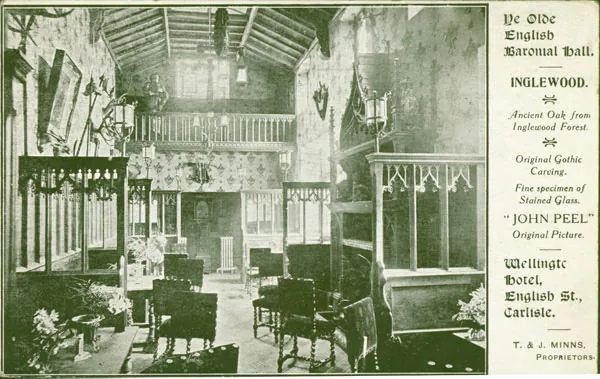
The hotel was known far and wide for its Baronial Hall, an internal feature visited by thousands of people from all over the world who signed the visitors' book. Its oak panelling, screens and doors had been made for Carlisle Cathedral, where they stood for about a century. The column traces them to about 1746, when a local craftsman, named in the Transactions of the Cumberland and Westmorland Antiquarian and Archaeological Society (C. G. Bulman) as Thomas Carlyle, carried out the work to the designs of the Bishop's nephew, the amateur architect Thomas Pitt, later Baron Camelford, after Bishop Lyttleton began a restoration of the fabric in 1762. The woodwork stayed in the Cathedral until about 1850, when restoration removed it.
The reredos went to Featherstone Castle and the pulpit to Thursby church, and the rest was stored in the Fratry, then taken to Brunstock, to the home of a Mr Saul, a Chapter clerk, who used it as panelling. After his death John Minns bought it at auction and had it installed in the hotel as the Baronial Hall, decorated with shields, armour and halberds.
It was a Carlisle Old Brewery house when the State Management Scheme acquired it in August 1916, and that year it was proposed that the Wellington and the Three Crowns next door should amalgamate. By 1 November 1916 the Board's local committee had recommended 'very large alterations' to the two, and the general manager expected the work, then in hand, to take four months; it took eleven. The same report names the Wellington Hotel, English Street, among the seventeen houses where spirits could still be bought to take away. What came out of it was the Citadel Tavern, which appears in the directories from 1920; a letter in the Cumberland News of 18 November 1922 says the Wellington by then formed part of it.
The Baronial Hall did not survive the change. The scheme removed the fittings and stored them, first in a brewery and then in a warehouse, and in 1920 the parishioners of St Mary's, only yards from the woodwork's first home in the Cathedral, acquired it as part of a memorial to the parish's dead of the First World War. St Mary's was closed just before the Second World War and demolished in 1954, and most of the woodwork went to St Paul's church, with which St Mary's parish had been joined, and the rest into other churches in and around Carlisle.
Photograph
Sources 15
- cumberlandscarrow.com
- CARLISLE_PUBS_Ver_3.xls (Mike Tuer's pub database)
- Historic England, Countering the 'deadliest of foes': public houses of the Central Control Board and the State Management Scheme, 1916-73 (Clare Howard, Research Report 89-2018): Appendix C, gazetteer of scheme premises
- The Cumberland News, 18 November 1922, p. 9: G. A. Rimington's letter, 'Control in Carlisle' (via newspapers.com)
- The Cumberland News, 4 November 1916, p. 5: 'The Control Board: progress of the Carlisle scheme' (E. C. Sanders's report of 1 November) (via newspapers.com)
- The Cumberland News, 31 May 1991, p. 4: 'Pubs of yesteryear', Wellington Hotel and Three Crowns (via newspapers.com)
- Carlisle Patriot, 29 May 1868, p. 5: 'Transfer of public-house licences in Carlisle' (via British Newspaper Archive)
- Carlisle Express and Examiner, 6 September 1884, p. 5: 'City Brewster Sessions' (via British Newspaper Archive)
- Carlisle Express and Examiner, 11 September 1880, p. 8: Brewster Sessions, transfers and the black list (via British Newspaper Archive)
- Carlisle Journal, 4 August 1899, p. 6: 'The bathing fatality in the Eden' (via British Newspaper Archive)
- Carlisle Express and Examiner, 27 September 1884, p. 5: licensing day, transfers (via British Newspaper Archive)
- Mannix and Whellan, History, Gazetteer and Directory of Cumberland (Beverley, 1847), Carlisle: hotels, inns and taverns, and beer houses (University of Leicester digital copy)
- Post Office Directory of Durham, with the principal towns of Northumberland, Cumberland and Westmorland (London: Kelly and Co., 1873), Carlisle: street directory and publicans (University of Leicester digital copy)
- Bulmer's History, Topography and Directory of Cumberland (1901), Carlisle: trades and alphabetical directory (University of Leicester digital copy)
- Kelly's Directory of Cumberland (London: Kelly and Co., 1906), Carlisle: street directory and public houses (University of Leicester digital copy)
Open question
A date we can't pin down
Are the dates given for the Cathedral woodwork in the Wellington's Baronial Hall reliable: made in 1746 or 1764, and removed from the Cathedral about 1850?
If you know the answer, or where it might be found (an old photograph, a family story, a document), tell us and it goes into the story above.
Also lost on English Street
- The Liverpool Arms
- The String of Horses Inn
- The White Lion Inn
- The Royal Hotel
- The White Hart Hotel
- The White Swan Inn
- The Grey Goat Hotel
- The Kings Arms Inn
- The Angel Inn
- The White Horse Inn
- The Bush Hotel
- The Victoria Hotel
- Yates Wine Lodge
- Outrageous
- The Bull Dog Inn
- The Carlisle Arms
- The Citadel Tavern
- The Cross Keys
- The Crown & Anchor
- The Pack Horse Inn
- The Skinners Arms
57 other lost pubs stood within 250 m of here. See them on the map
Still serving, near where it stood
-
20 maway
-
30 maway
-
30 maway
-
50 maway