Lost pub · English Street
The Angel Inn
- Built
- Recorded from 1634; rebuilt after a fire in 1841
- Gone
- Closed as a pub in 1916; an off-licence until 1973
- There now
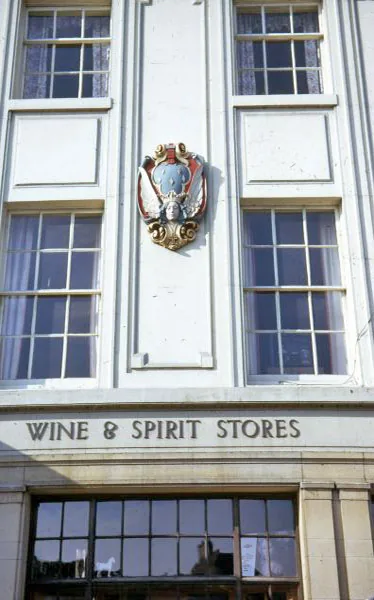
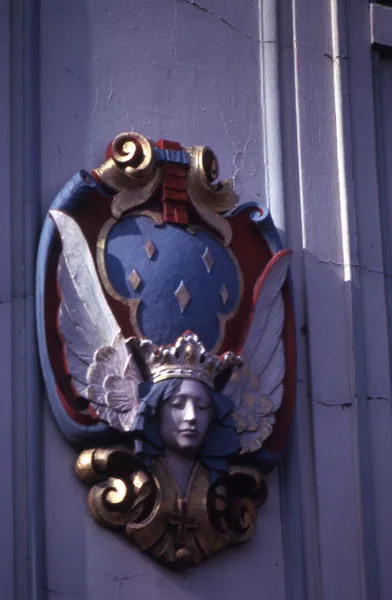
- Wilkinson Cameras, in the building that replaced it in the 1970s, with the Angel's sign restored to it
- Address
- 14-16 English Street, formerly numbered 77
- Where exactly
- Where Wilkinson Cameras is now, at 14-16 English Street.
One of the oldest houses in the city: in 1634 three army officers from Norwich, touring the country, came 'safe and well, though well wet, to our Inne ye Angell, in the Market Place'. The line is from their journal, which Samuel Jefferson printed in his History and Antiquities of Carlisle in 1838. Some accounts name the 1634 visitor as Walter Brand; the journal itself names none of the three.
It stood on the west side of English Street, overlooking the Market Place: 14-16 English Street in today's numbering, 77 in the old. The inn sat near the middle of a block running about 67 yards from St Cuthbert's Lane to the Coffee House Hotel, entered by a covered passage 3½ feet wide, with dwellings, a stable and a hayloft behind. The directories of 1847, 1850-51 and 1858 call it the Angel Inn and London Tavern, which would put a London Tavern here too.
John Mulcaster had it in 1802, Mrs Elliot advertised it to let in August 1810, and John Mitchinson had it in 1821, when the address was written down as Castle Street rather than English Street. One Saturday in January 1827 a bushel of rye was stolen from the front of the Angel, where it had been left while the man who brought it asked whether the buyer was inside; a bushel of wheat went from the door of the Pack Horse the same day. In 1829 James Pasley's carrier to Longtown left from it.
Then, in 1841, it burnt down, and the fire was arson. A Cumberland News column of 6 December 1991, 'A landlady who was no angel!', tells it. A patrolling watchman named Robertson found the fire in the early hours of Saturday 12 March and, with Constable Hetherington, hammered on the locked door. The police ran the fire engines, soldiers from the Castle helped, and water came from the city jail reservoir. The landlady, Mrs Christopherson, a city auctioneer's widow, was seen at a first floor window with her daughter and a servant, and all three were brought out; Mr Graham, a horse keeper living in the building, was got out through the passage with his family.
Superintendent Graham found that it was no ordinary outbreak. The kitchen floor had been torn up and fires lit, ale barrels stood on end with shavings piled on their tops, bedrooms were stuffed with wood and old furniture, and the staircase had been prepared for burning.
The three women were taken into custody and brought before the city magistrates on charges of arson. An agent for the York and London Insurance Company said Mrs Christopherson had recently insured the furniture: she had tried to cover it for £450 to £500 and been refused, and it was covered for £350 and the stock for £50.
Over the weeks before the fire sixteen packages of linen, clothing and furniture from the Angel had been deposited at the Canal warehouse, addressed to 'Mrs Mary Blaylock, passenger, New York'. The servant, Mary Blaylock, admitted arson but said Mrs Christopherson's daughter had no part in it. Mrs Christopherson pleaded guilty to setting the fire in the hope of claiming the insurance and emigrating to America, and was transported to Australia instead. It was the major local story of the week in the Carlisle Journal.
The inn was rebuilt, and an advertisement shows it reopening on 1 February 1843 under Aaron Martin, who still kept it in 1847, when he was among the publicans who took their bills to the party agents after the election. A P.P.G.M. John Beck chaired the Odd-fellows' Easter dinner of 1848 there, and in December 1850, under John Beck, very likely the same man, it hosted a public meeting called to form the city's third club for the Great Exhibition, with the late mayor, Joseph Rome, in the chair. Tom Fleming took it in 1858, and Thos. Fleming signed the innkeepers' memorial of February 1867 for the Angel Inn.
In June 1881 a new licence was granted to Mr Bewsher, of Mr Halstead's, the lessee, because the tenant, Miss Mather, 'had left the place in consequence of getting into difficulties'; the owner was a Miss Mason. From then on the name Angel seems to have faded under the new proprietor. F. O. Bewsher is first listed in 1893-94, when it traded as Bewsher's Vaults, and his nameboard called him a 'wholesale family wine and spirit merchant'; the photographs of the rebuilt Crown & Mitre show F. O. Bewsher and Son next door, which is the old Angel.
The State Management Scheme acquired it in September 1916 and closed it as a pub straight away. The Cumberland News of 7 October 1916 reported that the Board had just acquired 'the Angel (Mr Bewsher's)', given up its full licence and closed the bar at the back for 'on' sales, keeping only the off-licence, and the Board's report of 1 November 1916 lists '14 English Street (Bewsher's)' among the seventeen houses in the city where spirits could still be bought to take away. The directory has it as Bewsher's Branch in 1920, the Angel in 1934, and Bewsher's Branch again on its last appearance in 1940. The off-licence was advertised for sale as off-licence stores in 1972 and went when the scheme was sold off in 1973.
When the local press reported a plan to demolish the building in 1974 there was an uproar, and the Civic Society made a plea for its retention. It had been listed by the Department of the Environment, but the city council gave the go-ahead, on condition that the new building keep the scale and character of the old, with windows like the ones that had been there. A newspaper reported the demolition in 1975. The Angel's sign was put back on the new building and can still be seen there: the 1991 column found the Radio Rentals building on the site, with the angel cartouche on its face, and Wilkinson Cameras is there now. Next door, on the site of the Liverpool Arms, Bordo Lounge opened in the old Topshop unit in October 2023.
Sold in 1973 as “Angel off-licence, 14 English Street” to S & J Property Investments, Newcastle for £50,000. Who bought the rest
Photograph
Sources 19
- cumberlandscarrow.com
- CARLISLE_PUBS_Ver_3.xls (Mike Tuer's pub database)
- Carlisle Encyclopaedia
- Wilkinson Cameras, 14-16 English Street
- CAMRA: Bordo Lounge, opened 13 October 2023 next to the site of the former Angel
- Cumbria Crack, October 2023: Bordo Lounge in the former Topshop unit
- Historic England, Countering the 'deadliest of foes': public houses of the Central Control Board and the State Management Scheme, 1916-73 (Clare Howard, Research Report 89-2018): Appendix C, gazetteer of scheme premises
- The Cumberland News, 4 November 1916, p. 5: 'The Control Board: progress of the Carlisle scheme' (E. C. Sanders's report of 1 November) (via newspapers.com)
- The Cumberland News, 6 December 1991, p. 4: 'Pubs of yesteryear', 'A landlady who was no angel!', the Angel, English Street (via newspapers.com)
- Carlisle Journal, 20 December 1850, p. 2: 'Exhibition of 1851', Carlisle exhibition clubs (via British Newspaper Archive)
- Carlisle Journal, 14 April 1848, p. 2: advertisement, Independent Order of Oddfellows, Carlisle District (via British Newspaper Archive)
- Carlisle Patriot, 22 February 1867, p. 7: 'Carlisle Town Council: the Public House Closing Act', with the innkeepers' memorial (via British Newspaper Archive)
- The Cumberland News, 7 October 1916, p. 5: 'The Carlisle Experiment: Reconstruction of Inns' (via newspapers.com)
- Carlisle Express and Examiner, 11 June 1881, p. 5: 'Transfer of licences' (via British Newspaper Archive)
- Carlisle Journal, 3 March 1848, p. 2: the Carlisle election inquiry (via British Newspaper Archive)
- Carlisle Journal, 25 August 1848, p. 2: the Carlisle election inquiry, evidence (via British Newspaper Archive)
- Carlisle Patriot, 6 January 1827, p. 2: grain stolen at the Pack-horse inn and the Angel (via British Newspaper Archive)
- W. Parson and W. White, History, Directory, and Gazetteer of the Counties of Cumberland and Westmorland (Leeds, 1829), p. 168: carriers from the inns (University of Leicester digital copy)
- Samuel Jefferson, The History and Antiquities of Carlisle (Carlisle: Samuel Jefferson, 1838), p. 47: the 1634 journal of three officers of the Norwich military company, from a manuscript in the British Museum
Open question
A date we can't pin down
Was the Angel fire of 1841 or 1842? The Cumberland News of 6 December 1991 dates it to the early hours of Saturday 12 March 1841, but 12 March 1841 was a Friday and 12 March 1842 a Saturday, and the inn reopened on 1 February 1843.
If you know the answer, or where it might be found (an old photograph, a family story, a document), tell us and it goes into the story above.
Also lost on English Street
- The Liverpool Arms
- The String of Horses Inn
- The White Lion Inn
- The Royal Hotel
- The White Hart Hotel
- The White Swan Inn
- The Grey Goat Hotel
- The Kings Arms Inn
- The Wellington Inn
- The White Horse Inn
- The Bush Hotel
- The Victoria Hotel
- Yates Wine Lodge
- Outrageous
- The Bull Dog Inn
- The Carlisle Arms
- The Citadel Tavern
- The Cross Keys
- The Crown & Anchor
- The Pack Horse Inn
- The Skinners Arms
77 other lost pubs stood within 250 m of here. See them on the map
Still serving, near where it stood
-
10 maway
-
40 maway
-
80 maway
-
110 maway