Lost pub · English Street
The Pack Horse Inn
- Gone
- Pulled down about 1841 for shops
- There now
- Shops, built on the site from 1841
- Where exactly
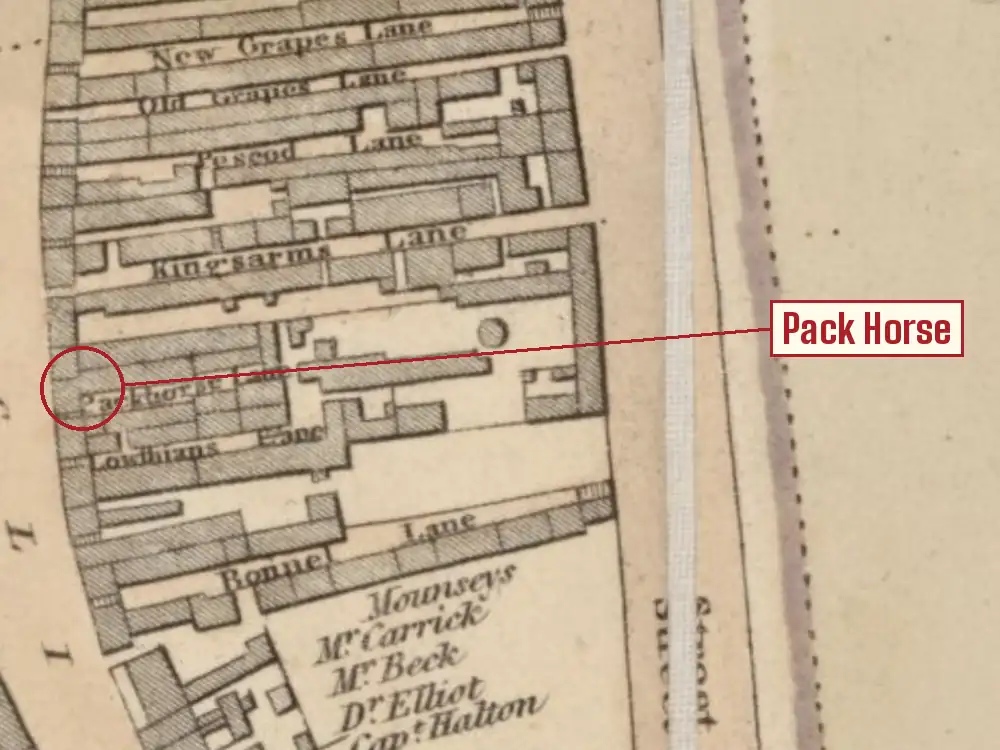
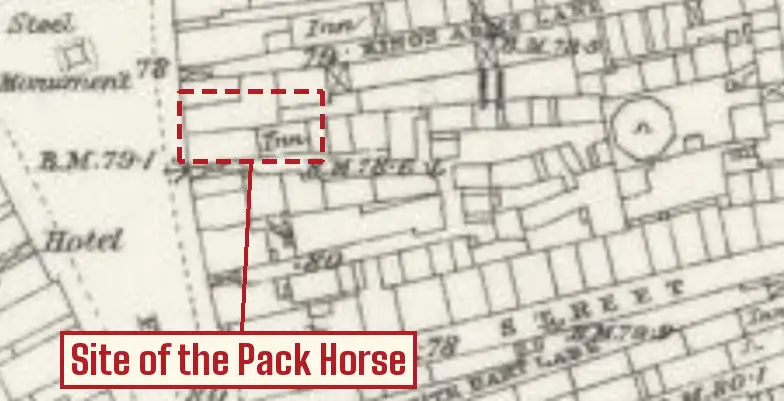
- On the east side of English Street at the head of Pack Horse Lane, between King's Arms Lane and Lowthian's Lane, with its yard at the far end of Lowthian's Lane, by the 1841 letting advertisement. The inn had gone by the Ordnance Survey of 1865, so the pin marks the block, and the position is approximate.
One of the old market inns of English Street, trading before 1754, on the east side of the street at the head of the lane named after it, Pack Horse Lane, between King's Arms Lane and Lowthian's Lane, the order John Wood's plan of 1821 gives the three lanes. Its yard, stables and cow houses lay behind, at the far end of Lowthian's Lane. It was a farmers' house: on Saturdays, market day, country people and their agents could be found there, farm tenancies were settled in its rooms and property was auctioned in its long room.
It was a carriers' inn too. In 1811 Joshua Varty's carrier left it for Newcastle, J. Baxter's for Longtown and Dumfries and John Little's for Canonbie and Langholm, and in 1829 the Baxters, father and son, were still carrying from it to Dumfries, Longtown and Newcastle, with James Armstrong to Langholm and William Dean to Penrith. One of the city's three women's benefit societies met at 'the Pack-horse' in 1811, very probably this one.
On Ascension Day 1811, when the guilds hung their flags from the Guild Hall and rode out to Kingmoor for the races, with a saddle for the horses and a cup for the donkeys, the city's MP, John Christian Curwen, entertained a party of friends at the Pack Horse before going round the guilds to thank his constituents, professing himself 'an enemy to the abuses and corruption' of the day. The report names no street, but the only other Pack Horse then was the roadside house at Newtown, so this was very probably the English Street inn.
The Browns kept it in the early years of the century. John Brown was the proprietor in 1809, and by 1818 the house was Mrs Brown's; that April her brother, John Watson, was killed in Mr Brown's field near Blackwell when the cart horse he was fitting with blinders sprang forward and the wheels went over him.
In 1820 a herring dealer, Mr Farquhar, sold white herrings from Mrs Brown's at 27 shillings a barrel, 'ready money only'. William Bowman had the inn by 1825, Parson and White's directory of 1829 names him as keeper, and Mr Waugh had it in 1831. The tenants of farms at Farmanby, Warwick Bridge and Clift in Kirklinton were declared there, an importer at the canal basin took orders there for American pine, and in 1835 a covered tub gig began running weekly from the Spur at Cockermouth to the Pack Horse.
Market days had their hazards. One Saturday in January 1827 a countryman left two bushels of wheat at the door of the Pack Horse for a few moments and came back to find one gone; a bushel of rye went from outside the Angel the same day, and the Patriot printed the story 'by way of caution to country people'. On hiring day in 1833 a farm lad fell in with a private of the 15th Regiment and took him into the Pack Horse for 'fourpenny yell'. Warmed by it, he agreed to swap clothes 'to try, as the players say, how he would look the character', and while he strutted about the room in the red coat the soldier deserted in the lad's clothes, with his half-year's wages in the pocket. 'He'll ne'er be a sowdger while Watty's his neame.'
Robert Brown kept it from about 1837, and he was a timber merchant as well as an innkeeper. In 1837 the Pack Horse advertised twenty thousand feet of mottled Spanish mahogany veneers with Rio rosewood, zebra wood and bird's eye maple, and his yard on Corporation New Road sold Honduras mahogany, Havana cedar and Archangel deals. The cloth trade used his Long Room for auctions, and in 1840 seventy wrestlers' subscribers sat down to supper there to give out the prizes. In January 1838 the inn caught fire at three in the morning, from a candle left by the servant's bed, and was saved by two men from the police office.
In November 1839 Brown kept missing copper from the shelf in the bar. He marked thirteen coins, 'making a cross behind the king's ear', and put them out; within an hour eight had gone. A lodger, Abraham Lewis Menser, who asked to be sworn on the Old Testament, had watched the new servant, Elizabeth Ferguson, eighteen, take something from the shelf, and the marked coins were in her pocket. She got three months.
In December 1840 Mr Brown, a jeweller, told the council he proposed to take down the Pack Horse and build shops on the site, and asked leave to open three cellar windows to the street. By October 1841 the inn had gone. The yard, stables and cow houses 'formerly attached to the Pack Horse Inn', at the far end of Lowthian's Lane, were to let, with a new house in Pack Horse Lane, and the brewing plant was for sale: two large tubs, two coolers and a cast-iron boiler for about 250 gallons, 'suitable for a private brewer'.
Brown moved his timber yard to Water Street, and by 1845 he was keeping a new Pack Horse there. Other records carry a Pack Horse in the directories to 1884, which belongs to the later houses on Water Street or Newtown Road; the lane kept the name, and the Guardsman traded in it until 1893.
Photograph
Sources 38
- cumberlandscarrow.com
- CARLISLE_PUBS_Ver_3.xls (Mike Tuer's pub database)
- Carlisle Patriot, 25 September 1891, p. 6: 'Public houses in Carlisle sixty years ago', reprinting the 1829 Parson and White directory list (via British Newspaper Archive)
- Carlisle Journal, 21 July 1810, p. 1: Farmanby farm to be let at the Pack Horse Inn (via British Newspaper Archive)
- Carlisle Patriot, 30 August 1817, p. 1: farm and corn mill at Warwick Bridge, proposals at the Pack Horse Inn (via British Newspaper Archive)
- Carlisle Patriot, 18 April 1818, p. 3: 'Melancholy accident', John Watson (via British Newspaper Archive)
- Carlisle Patriot, 2 December 1820, p. 2: herrings at Mrs Brown's, Pack Horse Inn (via British Newspaper Archive)
- Carlisle Patriot, 30 July 1825, p. 1: Clift farm to let, tenant declared at Mr Bowman's, the Pack Horse Inn (via British Newspaper Archive)
- Carlisle Patriot, 6 January 1827, p. 2: grain stolen at the Pack-horse inn and the Angel (via British Newspaper Archive)
- Carlisle Patriot, 9 August 1828, p. 1: 'Timber on sale', Wm Bowman, Pack Horse Inn (via British Newspaper Archive)
- Carlisle Patriot, 5 September 1829, p. 1: houses in English Street for sale at Mr William Bowman's, the Pack Horse Inn (via British Newspaper Archive)
- Carlisle Patriot, 17 September 1831, p. 1: Water Street houses for sale at Mr Waugh's, Pack Horse Inn (via British Newspaper Archive)
- Carlisle Journal, 1 June 1833, p. 2: 'A martial clodpole' (via British Newspaper Archive)
- Carlisle Journal, 19 September 1835, p. 2: Robert Johnston's tub gig to the Pack Horse Inn (via British Newspaper Archive)
- Carlisle Journal, 18 June 1836, p. 2: 'A challenge' (via British Newspaper Archive)
- Carlisle Journal, 25 June 1836, p. 1: Henry Street property for sale at the Pack Horse Inn (via British Newspaper Archive)
- Carlisle Journal, 8 July 1837, p. 1: Lineholm estate, Thomas Moffat at the Pack Horse Inn every Saturday (via British Newspaper Archive)
- Carlisle Journal, 9 September 1837, p. 1: 'Veneers for sale', Robert Brown, Pack Horse Inn (via British Newspaper Archive)
- Carlisle Patriot, 11 November 1837, p. 2: sale of mahogany, the property of Robert Brown, timber merchant (via British Newspaper Archive)
- Carlisle Patriot, 13 January 1838, p. 2: 'Fire' (via British Newspaper Archive)
- Carlisle Journal, 14 July 1838, p. 1: Kirk Steads estate for sale at Mr Brown's, Pack Horse Inn (via British Newspaper Archive)
- Carlisle Journal, 18 August 1838, p. 2: 'Lost', a cur bitch, Lassie (via British Newspaper Archive)
- Carlisle Journal, 16 November 1839, p. 2: 'Carlisle Police Office' (via British Newspaper Archive)
- Carlisle Journal, 4 January 1840, p. 3: Quarter Sessions, Elizabeth Ferguson (via British Newspaper Archive)
- Carlisle Journal, 25 April 1840, p. 3: wrestling, the supper at the Pack Horse inn (via British Newspaper Archive)
- Carlisle Journal, 23 May 1840, p. 2: woollen cloths at Mr Robert Brown's Long Room, Pack Horse Inn (via British Newspaper Archive)
- Carlisle Journal, 12 December 1840, p. 3: town council, 'Improvements' (via British Newspaper Archive)
- Carlisle Journal, 9 October 1841, p. 2: 'Stable and dwelling house to let; brewing utensils for sale' (via British Newspaper Archive)
- Carlisle Journal, 4 April 1846, p. 2: sale of foreign woods at the timber yard of Mr Robert Brown, Water Street (via British Newspaper Archive)
- Ordnance Survey 25-inch map, Cumberland XXIII.3, surveyed 1865, published 1874, via the National Library of Scotland
- The Cumberland News, 1992: the Lanes between English Street and Lowther Street, south to north (Lowthian's Lane, Packhorse Lane, King's Arms Lane), as summarised in the site's research notes
- Jollie's Cumberland Guide & Directory (Carlisle: F. Jollie & Sons, 1811), p. vii: carriers and the inns they left from (Google Books scan of the Bodleian copy)
- Jollie's Cumberland Guide & Directory (Carlisle: F. Jollie & Sons, 1811), p. viii: benefit societies and freemasons' lodges (Google Books scan of the Bodleian copy)
- W. Parson and W. White, History, Directory, and Gazetteer of the Counties of Cumberland and Westmorland (Leeds, 1829), p. 168: carriers from the inns (University of Leicester digital copy)
- Carlisle Journal, 25 May 1811, p. 2: Ascension Day; J. C. Curwen at the Pack Horse inn (via British Newspaper Archive)
- Carlisle Journal, 7 June 1845, p. 2: sale of Spanish mahogany at Mr Robert Brown's new timber yard, Water Street, dated from the Pack Horse Inn, Water Street (via British Newspaper Archive)
- John Wood, Plan of the City of Carlisle from actual survey, 1821, engraved by Robert Walker (National Library of Scotland, EME.b.4.26)
- John Wood, Plan of the City of Carlisle from actual survey, 1821, engraved by Robert Walker (National Library of Scotland)
Also lost on English Street
- The Liverpool Arms
- The String of Horses Inn
- The White Lion Inn
- The Royal Hotel
- The White Hart Hotel
- The White Swan Inn
- The Grey Goat Hotel
- The Kings Arms Inn
- The Angel Inn
- The Wellington Inn
- The White Horse Inn
- The Bush Hotel
- The Victoria Hotel
- Yates Wine Lodge
- Outrageous
- The Bull Dog Inn
- The Carlisle Arms
- The Citadel Tavern
- The Cross Keys
- The Crown & Anchor
- The Skinners Arms
84 other lost pubs stood within 250 m of here. See them on the map
Still serving, near where it stood
-
40 maway
-
90 maway
-
100 maway
-
120 maway