Lost pub · Stanwix Bank
The Drove Inn
- Built
- Trading before 1787; the Sign of the Drove of Cattle in 1813
- Gone
- Closed 1917
- There now
- In residential use by 2018
- Address
- Albert Place, Stanwix Bank
- Where exactly
- Placed from the Ordnance Survey grid reference, NY4001356837, in Historic England's gazetteer of the scheme's premises. The building's use in 2018: residential.
A separate Drove Inn from the Rickergate one, at Albert Place on Stanwix Bank, and trading before 1787. The Cumberland News column of 11 October 1991 calls the name a shortened version of the one it carried when cattle droving was active, the Drove of Cattle, and the earlier sign survives in an 1813 advertisement: the Carlisle Journal of 11 September that year lists houses for sale 'at Mary Bushby's, the Sign of the Drove of Cattle,' evidently this same pub before it settled on the shorter name. Property sales were commonly held in handily placed inns.
The Journal of 3 July 1809 names Mrs Halliburton as innkeeper, and the 1829 directory gives Thomas Story as 'The Drover, Stanwix.' The 1851 census records Henry Dyer, engineer and innkeeper, remembered as the father of Jimmy Dyer, a local bard; the 1861 census gives Edward Fairbairn, 43, innkeeper and florist. Mrs Marrs died at the Drove Inn on 1 December 1868, aged 79, per the Carlisle Journal. John Dover, whose application for a licence for the Pack Horse in Water Street was refused in August 1868, was keeping the Drove by 1873. The North Cumberland Reformer of 8 September 1892 described it as licensed for a very long time, with Jane Short as landlady and poor accommodation.
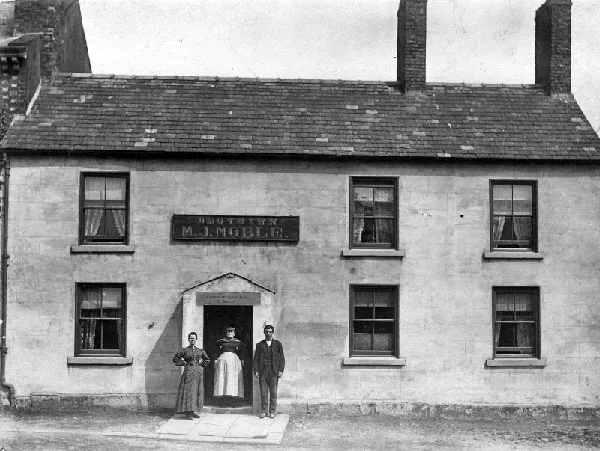
The licence passed from Jane Short to Mary Noble in 1896, and the city directories for 1902-03 name the licensee as Mrs M. J. Noble, which ties up with the name on the inn board in the column's photograph, taken about the turn of the century. In 1903 the licence was to pass from Walter Walker to Charles Basford, a transfer the magistrates refused, sending it instead to David Mitchell; a Charles Basford was tenant of the Duke's Head on Corporation Road in January 1905, when he was fined for serving after hours.
At the Cumberland Ward licensing sessions of 1911 the licence passed from Margaret Forrest to Thomas Henry Tanner, and he was tenant when the Carlisle Journal advertised the inn for sale on 7 February 1913. In November 1915 the magistrates granted a temporary transfer of the licence from Andrew Gardner to Sarah Ann Skipton, sister-in-law to the landlord of the Green Dragon at Newtown.
It was a Carlisle Old Brewery house when the scheme acquired it in August 1916, and it closed in 1917, in April by one record and in December by another. The 1991 column found it gone from the directories after the outbreak of the First World War and wondered whether it was a casualty of the State Management Scheme, which it was. A Carlisle Journal photograph from 2 June 1967, captioned 'a former inn', shows the building still standing half a century later, and by 1991 it was a house familiar to passers-by on Stanwix Bank.
Photograph
Sources 11
- Carlisle Encyclopaedia, "D" page
- closedpubs.co.uk
- Carlisle Encyclopaedia, "D" page
- CARLISLE_PUBS_Ver_3.xls (Mike Tuer's pub database)
- Historic England, Countering the 'deadliest of foes': public houses of the Central Control Board and the State Management Scheme, 1916-73 (Clare Howard, Research Report 89-2018): Appendix C, gazetteer of scheme premises
- Carlisle newspaper, 1911: 'County licensing sessions: a lapsed licence' (via newspapers.com)
- The Cumberland News, 11 October 1991, p. 4: 'Pubs of yesteryear', Drove Inn, Stanwix (via newspapers.com)
- Carlisle Journal, 28 February 1905, p. 3: 'The Duke's Head', adjourned licensing sessions (via British Newspaper Archive)
- Cumberland Evening News, 22 November 1915, p. 2: 'A Stanwix transfer' (via British Newspaper Archive)
- Carlisle Patriot, 28 August 1868, p. 7: 'Annual Brewster Sessions' (via British Newspaper Archive)
- Post Office Directory of Westmorland and Cumberland, 1873: Drove, John Dover, Stanwix bank
1 other lost pub stood within 250 m of here. See them on the map
Still serving, near where it stood
-
240 maway
-
270 maway
-
270 maway
-
320 maway