City Centre, Carlisle
The Cumberland Inn
Redfern's least-altered surviving pub, and on CAMRA's National Inventory of Historic Pub Interiors.
Sold to Greenall Whitley as part of Group 2, handed over on 3 April 1973. Who bought the rest
Botchergate local with a good draught range at low prices and live sport on. Late licence Saturdays.
- Today
- See opening hours
- Address
- 22 Botchergate, Carlisle CA1 1QS
- Phone
- 01228 273059
History
Opened 29 September 1930
- Designed
- 1928, by Harry Redfern
- Built
- 1929-30, by J&R Bell of Carlisle
- Opened
- 29 September 1930
- Cost
- £13,678
- Listed
- Grade II, list entry 1380211
- Also
- CAMRA National Inventory of Historic Pub Interiors
If you want to understand what the State Management Scheme was actually for, this is the building. Harry Redfern gave it more care than any other pub he did for the scheme, down to the door handles, the furniture and the lettering, and it is the least altered of them all. It is on CAMRA's National Inventory of Historic Pub Interiors, the national list of Britain's most intact pub interiors, and CAMRA rank it the best preserved State Management pub anywhere. There's been opening-out and refitting, but the intended ambience survives.
Two pubs stood here before it. Olive Seabury's book names the first as the Three Horseshoes; after it came a mid-Victorian Cumberland Inn, a New Brewery house that went to the state in August 1916. The scheme demolished it to make room, the same pattern as the Apple Tree, the Crown Inn and the Horse & Farrier. In September 1890 the licence of the Cumberland Hotel, Botchergate, passed from Margaret Herries to William Skelton Gate.
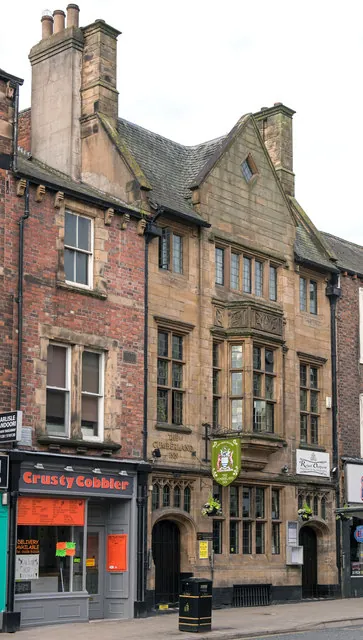
Redfern designed the new pub in 1928 and J & R Bell of Carlisle built it in 1929-30, in Tudor style: buff ashlar sandstone, coped gables, tall gable chimneys and a green Lakeland slate roof. The Twentieth Century Society note that at first glance you might take it for a superior bank or post office. That was rather the point. It was not supposed to look like a pub, and it never had a sign: the name was too long for a board the Corporation's rules allowed over the street. It opened on 29 September 1930, at a cost of £13,678, which CAMRA call hefty.
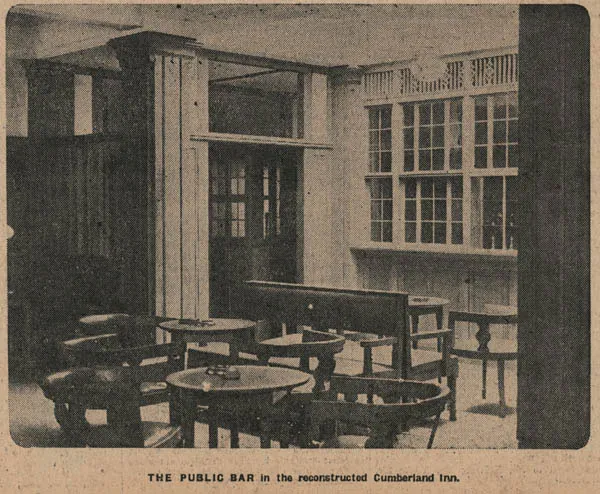
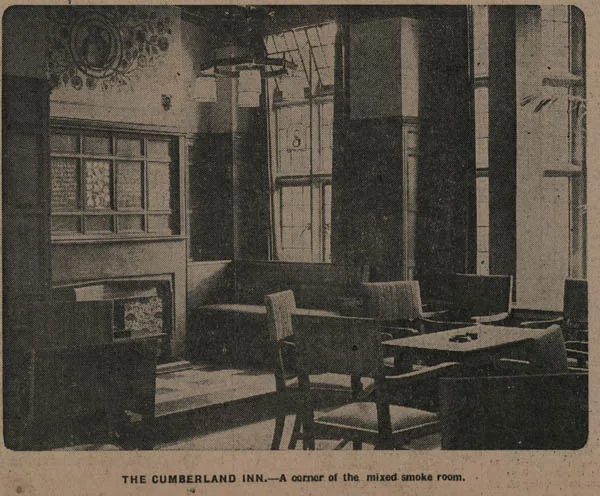
The plan is the class system built into the walls. The plot was long and narrow, and Redfern made the most of it. Downstairs, one behind another off one long counter, were a second class mixed room at the front, a big public bar, and a weekend room behind that opened into the bar when busy. The public bar had only two windows, so he ran a light well down the middle. Upstairs, reached by their own entrance and stair straight off the street, were a mixed first class room and a men's first class room, which one barman could mind on a quiet day. First class upstairs, second class down, and a separate front door for each, so the two never had to meet on the way in.
Redfern's Carlisle pubs also gave the manager and his family generous quarters, because a state manager was a civil servant and had to be housed like one. Inside, the walls are panelled in Japanese oak to two-thirds height, with furniture Redfern designed himself. A long panelled passage runs from the left-hand door to the main bar, the original bar counters and back shelving remain, and there are several good stone fireplaces, two of them dated 1930. The panelling carries gilded inscriptions in praise of moderate drinking, with painted cartouches, vine motifs, and jugs and glasses over the fireplaces.
And then there is the joke, if it is one. The Twentieth Century Society identify the gilded quotations upstairs as coming from Omar Khayyam, Robert Burns and G. K. Chesterton: three writers famous for verse about drink, and not one of them famous for moderation. Khayyam wanted a jug of wine under the bough. Burns wrote John Barleycorn. Chesterton spent a good part of his career attacking prohibitionists and temperance legislation in print. A government temperance scheme gilded their names onto the walls of its finest pub, in praise of drinking less. The lettering was painted by E. M. Dinkel, and no other scheme pub keeps his work.
Redfern signed it too, in a window. In six windows of the first-floor mixed first class bar he set stained glass rebuses that pun on two names at once: a bell for J & R Bell, who built it, and three red fern leaves for himself. The other initials name the men behind the building: "JS" for the assistant architect Joseph Seddon, "AEM" for the scheme's general manager A. E. Mitchell, and an "S" for the clerk of works, Ernest A. Streatfield. Most drinkers walk straight past them.
The building went back into private hands on 3 April 1973, sold to Greenall Whitley with the Crown & Thistle, the Arroyo and the Currock. It was listed only on 14 April 2000, which is very late for a building of this quality, and it is registered as an Asset of Community Value. When Historic England looked again in 2016, both bars kept their fireplaces and panelling, though the counters were later or altered.
For a time the two little-used first class rooms upstairs were a separately run Thai restaurant, the Royal Outpost, with its own stair and street door. It did not come back after Covid: the Royal Outpost took over premises licence PL077 at 11 Warwick Road on 16 October 2020 and trades there now, in what had been Dempseys, and nothing is confirmed trading upstairs since. Downstairs the Cumberland is run today by the Unity Social Pub Co. If you can get upstairs it is a step up from the ground floor: more oak panelling, better fireplaces, and the windows. There is more on Redfern, and on the scheme, on the page about the scheme itself.
- Cheap pint
- Historic interior
- Open late
- Live sport
Photographs
Opening hours
| Mon | 10:00–23:00 |
| Tue | 10:00–23:00 |
| Wed | 10:00–23:00 |
| Thu | 10:00–midnight |
| Fri | 10:00–midnight |
| Sat | 10:00–02:00 |
| Sun | 11:00–23:00 |
Hours last checked August 2026, about 2 months ago.
Hours are kept by hand and change without warning. Ring ahead if it matters.
More like this
- Cheap pint pubs in Carlisle
- Historic interior pubs in Carlisle
- Open late pubs in Carlisle
- Live sport pubs in Carlisle
- All pubs in City Centre
Nearest to here
-
20 maway
-
20 maway
-
30 maway
-
30 maway
Lost on Botchergate
- BrewDog Carlisle gone 2026
- Buzz Bingo gone 2021
- The Crown gone 2021
- The Las Vegas Strip gone 2018
- The Earl Grey gone 2010
- Terminal gone 2010
- Mood gone 2008
- The Albion Tavern gone 1992
66 lost pubs stood within 400 m of here. See what used to be around it
Sources
- The State Management Story: Cumberland Inn
- Twentieth Century Society: Building of the Month, November 2015, by Aidan Turner-Bishop
- CAMRA National Inventory of Historic Pub Interiors
- Pub Gallery: Harry Redfern's Carlisle legacy
- Historic England list entry 1380211
- Historic England list entry 1380211, with the plan and elevation
- Pub Gallery: Harry Redfern's Carlisle Legacy, a tour of the scheme's fifteen new-build pubs
- Carlisle Encyclopaedia
- Cumberland Council licensing register: premises licence PL077, Royal Outpost, 11 Warwick Road, transferred 16 October 2020
- Historic England, Countering the 'deadliest of foes': public houses of the Central Control Board and the State Management Scheme, 1916-73 (Clare Howard, Research Report 89-2018): Appendix B, summaries of key State Management public houses
- Historic England, Countering the 'deadliest of foes': public houses of the Central Control Board and the State Management Scheme, 1916-73 (Clare Howard, Research Report 89-2018): Appendix C, gazetteer of scheme premises
- Carlisle newspaper, 10 June 1941: obituary of R. C. Bell of J & R Bell, builders (via newspapers.com)
- North Cumberland Reformer, 4 September 1890, p. 8: 'Transfer of licences' (via British Newspaper Archive)
Know more about this one?
History, a story, a correction, or just what it was called before: The Cumberland Inn is better on this site when locals fill it in.