City Centre, Carlisle
The Sportsman Inn
Acquired by the scheme on 11 August 1916, when it belonged to the Carlisle New Brewery Co, and sold to Greenall Whitley on 23 May 1973. Recorded on a plaque above the bar.
Sold to Greenall Whitley as part of Group 4, handed over on 23 May 1973. Who bought the rest
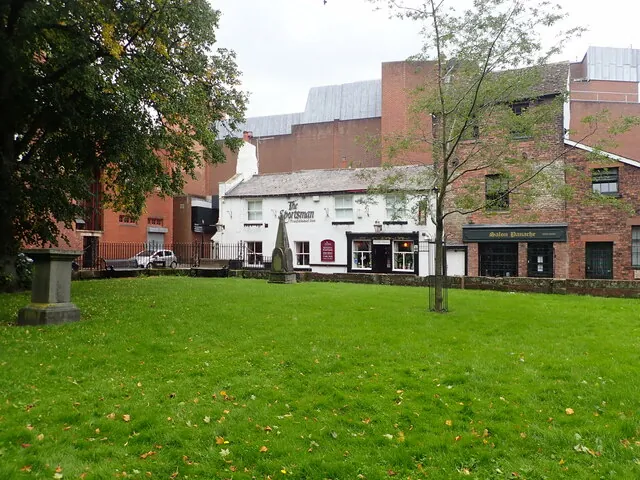
Tucked down Heads Lane behind the Marks & Spencer, and easy to walk past. Small, traditional and serious about cask beer, so expect to stand at busy times. It does food too, and the homemade steak and ale pie is the one people order.
Part of Punch Pubs & Co
- Today
- See opening hours
- Address
- 1 Heads Lane, Carlisle CA3 8AQ
- Phone
- 01228 533799
Also known as The White Ox, The Lowther Arms, Guy Earl of Warwick, The Rose & Thistle, The Golden Quoit
History
Opened 1747
- Dates from
- 1747, the oldest recorded pub in Carlisle
- Site
- The Blackfriars' Convent, a medieval Dominican friary
- Former names
- Five, before it settled
- State-run
- August 1916 to May 1973
Down a lane beside Marks & Spencer, opposite St Cuthbert's Church, is a low white inn that calls itself Carlisle's oldest pub, from 1747. Nobody has published evidence for that year, but most of its story can be traced, from a medieval friary through a mason's will and a landlord's quarrel with an earl to a painter born under its roof.
The ground is far older, and legally protected. This was the Blackfriars Convent, a Dominican friary founded in 1233 and dissolved in 1539. Carlisle's friary was treated unusually, kept as a council chamber and storehouse rather than pulled down, though nothing stands today. Excavation has shown the friary sat on a Roman settlement, and the whole block bounded by Heads Lane, West Walls and Blackfriars Street is a Scheduled Ancient Monument. A copy of a fifteenth-century map on the pub wall shows a building already here, and one account claims the inn as part of the old Blackfriars gatehouse, possibly the only part left standing.
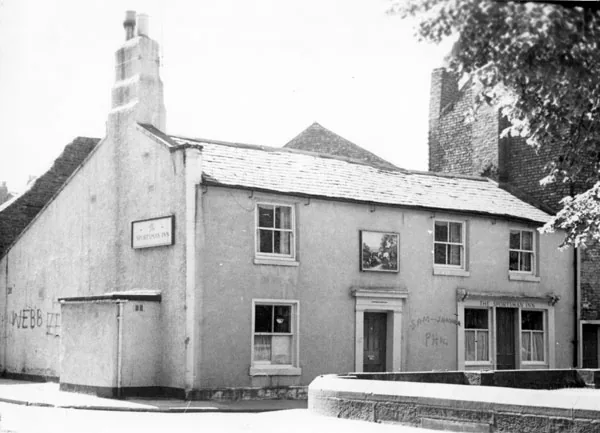
Historic England's listing disagrees. It describes the building, Grade II listed from 22 March 1974, as early eighteenth century throughout with later alterations, and no medieval fabric: painted rendered walls, a local slate roof, two low storeys and four bays, with the interior altered. For its history the listing points to manuscript notes in Carlisle Library, not online or published. The pub's earliest documented appearance is 1770, as the Guy Earl of Warwick, though the State Management Story gives 1797. So 1747 is the pub's own claim, and the Sportsman is the oldest recorded pub in Carlisle rather than certainly the oldest of all.
It has rivals. The Joiners Arms in Caldewgate was first recorded in 1785 but may have been trading from around 1745, and the Kings Head on Fisher Street stands on older ground still. Three claimants: oldest recorded, possibly oldest of all, and oldest site.
A Cumberland News column of 20 December 1991, drawing on research by the Carlisle historian Denis Perriam, ties the inn to a family called Warwick and the lane to a family called Head. A mason, Guy Warwick, who lived in the former Earl's Inn on English Street, made his will on 5 April 1743 and died on 25 April, aged 51, leaving everything to his wife Margaret. She died that December and passed it to their eldest son John. John died in 1752, and when the last male heir, Mark Warwick, died in 1769, the house passed to his sister Isabella. In 1754 she had married Thomas Head, a butcher turned innkeeper, and the lane outside was once Bella Head's Lane.
That explains the best of its names, which works twice over. Guy of Warwick was a legendary folk hero and a popular pub sign, and here he was also the family's own Guy. Primary sources back it. In 1786 Thomas Head, in a legal fight with the Earl of Lonsdale over licences refused for voting against him, petitioned that he had "kept an inn or Public house called the Earl of Warwick" for seventeen years.
The inn is also a painter's birthplace. Guy Head, born here in 1753 and raised in the building, became a notable Cumbrian portrait painter in Rome and London; his first name is a coincidence with the sign, not its source. The Dictionary of National Biography, though, calls him the son of a house-painter at Carlisle rather than of an innkeeper, and his birth in 1753 falls a year before the marriage the Perriam account dates to 1754, so either a date or the parentage is out.
Thomas Head died in 1796 and his widow moved to Newcastle, selling the inn in 1797 to Joseph Sewell. It traded on, advertised to let in April 1811 as "known by the sign of Guy, Earl of Warwick" and kept by Thomas Shearer by March 1813. Somewhere between 1813 and 1822 it became the Sportsman.
It has worn more names than any pub in the city: the White Ox, the Lowther Arms, Guy Earl of Warwick, the Rose & Thistle and the Golden Quoit. The order is not what it looks like. The Carlisle Encyclopaedia places the Golden Quoit in the 1855 directory, with the Sportsman both before and after, so the Golden Quoit was an interlude rather than a predecessor. It is sometimes dated 1848; 1855 is the directory year.
A 1901 photograph shows it painted to look brick-built, otherwise unchanged. The State Management Scheme took it on 11 August 1916 from the Carlisle New Brewery Company. Not a Redfern rebuild, just one of the old inns the scheme absorbed; a plaque above the bar records those years. It was sold to Greenall Whitley on 23 May 1973, in the last group to go. The freehold is Punch Pubs & Co's today, brewery to state to Greenall Whitley to Punch, ruling out the claim that one family owned it for centuries.
Amanda Picken has been licensee since September 2020, following Dave and Alison Foster, and the pub is still small, low-beamed and serious about cask, with Wainwright as the regular and guests alongside. The home-made steak and ale pie with a dumpling topper is the thing people order. A jukebox rather than a television, a Monday quiz, resident greyhounds, drinkers in the courtyard in summer, and functions catered at the Tithe Barn up the lane. It is easy to miss and ten minutes from both stations.
- Food
- Historic interior
- Quiz night
- Real ale
Photographs
Opening hours
| Mon | 12:00–21:00 |
| Tue | 12:00–21:00 |
| Wed | 12:00–21:00 |
| Thu | 12:00–21:00 |
| Fri | 12:00–midnight |
| Sat | 12:00–midnight |
| Sun | 12:00–20:00 |
Hours last checked August 2026, about 2 months ago.
Hours are kept by hand and change without warning. Ring ahead if it matters.
More like this
- Food pubs in Carlisle
- Historic interior pubs in Carlisle
- Real ale pubs in Carlisle
- Pub quiz nights in Carlisle
- All pubs in City Centre
Nearest to here
-
50 maway
-
80 maway
-
100 maway
-
120 maway
112 lost pubs stood within 400 m of here. See what used to be around it
Sources
- Historic England list entry 1210153, via British Listed Buildings
- The State Management Story
- The Carlisle Kid, via Co-Curate
- Co-Curate: Heads Lane
- D.R. Perriam, Carlisle in Camera (1988), p.60, for a 1900 illustration
- Plaque and 15th-century map displayed in the pub
- Carlisle Encyclopaedia: Golden Quoit
- Carlisle Dominican Friary
- J. Wilson, 'The friaries: Carlisle, Penrith and Appleby', VCH Cumberland vol 2 (1905), pp.194-199
- Cumbria and The Borders History, 27 September 2024: Guy Warwick, his daughter Isabella, and the 1743 name
- Mike Tuer, State Management Scheme 40 Years On: the 1973 handover groups, dates and prices paid (Solway CAMRA)
- Paul Claringbold, Pubs That Built Carlisle series (Solway CAMRA)
- CJ 20.04.1811: the inn to let, "known by the sign of Guy, Earl of Warwick"
- Carlisle Encyclopaedia, "S2" page: the 1786 Lonsdale licensing dispute and Guy Head the painter
- Co-Curate: the Sportsman Inn, documented in 1770 as the Guy Earl of Warwick
- Dictionary of National Biography: Guy Head, "son of a house-painter at Carlisle"
- Historic England, Countering the 'deadliest of foes': public houses of the Central Control Board and the State Management Scheme, 1916-73 (Clare Howard, Research Report 89-2018): Appendix C, gazetteer of scheme premises
- The Cumberland News, 20 December 1991, p. 4: 'Pubs of yesteryear', Sportsman Inn, Heads Lane (via newspapers.com)
Open question
A date we can't pin down
How old is the Sportsman, and which date do you believe? The pub claims 1747. The listing says early 18th century. The Perriam account in the Cumberland News of 20 December 1991 has the Warwick family house at Blackfriars, with a brewhouse and cellar, in a will of 1743, but the mason Guy Warwick lived at the Earl's Inn on English Street. A survey of the state management pubs dates it to at least 1770 as the Guy Earl of Warwick. Nobody has published the evidence for 1747.
If you know the answer, or where it might be found (an old photograph, a family story, a document), tell us and it goes into the history above.