Lost pub · Rickergate
The Light Horseman Inn
- Built
- The building carried the date 1683 over its passage doorway
- Gone
- 10 October 1900, when its licence lapsed
- There now
- Carlisle Magistrates' Court
- Address
- 36 Rickergate
- Where exactly
- Under the Magistrates' Court, at the former corner of Rickergate and Warwick Street.
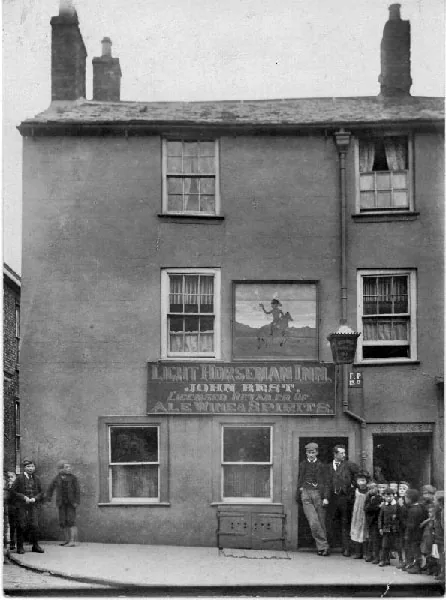
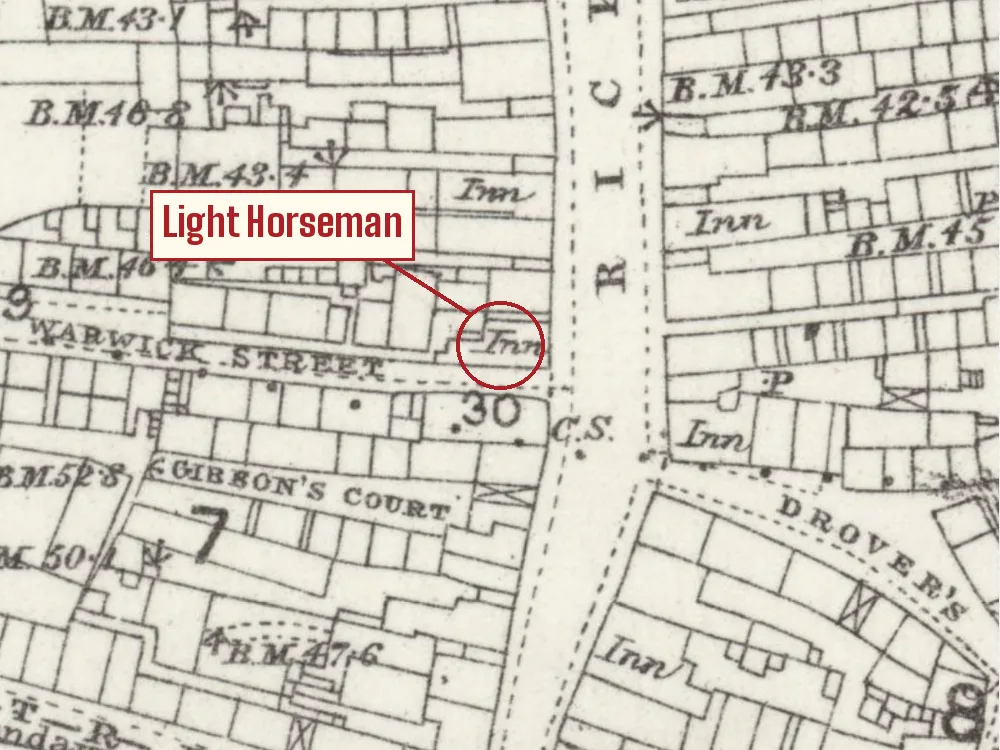
Stood at 36 Rickergate (21 before the street was renumbered in the 1860s), on the corner of Warwick Street: the last house on the west side before Warwick Street, which led through to the new markets. It was a tall, narrow, three-storey inn with a painted horseman on the front. The building was older than any record of the pub. Over the passage doorway to the right was the date 1683: W. Y. Hobbiss sketched 'the date over the passage at the old Light Horseman Inn' for his prize-winning Rambling Sketches in Carlisle at the School of Art exhibition of December 1882, and the Cumberland News read 1683 there in a Tullie House photograph in 1991.
The pub itself first appears in the 1820s. Pigot's directory of 1828-29 lists a 'Keg, John Gibson, Rickergate', very probably this house in its Letters Keg years, and Parson and White's of 1829 already names Joseph Henry as keeper of the Light Horseman. It was also called the Flying Horseman: the 1861 and 1891 censuses use that name, and so did the papers now and then in the 1860s. The licence, the advertisements and the courts always called it the Light Horseman.
In November 1840 two soldiers, Paul Reed of the 87th Fusiliers and Martin Harrison of the 4th Dragoon Guards, laid into the landlord, Jacob Chokes as the Carlisle Journal printed his name, and anyone else in the house. Reed hit him over the head with a heavy iron scraper; Harrison seized the poker, struck 'indiscriminately every person who came in his way', and ran off. As Reed was taken down Rickergate to the Police Office, soldiers of the 87th and a mob tried to rescue him. The Superintendent was knocked to the ground, and Constable Kent laid out one of the attackers with his staff, a blow across the cheek that the paper said would make him easy to identify. Reed and Harrison were fined 20s. each, or a month's hard labour.
Mrs Poole had it in 1846, when the creditors of a Stanwix master builder, Thomas Atkin, were told to send their claims to her at the Light Horseman. In race week of July 1848 Peter Campbell, a stranger in the city, was found dead in its privy, the inquest giving the address as Bewley's Lane. He had lost a leg as a railway labourer and since lived by begging round the country with a certificate 'written in gilt' that set out his misfortune; he had lodged in Drover's Lane for the races and enjoyed them 'pretty freely'. In November 1852 John Poole announced that he had moved from the Light Horseman to the Rising Sun in Scotch Street.
On 12 July 1858 Orange lodge 78 dined at Mr Sherrington's, the Light Horseman, with James Hamilton, district master, in the chair and 'harmony until a late hour'; the Cumberland News's 1933 list of the street's licensed houses has John Sherrington keeping it in the 1860s. That November the inn was advertised to let at Martinmas. Marion Armstrong had it by 1861, and in 1865 advertised for a lost white pointer bitch with a brown head. At midday on 10 July 1863 a swarm of bees turned the corner into Warwick Street and settled in the eaves of the house behind; the tenant set a straw hive on a lower roof, coaxed them in and blocked their other door. They went in, the Carlisle Examiner said, 'most ungraciously and unwillingly'.
In February 1870 a man walked into Bradford police station at half past eleven at night, the worse for drink, and said he was wanted in Carlisle for killing a man in a quarrel at the Flying Horseman in July 1867. He was Richard Mason, who called himself Joe Goss after the English middleweight champion of the day, and 'aspires to the reputation of a boxer'. He had fought a Stanwix man in the pub and run off, believing he had killed him. Nobody had died. The Bradford police didn't believe him either, and the Carlisle Patriot suspected he had hoped for a free ride home to Carlisle: 'In this he has been baulked.'
The year before, in April 1869, the coroner sat in the Light Horseman on Thomas Ewart, a butcher of Bewley's Court, aged 33. When another butcher, James Hetherington, 'better known as Jim o' the Bank', refused to go away from his shop door, Ewart picked up a butcher's 'belly stretcher' in fun and struck him on the shoulder. The stick sprang back and burst Ewart's own left eye. He died raving four days later, tied to his bed. The doctors found 'a drunkard's brain', and the jury found he had hastened his own death.
John Wainman died in May 1881, and his widow Deborah took the house on with nothing but the furniture and a little stock. She catered the judges' dinner at the Horticultural Society's first summer show in 1884, was on the magistrates' black list in 1885 and again in 1889, and went bankrupt at the end of 1888, nearly £900 short, blaming bad trade and standing surety for her son. She had kept no books at all, and her stock sold for £2 1s. In October 1889 the mortgagees put the inn up for auction with the shop beside it, five tenements behind and three houses in Warwick Street: 'old-established', with 'a very influential patronage'. John McCormack, born in Scotland, was the tenant.
In 1893, with the house still in the hands of its mortgagees, the owners planned to rebuild. The temperance North Cumberland Reformer feared they would turn it into a 'heavy horseman' and suggested a baker's shop instead. Their solicitor asked the city magistrates to approve the plans before any work began, so that the licence wouldn't be lost over the alterations. Because of this case the magistrates agreed on 30 October 1893 that every plan to alter a licensed house in the city should come before them first. Then, in November, a very full bench refused the Light Horseman's plans.
In January 1894 the bench three times refused to pass the licence to Joseph Wallace, though two teetotallers wrote to say they had 'watched Mr Wallace's movements' and found him most respectable (laughter in court). Mary Peascod, lately of the Old Bush, took it instead, and in September 1894 passed it to John Best, whose name is on the sign in the photograph. That summer the owners, the Sauls, a family of Carlisle solicitors, offered the whole property to the Corporation, since a new building line in Rickergate and Warwick Street would leave them 216 of their 530 square yards. The council said no: buying it 'would only open one end of the bottle-neck'.
In August 1898 the Chief Constable found it 'filthy', with defective sanitation and 'a most objectionable back door'. When the works were done he called it 'an abominable place before', and objected to a box room by the urinal that he had seen full of youths of 15 to 20. The licence was renewed on condition that room was kept out of use, and the owners' solicitor said an application would shortly be made to move the licence 'to an entirely different place'.
The place was Lindisfarne Street, near London Road station, where Mr Saul proposed a new hotel. On 28 August 1899 the residents held an open-air meeting on the very site; a railwayman, Robert Long, asked 'What have the licences done for Rickergate?' and was warmly applauded, and 430 of the 700 to 800 households signed a petition. The justices granted the removal that September by a small majority, the Carlisle Journal calling it 'an anomalous arrangement': a new district got a public house because an over-crowded one gave one up. In September 1900 the removal was made absolute, with Edmund Blair as tenant. Asked what the hotel was to be called, the solicitor said: 'It hasn't been christened yet.' (Laughter.)
The Light Horseman's licence lapsed by arrangement on 10 October 1900, and Blair opened the new hotel, the Linton Holme, now the Lint, on 12 November. In February 1901 the owners asked the Corporation to widen the two streets, and the City Surveyor understood they meant to make the old inn a shop; the Cumberland News in 1991 found it in the city directories until 1902-03. Rickergate was losing pubs long before the State Management Scheme: of the fourteen or so the street had at the end of the nineteenth century, only eight lasted to 1916. The site is under the Magistrates' Court; the 1991 column put it where the police station stood.
Photograph
Sources 37
- co-curate.ncl.ac.uk
- Carlisle Encyclopaedia, "L" page
- CARLISLE_PUBS_Ver_3.xls (Mike Tuer's pub database)
- The Cumberland News, 18 March 1933, p. 14: 'A Cumbrian Notebook: Changes in Scotch Street and Rickergate' (via newspapers.com)
- The Cumberland News, 26 April 1991, p. 4: 'Pubs of yesteryear', 'An old pub gave way to the new', the Light Horseman and the Linton Holme (via newspapers.com)
- Carlisle Patriot, 25 September 1891, p. 6: 'Public houses in Carlisle sixty years ago', reprinting the 1829 Parson and White directory list (via British Newspaper Archive)
- North Cumberland Reformer, 8 September 1894, p. 2: Brewster Sessions, transfers (via British Newspaper Archive)
- East Cumberland News, 29 September 1900, p. 8: 'Carlisle adjourned licensing sessions' (via British Newspaper Archive)
- Carlisle Patriot, 17 July 1858, p. 5: 'The 12th of July in Carlisle' (via British Newspaper Archive)
- East Cumberland News, 10 September 1898, p. 3: 'Carlisle brewster sessions' (via British Newspaper Archive)
- Pigot and Co., National Commercial Directory (London, 1828-29), Carlisle: inns, taverns and public houses, and wine and spirit merchants (University of Leicester digital copy)
- Bulmer's History, Topography and Directory of East Cumberland (1884), Carlisle: hotels, inns and taverns, beerhouses, and wine and spirit merchants (University of Leicester digital copy)
- Carlisle Journal, 14 November 1840, p. 2: 'Magistrates' Office, Carlisle' (via British Newspaper Archive)
- Carlisle Patriot, 27 November 1846, p. 2: 'Thomas Atkin, deceased' (via British Newspaper Archive)
- Carlisle Journal, 14 July 1848, p. 3: inquest on Peter Campbell (via British Newspaper Archive)
- Carlisle Journal, 12 November 1852, p. 2: Rising Sun Inn, John Poole, proprietor (via British Newspaper Archive)
- Carlisle Journal, 5 November 1858, p. 1: 'To be let' (via British Newspaper Archive)
- Carlisle Examiner, 11 July 1863, p. 6: bees in Warwick Street (via British Newspaper Archive)
- Carlisle Journal, 12 May 1865, p. 8: 'Lost', M. Armstrong, Light Horseman (via British Newspaper Archive)
- Carlisle Examiner, 17 April 1869, p. 9, and Carlisle Patriot, 23 April 1869, p. 5: inquest on Thomas Ewart (via British Newspaper Archive)
- Bradford Observer, 5 February 1870, p. 3: 'A self-accused murderer', and Carlisle Patriot, 11 February 1870, p. 4 (via British Newspaper Archive)
- Carlisle Express and Examiner, 14 May 1881, p. 5: death of John Wainman (via British Newspaper Archive)
- Carlisle Journal, 22 December 1882, p. 4, and Carlisle Express and Examiner, 23 December 1882, p. 5: Carlisle School of Art exhibition (via British Newspaper Archive)
- Carlisle Express and Examiner, 19 July 1884, p. 5: 'Carlisle Flower Show' (via British Newspaper Archive)
- Carlisle Patriot, 2 October 1885, p. 7: 'Adjourned licensing day' (via British Newspaper Archive)
- Carlisle Express and Examiner, 5 and 19 January 1889, and Carlisle Patriot, 11 January 1889, p. 3: Mrs D. Wainman's bankruptcy (via British Newspaper Archive)
- Carlisle Patriot, 6 September 1889, p. 7: 'The black list and renewals' (via British Newspaper Archive)
- Carlisle Patriot, 25 October 1889, p. 1: sale of the Light Horseman (via British Newspaper Archive)
- Carlisle Journal, 17 and 31 October 1893, and North Cumberland Reformer, 19 and 26 October, 4 November and 2 December 1893: the proposed alterations (via British Newspaper Archive)
- North Cumberland Reformer, 13, 20 and 27 January 1894: transfers (via British Newspaper Archive)
- North Cumberland Reformer, 7 July, 18 August and 15 September 1894, and Carlisle Journal, 14 September 1894, p. 6: the offer to the Corporation (via British Newspaper Archive)
- North Cumberland Reformer, 10 September and 1 October 1898; Carlisle Journal, 6 and 27 September 1898; East Cumberland News, 1 October 1898, p. 6: licensing sessions (via British Newspaper Archive)
- Carlisle Journal, 29 August, 5 September and 26 September 1899: Lindisfarne Street (via British Newspaper Archive)
- Carlisle Journal, 4 September 1900, p. 2: 'The Lindisfarne Street Hotel' (via British Newspaper Archive)
- East Cumberland News, 9 February 1901, p. 5: 'The Light Horseman' (via British Newspaper Archive)
- East Cumberland News, 8 June 1901, p. 6: 'The failure of a Carlisle hotelkeeper' (via British Newspaper Archive)
- National Library of Scotland: Ordnance Survey 25-inch, Cumberland XXIII.3, surveyed 1865, published 1874
Location from geograph.org.uk. The pin marks the site.
Open question
An unsolved mystery
Where was Bewley's Lane? The 1848 inquest put the Light Horseman 'in Bewley's lane', the butcher whose inquest was held there in 1869 lived in Bewley's Court, and a Miss Bewley was one of its tenants in 1889, yet the 1865 Ordnance Survey map names no Bewley's Lane or Court beside it. And was Gibson's Court, just south of Warwick Street on the same map, named after John Gibson of the Keg?
If you know the answer, or where it might be found (an old photograph, a family story, a document), tell us and it goes into the story above.
Also lost on Rickergate
- Bay Horse
- Scotch Arms Hotel
- The Wheat Sheaf Inn
- Three Crowns
- Blue Bell Inn
- The Drove Inn
- The Malt Shovel
- Fox & Hounds
- The Durham Ox
- Alma Inn
- Barley Stack
- Crown and Thistle
- The George and Dragon Inn
- The Fortune of War
- The Prince Regent
- The Horse and Farrier
- The Ship Inn
- The Spirit Stores
80 other lost pubs stood within 250 m of here. See them on the map
Still serving, near where it stood
-
50 maway
-
100 maway
-
120 maway
-
140 maway