Lost pub · Scotch Street
The Plume of Feathers
- Gone
- Gone from the directories after 1869
- There now
- The back part of Waterstones on Scotch Street
- Address
- Plume of Feathers Court, off the west side of Scotch Street
- Where exactly
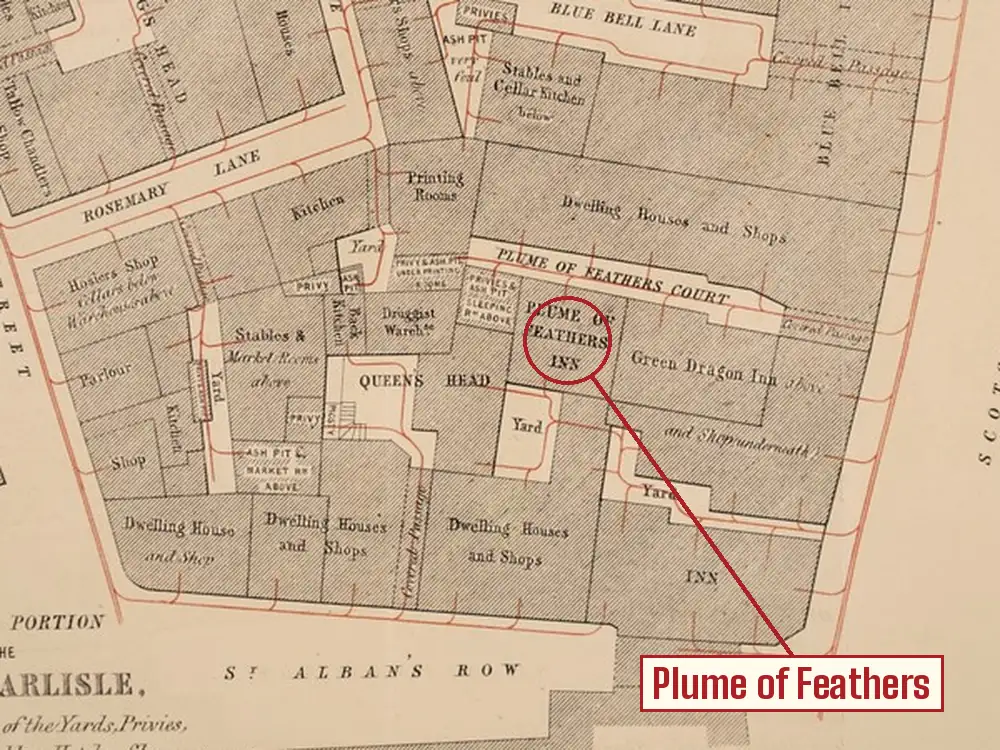
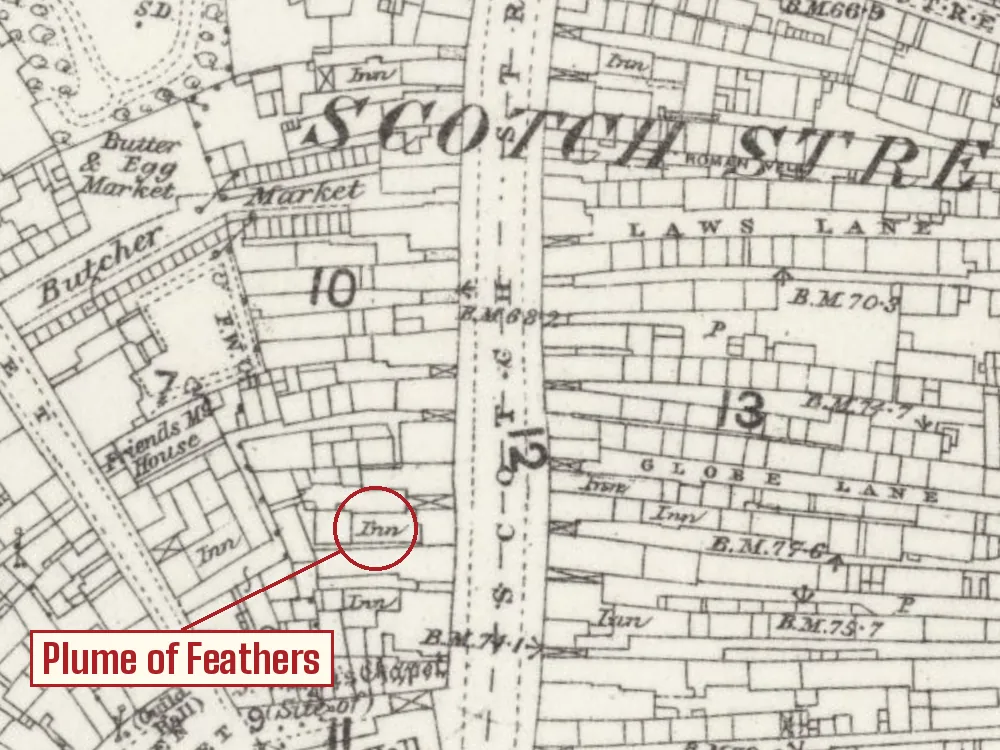
- Approximate. Placed from Rawlinson's 1850 Board of Health plan, which shows the inn set back behind the west side of Scotch Street, just south of Plume of Feathers Court and a few yards east of the Old Queen's Head.
The Plume of Feathers stood behind the west side of Scotch Street, a few doors up from St Alban's Row and the Town Hall, at the end of a covered passage named after it, Plume of Feathers Court. Parson and White's directory of 1829 names William Coneton as its keeper; Jollie's of 1811 has him as an innkeeper in Botchergate. It traded into the 1860s, and the directories carry it to 1869.
Its exact place is known because the General Board of Health drew it. Robert Rawlinson's 1850 report on Carlisle's drains has a large plan of the block between Fisher Street and Scotch Street, drawn to show how crowded the centre had become. The 'Plume of Feathers Inn' stands on the south side of its court, back from the street, behind the Green Dragon, which fronted Scotch Street over a row of shops. The Queen's Head was its neighbour on the west, the Duke's Head and the Blue Bell stood further up the street, and the Old King's Head backed onto the same block from Fisher Street.
Against the inn's west wall were privies and an ash pit with a sleeping room over them, and at the far end of the court were printing rooms. Rawlinson's note on the block was that its lanes and yards had once been the gardens of the houses on the main streets, built over piece by piece as the houses became shops, hotels and taverns, and the plan carries the warning that there were no proper sewers or drains in the district. The 1865 Ordnance Survey still marks an inn in the same place, set back just south of the passage into the court.
The earliest newspaper notice of the house is a sad one. In May 1832 Henry Murray, who travelled the country from Egremont selling writing paper, died at 'the Plume of Feathers public house, Scotch Street', where he had been nursed for about a fortnight after taking poison. The coroners' jury found that he had done it in a state of temporary lunacy. He left a wife and family.
Mike Tuer's database gives the house an earlier name, the Grey Horse, from 1822. The newspapers keep the two apart: in 1841, while the Plume of Feathers was trading under its own name, the Grey Horse was John Fish's inn in the same street, where new houses in John Street, Botchergate, were sold by auction that June, and where his son William had died that May, aged five.
The court had more in it than the inn. In September 1843 James Foster opened a cheap circulating library there, at twelve shillings a year, with Scott, Dickens, Marryat, Bulwer and Ainsworth on the shelves, open from eight in the morning till eight at night and till nine on Saturdays, with a printing shop alongside. In June 1852 he took the Old Bush Inn across the street as well, kept the press and the library going in the court, and advertised from 'Old Bush Lane, & Plume of Feathers Court'. That March Harriet, the fourth daughter of a James Forster, very probably the same man, had died in the court, aged seven.
In 1861 Mrs Foster, giving up the printing, sold the presses, about 3,000 pounds of type and 7,000 envelopes from the shop in the court. The tailors knew the place too. James Little, a tailor of 32, died suddenly in the court in September 1846, and in April 1847 the society of operative tailors dined at the Plume of Feathers Inn to celebrate a rise in wages, toasting the master tailors 'who had signed the new bill of prices'. The dinner 'reflected great credit upon Mr. and Mrs. Kinghorn, the worthy host and hostess'; George Kinghorn is its keeper in the 1847 directory.
Daniel Boyle had it from at least 1851 to 1856. He held a sparrow shoot in December 1851 that ended early for want of birds ('Hardy, the celebrated shot, missed his first bird'), and from 1853 William Edgar, a bone-setter from Wigton, could be consulted at Boyle's every Saturday. In April 1852 Boyle treated two women in the parlour of a neighbouring house, the Andrew Marvel, and fell asleep in a chair. Mary Macalraith, who had joined them, took his silver watch and sold it for fifteen shillings to John Rennie of Scotch Street. She was transported for seven years.
In 1856 a soda-water maker sued Boyle for bottles he said had not come back, and sued the White Horse and the Spread Eagle the same day. He lost all three. His bottles were collected by a boy with a cart who wrote nothing down, and the judge said he had 'an extremely bungling mode of keeping his accounts' and could not 'rely upon the memory of a boy'.
Mrs Denton took the house in April 1857, 'very recently' altered and repaired, and offered lodgings. By 1863 it was in the hands of William Murray, a boot and shoe maker, whose creditors' assignee sold his furniture and 'spirit bar and public house requisites' in the Market Place that August. The Cumberland News's 1933 list of the street's licensed houses has Mrs Catherine Denton keeping it in the 1860s, so she may have come back to it; the directories carry it to 1869.
It was not Carlisle's first Plume of Feathers. In 1811 an Upperby weaver, who could weave a coat of arms into a damask cloth, took orders at 'Mr. M'Knight's, the Plume of Feathers, St. Cuthbert's-lane', and in October 1823 the 'Plume and Feathers' there, a common inn with stables, a pump in the yard and five bedrooms, was sold by auction together with a front pew, No. 93, in the north gallery of St Cuthbert's Church. That house may have become the Robert Burns, which began as the Prince of Wales Feathers at about the same time. Only the sign links it to the Scotch Street house.
Photograph
Sources 22
- Carlisle Encyclopaedia, "P" page
- CARLISLE_PUBS_Ver_3.xls (Mike Tuer's pub database)
- The Cumberland News, 18 March 1933, p. 14: 'A Cumbrian Notebook: Changes in Scotch Street and Rickergate' (via newspapers.com)
- Carlisle Patriot, 25 September 1891, p. 6: 'Public houses in Carlisle sixty years ago', reprinting the 1829 Parson and White directory list (via British Newspaper Archive)
- Jollie's Cumberland Guide & Directory (Carlisle: F. Jollie & Sons, 1811), Carlisle directory, pp. i-xxii: Coneton William, innkeeper, Botchergate (Google Books scan of the Bodleian copy)
- Robert Rawlinson, Report to the General Board of Health on ... the City of Carlisle (London: HMSO, 1850), plan of a portion of the city between Fisher Street and Scotch Street (Wellcome Collection, Public Domain Mark)
- Ordnance Survey 25-inch map, Cumberland XXIII.3, surveyed 1865, published 1874 (National Library of Scotland)
- Carlisle Journal, 9 March 1811, p. 1: Anthony Charters of Upperby, weaver; orders taken in at Mr M'Knight's, the Plume of Feathers, St Cuthbert's Lane (via British Newspaper Archive)
- Carlisle Patriot, 18 October 1823, p. 1: public house for sale, the Plume and Feathers, St Cuthbert's Lane (via British Newspaper Archive)
- Carlisle Patriot, 26 May 1832, p. 3: death of Henry Murray at the Plume of Feathers, Scotch Street (via British Newspaper Archive)
- Carlisle Journal, 29 May 1841, p. 3, and 5 June 1841, p. 2: Mr John Fish of the Grey Horse, Scotch Street (via British Newspaper Archive)
- Carlisle Journal, 9 September 1843, p. 2; Carlisle Patriot, 16 September 1843, p. 2; Carlisle Journal, 4 November 1843, p. 2: James Foster's circulating library, Plume of Feathers Court (via British Newspaper Archive)
- Carlisle Patriot, 11 September 1846, p. 2: inquest on James Little, tailor, Plume of Feathers Court (via British Newspaper Archive)
- Carlisle Patriot, 9 April 1847, p. 2: operative tailors' dinner at the Plume of Feathers Inn, Mr and Mrs Kinghorn (via British Newspaper Archive)
- Carlisle Journal, 19 December 1851, p. 3: Daniel Boyle's sparrow shooting (via British Newspaper Archive)
- Carlisle Journal, 19 March 1852, p. 3, and 25 June 1852, p. 2: Harriet Forster; James Foster at the Old Bush Inn and Plume of Feathers Court (via British Newspaper Archive)
- Carlisle Journal, 2 July 1852, p. 2: Mary Macalraith, stealing a watch from Daniel Boyle (via British Newspaper Archive)
- Carlisle Journal, 28 October 1853, p. 6: William Edgar, bone setter, at Mr D. Boyle's (via British Newspaper Archive)
- Carlisle Journal, 1 February 1856, p. 6: County Court, Moore v. Boyle (via British Newspaper Archive)
- Carlisle Journal, 17 April 1857, p. 4: Mrs Denton enters the Plume of Feathers Inn (via British Newspaper Archive)
- Carlisle Journal, 26 April 1861, p. 1: sale of Mrs J. Foster's printing plant, Plume of Feathers Court (via British Newspaper Archive)
- Carlisle Journal, 14 August 1863, p. 1: William Murray's assignment, Plume and Feathers Inn (via British Newspaper Archive)
Open question
An unsolved mystery
Was the Plume and Feathers sold in St Cuthbert's Lane in October 1823 the house that became the Robert Burns, and did its sign move to Scotch Street? And where in Scotch Street was John Fish's Grey Horse of 1841?
If you know the answer, or where it might be found (an old photograph, a family story, a document), tell us and it goes into the story above.
Also lost on Scotch Street
- The Blue Bell Hotel
- The Globe
- The Duke's Head
- The Old Turks Head
- Black Bull, Scotch Street
- The Grapes Hotel
- The Old Bush Inn
- The Three Cannons
- The Green Dragon
- Ismay's Vaults
- The Lion and Lamb
- Amos's Spirit Stores
- The Captain Cook
- The Rising Sun
78 other lost pubs stood within 250 m of here. See them on the map
Still serving, near where it stood
-
40 maway
-
70 maway
-
80 maway
-
80 maway