Lost pub · Scotch Street
The Blue Bell Hotel
- Built
- First mentioned by name in 1776
- Gone
- Closed 9 April 1973
- There now
- Retail units on Scotch Street
- Address
- 76 Scotch Street
- Where exactly
- Placed from the Ordnance Survey grid reference, NY4007256015, in Historic England's gazetteer of the scheme's premises. The building's use in 2018: commercial.
An eighteenth-century coaching inn at 76 Scotch Street, on what was the highway from England into Scotland, and none of the district's other Blue Bells: not the Rickergate one the state shut in 1917, not the Carleton one, not the Brampton one, and not the one still trading at Dalston. It first appears by name in 1776, per a Denis Perriam history piece for the Cumberland News in July 2012, which names a Mrs Norman as the licensee. Hutchinson's History of Cumberland, printed in 1794, names a Blue Bell among the inns 'much resorted to by travellers'. He gives no street, and Rickergate had a Blue Bell by then too, but a house for travellers on the main road north fits this one.
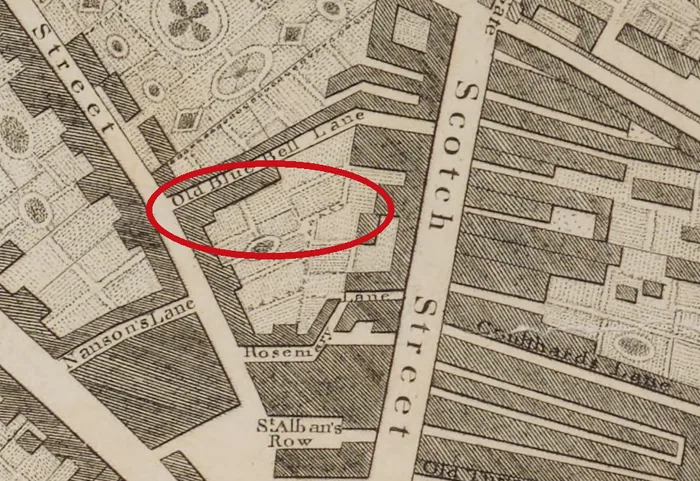
The plan of the city in the same book marks an Old Blue Bell Lane on the same, west side of Scotch Street, a little north of the hotel's site.
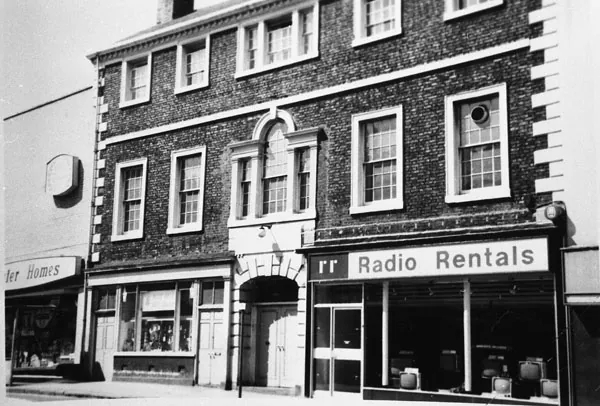
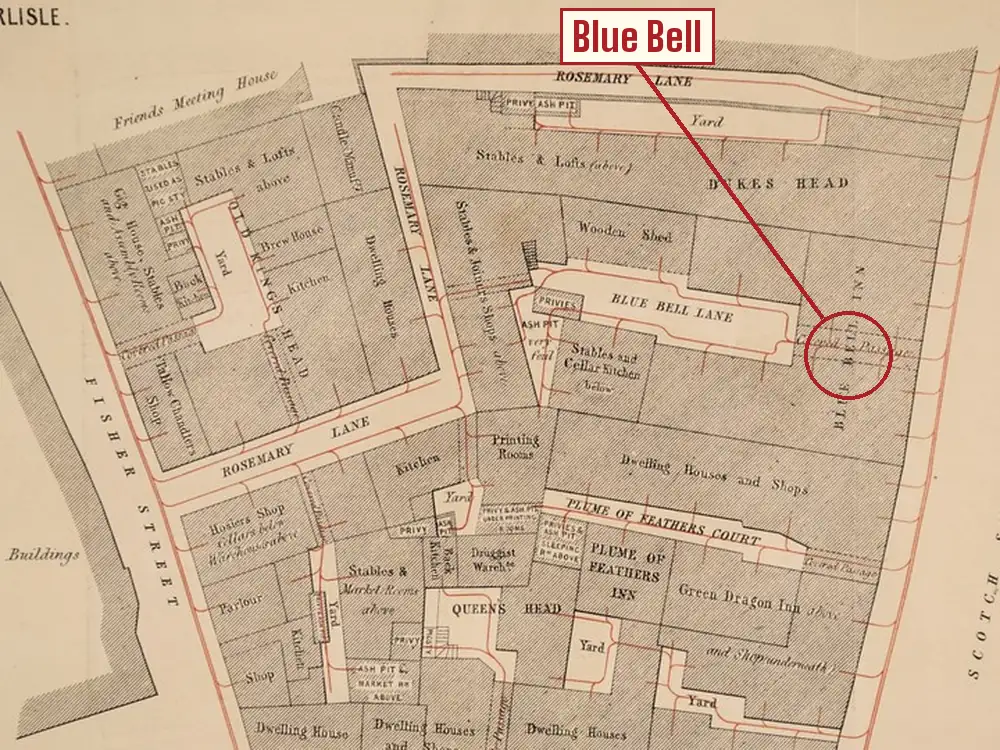
A Cumberland News column of 12 April 1991 describes a three-storey Georgian-fronted building with an extensive yard where there was stabling. For most of its life the main entrance seems to have been from Blue Bell Lane, the main door off Scotch Street coming later, and a well, probably Roman, was found in its yard. Rawlinson's plan of 1850 for the General Board of Health shows the Blue Bell Inn's long front on Scotch Street, with Blue Bell Lane running in beside it through a covered passage to stables and a cellar kitchen; the city's sanitary committee, quoted in the same report, complained that 'the numerous nuisances in Blue Bell-lane' it had pointed out the summer before were still there.
Mr Norman held it in 1801 and Thomas Norman the following years. In 1811 Jollie's directory named it among the principal inns, one of the city's four men's benefit societies met at 'Mr. Norman's', and Rowland Fawcett, a land surveyor from Scaleby, did his business there; his own death notice, in the Carlisle Journal in February 1818, called him 'for many years master of the Blue Bell Inn.' John Snowden had it by 1821 and Nancy Irving from 1822; she had kept the Crown and Mitre in 1811. In 1829 the Blue Bell was the city's third coach office, sending the Royal Invincible to Manchester by Penrith, Kendal, Lancaster, Preston and Bolton, and the Independent to Edinburgh by Longtown, Langholm and Hawick.
Later licensees include T. Loftus from 1842, Robert Mounsey in the 1847 directory, and William Tiffin, 39 and from Dalston, in the 1861 census; the Cumberland News's 1933 list of the two streets' licensed houses has William Tiffen at the Blue Bell in the 1860s. In May 1865 it was the base of Charles Elson, a nine-stone walker from Northampton who set out from the Blue Bell to walk 312 miles in six days, Carlisle to beyond Wigton and back twice a day, with crowds outside the door to see him in. In September 1893 the licence passed from Martha Matthews to William Wilson, who was 61 by 1901; his daughter Mary Louise Wilson died at the Blue Bell Hotel in September 1912, aged 38.
The state took it on 28 August 1916, and it survived the takeover, when many of the city's smaller pubs were closed. The scheme held it to the very end, extending it into its old yard to make a billiards room big enough for two tables. Before the Second World War there had been a Blue Bell Cafe upstairs; the top floor was taken over for troops during the war and the cafe closed and never reopened.
In its later years it was known as a working men's pub. A reader's recollection in the paper of 26 April 1991 has it known as a man's pub that women refused to enter, until the manager, Arthur Fearnley, and her brother, home from RAF service in Africa, pulled some in, the first women customers as far as she knew; her aunt and sister worked in the cafe upstairs until it closed. Towards the end customers were limited to two ground-floor rooms, a large bar and a small drinking room, with the manager living above. The Evening News and Star reported a ghost story attached to the pub in January 1971.
The sale was decided by a tie. Bass and a local property firm both tendered £50,000, and the government, as the annex to the scheme's official history records, decided to give the local firm the preference. So in 1973 the scheme sold it to W Vasey & Sons for fifty thousand pounds, and what changed hands was already more shop than pub: the sale took in the inn, an off-sales, and a shop unit let to Halfords. It closed on 9 April 1973, reported by the Evening News and Star as 'City pub closes', and the premises were taken over for an extension of Vasey's furniture store. A fire gutted the building in 1976, leaving only the front wall standing, which is very likely why the brick front was kept when the site was cut up into the shop units there now, with the gable end rebuilt.
Sold in 1973 as “Bluebell Inn and off-licence, Scotch Street” to W. Vasey and Sons for £50,000. Who bought the rest
Photograph
Sources 20
- geograph.org.uk
- Carlisle Encyclopaedia: directories, census and newspaper index
- D. Perriam, Cumberland News, 27 July 2012, p34
- CARLISLE_PUBS_Ver_3.xls (Mike Tuer's pub database)
- Historic England, Countering the 'deadliest of foes': public houses of the Central Control Board and the State Management Scheme, 1916-73 (Clare Howard, Research Report 89-2018): Appendix C, gazetteer of scheme premises
- Historic England, Countering the 'deadliest of foes': public houses of the Central Control Board and the State Management Scheme, 1916-73 (Clare Howard, Research Report 89-2018)
- The State Management Story documents: annex to H. B. Wilson's history of the scheme, for official eyes only (about 1975)
- The Cumberland News, 18 March 1933, p. 14: 'A Cumbrian Notebook: Changes in Scotch Street and Rickergate' (via newspapers.com)
- The Cumberland News, 12 April 1991, p. 4: 'Pubs of yesteryear', The Blue Bell, Scotch Street (via newspapers.com)
- The Cumberland News, 26 April 1991, p. 4: 'Pubs of yesteryear', a reader's memories of the Blue Bell, Scotch Street (via newspapers.com)
- North Cumberland Reformer, 7 September 1893, p. 2: brewster sessions transfers (via British Newspaper Archive)
- W. Hutchinson, The History of the County of Cumberland, vol. II (Carlisle: F. Jollie, 1794), p. 666: inns much resorted to by travellers, 1794
- W. Hutchinson, The History of the County of Cumberland, vol. II (Carlisle: F. Jollie, 1794), Plan of the City of Carlisle and Places Adjacent, facing p. 585: the 1794 town plan
- Jollie's Cumberland Guide & Directory (Carlisle: F. Jollie & Sons, 1811), p. viii: principal inns of Carlisle (Google Books scan of the Bodleian copy)
- Jollie's Cumberland Guide & Directory (Carlisle: F. Jollie & Sons, 1811), p. viii: benefit societies and freemasons' lodges (Google Books scan of the Bodleian copy)
- Jollie's Cumberland Guide & Directory (Carlisle: F. Jollie & Sons, 1811), Carlisle directory, pp. i-xxii: Fawcett Rowland, land surveyor, Scaleby, at the Blue Bell (Google Books scan of the Bodleian copy)
- W. Parson and W. White, History, Directory, and Gazetteer of the Counties of Cumberland and Westmorland (Leeds, 1829), p. 167: coaches and the inns they left from (University of Leicester digital copy)
- W. Parson and W. White, History, Directory, and Gazetteer of the Counties of Cumberland and Westmorland (Leeds, 1829), pp. 163-164: Carlisle inns and taverns (University of Leicester digital copy)
- Carlisle Journal, 23 May 1865, p. 4: 'A walking match against time' (via British Newspaper Archive)
- Robert Rawlinson, Report to the General Board of Health on ... the City of Carlisle (London: HMSO, 1850), plan of a portion of the city between Fisher Street and Scotch Street (Wellcome Collection, Public Domain Mark)
Location from britishlistedbuildings.co.uk. The pin marks the site.
Open question
An unsolved mystery
Carlisle's 1794 town plan marks an Old Blue Bell Lane off the west side of Scotch Street, a little north of where the Blue Bell Hotel stood. Was that the hotel's own Blue Bell Lane, and why was it already called old in 1794?
If you know the answer, or where it might be found (an old photograph, a family story, a document), tell us and it goes into the story above.
Also lost on Scotch Street
- The Globe
- The Duke's Head
- The Old Turks Head
- Black Bull, Scotch Street
- The Grapes Hotel
- The Old Bush Inn
- The Three Cannons
- The Plume of Feathers
- The Green Dragon
- Ismay's Vaults
- The Lion and Lamb
- Amos's Spirit Stores
- The Captain Cook
- The Rising Sun
77 other lost pubs stood within 250 m of here. See them on the map
Still serving, near where it stood
-
30 maway
-
70 maway
-
70 maway
-
80 maway