Lost pub · Spread Eagle Lane
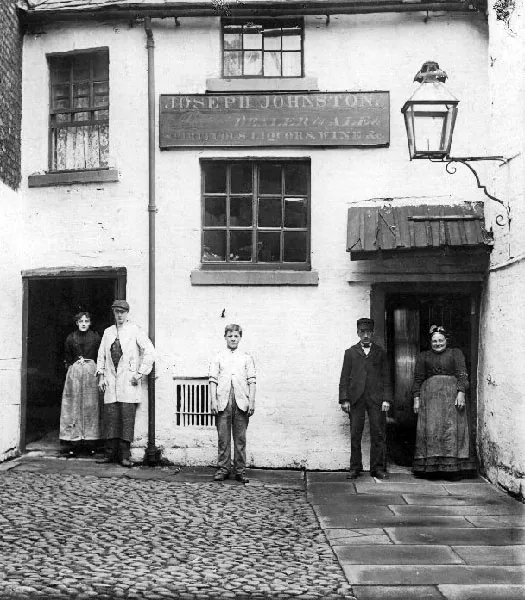
The Spread Eagle Inn
- Gone
- Closed 27 February 1903, demolished for the Crown & Mitre
- There now
- The Crown & Mitre hotel
- Where exactly
- Spread Eagle Lane went when the Crown & Mitre was built on English Street; the pin marks roughly where it was, not the building. The position is approximate.
Down a narrow lane of the same name between English Street and Castle Street, opening into a small yard. A Cumberland News column of 25 October 1991 gives its address as off Castle Street or English Street depending on the directory or advertisement, and says a report of 1894 put it right opposite the chemist Mr Sawyer's premises in the Greenmarket, in what was by 1991 a dress shop. It stood some 33 yards back from the street, up a lane just to the right of the old Crown and Mitre Coffee House, with rear access from St Cuthbert's Lane through the Crown and Mitre yard.
Described in 1899 as one of the oldest licensed houses in the city, it was trading before 1789 and is traceable to Jacob Johnston by 1795, whose widow had it by 1810. Parson and White's directory of 1829 names John Wharton as its keeper. Country cloth-makers used its yard as a market stand: in 1829 John Graves, a woollen manufacturer from Caldbeck, 'attends Sat.' at the Spread Eagle yard, and a city directory of 1837 lists a wool spinner from Caldbeck, John Nixon, as available there every Saturday. Mr Riley had it in February 1856, when a soda-water maker sued him over unreturned bottles, with the White Horse and the Plume of Feathers, and lost. T. Kirkpatrick signed the innkeepers' memorial of February 1867 for the Spread Eagle.
At the Licensing Sessions of September 1894, when Joseph Johnston kept it, a bid to stop the renewal of its licence failed. The police said the premises were not properly conducted and implied that the landlord regularly allowed gaming. They said they could not supervise it properly because the rear entry was always locked and the only way in was by the lane at the front, where someone was always on watch, and that when a constable went in, customers were sitting at tables with the glasses pushed to one end and the tops clear, as if cards had been put away.
The defence said it was a very old licensed house giving a good service to farmers on market days, with good stabling for up to 50 horses and room for up to a dozen potato carts on Wednesdays, when the potato market was held. It was also handy for visiting tradesmen to see customers and show their wares, and Mr Sawyer said it was well conducted.
It went in the end with the old Crown and Mitre, when the new and much enlarged hotel went up just after the turn of the century. The Carlisle Journal's report of the adjourned licensing sessions of March 1903 lists it among six city licences that would cease after April that year, though it had already closed on 27 February 1903. The property came down for the Crown & Mitre development, so what stands over it is the hotel bar still trading a few yards away.
Photograph
Sources 9
- cumberlandscarrow.com
- CARLISLE_PUBS_Ver_3.xls (Mike Tuer's pub database)
- The Cumberland News, 25 October 1991, p. 4: 'Pubs of yesteryear', Spread Eagle (via newspapers.com)
- Carlisle Journal, 3 March 1903, p. 6: adjourned licensing sessions for Carlisle, the Cumberland Ward and Brampton (via British Newspaper Archive)
- Carlisle Patriot, 25 September 1891, p. 6: 'Public houses in Carlisle sixty years ago', reprinting the 1829 Parson and White directory list (via British Newspaper Archive)
- Carlisle Journal, 22 February 1867, p. 6: the Public Houses Closing Act and the innkeepers' memorial (via British Newspaper Archive)
- W. Parson and W. White, History, Directory, and Gazetteer of the Counties of Cumberland and Westmorland (Leeds, 1829), p. 167: woollen manufacturers: John Graves, Spread Eagle yard, from Caldbeck, attends Saturday (University of Leicester digital copy)
- Kelly's Directory of Cumberland (London: Kelly and Co., 1894), Carlisle: street directory and public houses (University of Leicester digital copy)
- Carlisle Journal, 1 February 1856, p. 6: County Court, Moore v. Riley and others (via British Newspaper Archive)
78 other lost pubs stood within 250 m of here. See them on the map
Still serving, near where it stood
-
30 maway
-
70 maway
-
90 maway
-
110 maway