Lost pub · Scotch Street
The Grapes Hotel
- Opened
- 1775
- Gone
- Last in the directories in 1894; its licence was refused in 1891 but restored on appeal
- There now
- Unknown
- Address
- Market Place end of Scotch Street (37 Scotch Street in 1858; later 79; 1 Grapes Lane in 1884)
- Where exactly
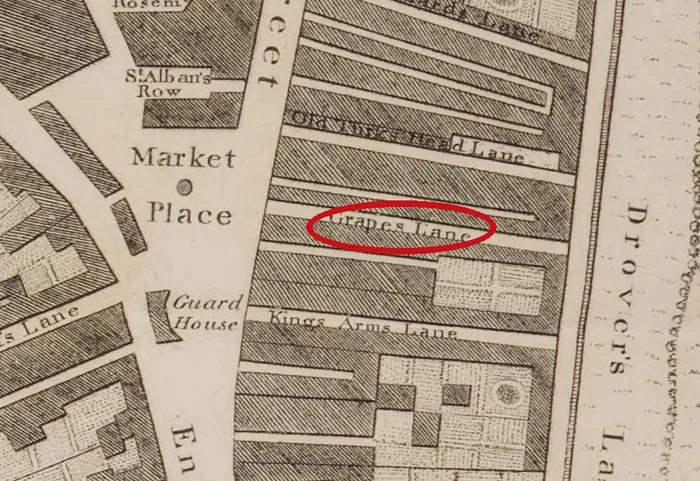
- Placed at the Scotch Street end of Grapes Lane, the lane the council bought with the inn in 1873, facing the Market Place, using Carlisle's 1794 town plan fitted to the modern map. The pin is approximate.
One of Carlisle's oldest recorded inns, trading before 1775. The Cumberland News of 13 March 1992 says it was probably a substantial private house converted to an inn in the 1750s or 1760s, as the turnpike roads and the military road to Newcastle, completed in 1758, made travel easier, and that the 1787 Carlisle Directory and Guide placed it among the city's principal inns, overlooking the Market Place.
Hutchinson's History of Cumberland, printed in Carlisle in 1794, lists the Grapes among the inns 'much resorted to by travellers', and its plan of the city already names Grapes Lane. Samuel Jefferson's History and Antiquities of Carlisle (1838) picks out the Grapes, with the Carlisle and Cumberland Bank, as one of the city's surviving fine old houses in the style of the seventeenth century, marked by rounded and angular pediments over its windows and doors, set alternately.
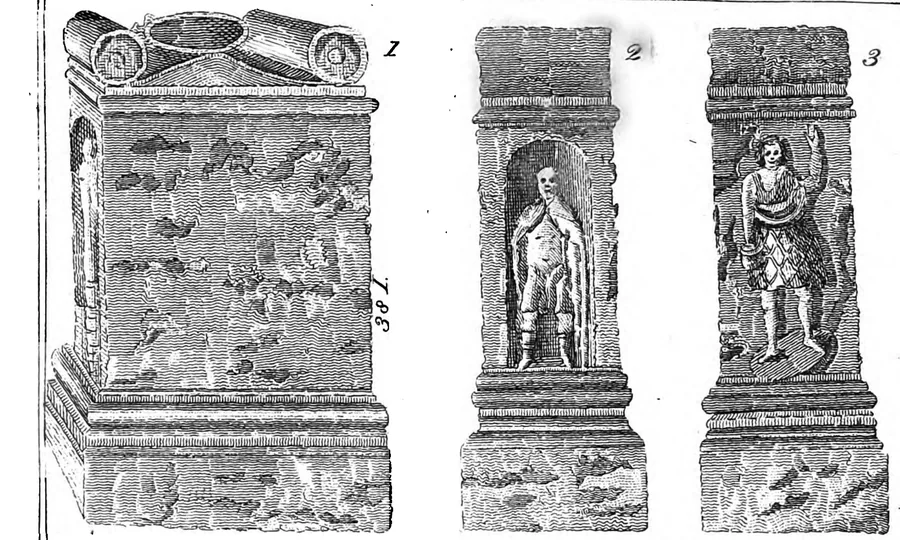
Its cellar has genuine Roman archaeology behind it: an altar carved with a relief of Mercury was found underneath the building in 1787, and a separate inscribed stone turned up seven feet down while digging the cellar; both are now in Tullie House Museum. Hutchinson engraved the altar 'found in digging the Grapes-inn cellar' as number one on his plate of Carlisle antiquities, with the carvings on its two sides, and noted that it 'appears never to have been finished'.
A Mrs Pringle kept it by the 1790s, and it traded continuously through the nineteenth century under a run of named licensees: Benjamin Holmes from around 1801 (still there in 1811, when Jollie's directory named the Grapes among the principal inns of Scotch Street), then the Armstrongs (David Armstrong, proprietor, in 1828-29, and Mary Armstrong in 1847), William Bell from the 1850s, at 37 Scotch Street in the 1860s by the Cumberland News's 1933 list of the two streets' licensed houses, and David Bell in 1873; one record also names a George Dalston.
Every directory from 1828 to 1873 puts the Grapes in Scotch Street, and Bulmer's of 1884 at 1 Grapes Lane, though its alphabetical list has 'Grapes lane, English street'. The 1829 street list in Parson and White's directory has both an Old Grapes Lane off English Street and a Grapes Lane off Scotch Street, which may be where the two-street confusion over this inn begins. John Wood's plan of 1821 has a New Grapes Lane and an Old Grapes Lane side by side on the east side of the street, between Jollie's Lane and Pescod Lane, close to where Scotch Street gives way to English Street.
In April 1873 the city council bought it with the adjoining Grapes Lane, meaning to demolish the property for a new thoroughfare between Scotch Street and Lowther Street, and a scheme for a covered market there was dropped in favour of the one the city has. The thoroughfare also fell through, leaving the council with the Grapes on its hands, and it let the inn to tenants, though it sometimes had trouble getting the rent.
The council removed three large panels from the house by the Whitehaven painter Matthias Read, who died in 1747: a view of Whitehaven, a view of Carlisle about 1715 and a fox eating a fowl titled Reynard Triumphant. The column suggests they were there because Carlisle Spedding, the Earl of Lonsdale's agent, had once occupied the house. The landlord opposed their removal, which was confusing because it came before the Royal Show in the city that year. The panels went first into the Town Hall, were cleaned by Thurnam's of Carlisle and are now in Tullie House Museum.
In 1879-80 the surveyor was authorised to make a luncheon bar in the Grapes and to board the floor. In September 1880 the licence passed from T. Johnston to J. Geddes, and an 1882 trade-directory advertisement billed it as the 'oldest established hotel in Carlisle', a direct rival to the claim the Kings Head makes today. Charles Daly had it in 1884. In September 1887 the Grapes and the Grapes Lane cottages, then the property of the town's Urban Sanitary Authority, were offered in an exchange with the Corporation for the Half Moon, the Butcher Market and the Butter Market, so that the new Covered Market could belong to the sanitary authority. In December 1890 its licence passed from Elizabeth Patterson to George Dawson.
Its end is told two ways. By the council minutes, in 1890-91 the United Kingdom Alliance, a temperance body, opposed renewal of the licence and the Town Clerk was instructed to support the application, but the justices refused it; the council appealed successfully at the following Quarter Sessions, and in 1891-92 four tenders for letting the Grapes were considered and it went to E. S. Musgrove for ten years at £110 a year. Musgrove was allowed to remove cubes in the passageway and entrance to the premises in Grapes Lane and relay it with wood pavement.
The newspapers tell it differently. At the Brewster Sessions of September 1891 the Grapes, 'belonging to the Corporation', was one of four city licences refused, and the Carlisle Journal reported that the Corporation had failed to give notice of appeal in time; the Carlisle Temperance Federation then tried, and failed, to lease it as a first-class temperance hotel. The two accounts are not reconciled here. The Grapes last appears in the directories in 1894, and by February 1895 it was Musgrove's warehouse.
Photograph
Sources 23
- Carlisle Encyclopaedia, "G" page
- CARLISLE_PUBS_Ver_3.xls (Mike Tuer's pub database)
- The Cumberland News, 18 March 1933, p. 14: 'A Cumbrian Notebook: Changes in Scotch Street and Rickergate' (via newspapers.com)
- The Cumberland News, 13 March 1992, p. 4: 'Pubs of yesteryear', Grapes Inn, Scotch Street (via newspapers.com)
- Carlisle Journal, 29 September 1891, p. 3: 'The refused licences in Carlisle: the appeals' (via British Newspaper Archive)
- North Cumberland Reformer, 31 December 1891, p. 6: 'Temperance progress' (via British Newspaper Archive)
- North Cumberland Reformer, 16 February 1895, p. 6: temperance meeting, Carlisle (via British Newspaper Archive)
- Carlisle Express and Examiner, 11 September 1880, p. 8: Brewster Sessions, transfers and the black list (via British Newspaper Archive)
- Carlisle Patriot, 16 September 1887, p. 7: 'The new market' (via British Newspaper Archive)
- North Cumberland Reformer, 4 December 1890, p. 6: 'Transfer of licences' (via British Newspaper Archive)
- Carlisle Journal, 16 December 1890, p. 3: adjourned licensing day (via British Newspaper Archive)
- W. Hutchinson, The History of the County of Cumberland, vol. II (Carlisle: F. Jollie, 1794), p. 652 and the plate 'Carlisle, Stanwix &c.': the altar found in digging the Grapes-inn cellar, figures 1 to 3
- W. Hutchinson, The History of the County of Cumberland, vol. II (Carlisle: F. Jollie, 1794), p. 666: inns much resorted to by travellers, 1794
- W. Hutchinson, The History of the County of Cumberland, vol. II (Carlisle: F. Jollie, 1794), Plan of the City of Carlisle and Places Adjacent, facing p. 585: the 1794 town plan
- Jollie's Cumberland Guide & Directory (Carlisle: F. Jollie & Sons, 1811), p. viii: principal inns of Carlisle (Google Books scan of the Bodleian copy)
- W. Parson and W. White, History, Directory, and Gazetteer of the Counties of Cumberland and Westmorland (Leeds, 1829), p. 154: street list: Old Grapes Lane, English Street; Grapes' Lane, Scotch Street (University of Leicester digital copy)
- Pigot and Co., National Commercial Directory (London, 1828-29), Carlisle: inns, taverns and public houses, and wine and spirit merchants (University of Leicester digital copy)
- Mannix and Whellan, History, Gazetteer and Directory of Cumberland (Beverley, 1847), Carlisle: hotels, inns and taverns, and beer houses (University of Leicester digital copy)
- Post Office Directory of Cumberland (London: Kelly and Co., 1858), Carlisle: commercial list and inns (University of Leicester digital copy)
- Post Office Directory of Durham, with the principal towns of Northumberland, Cumberland and Westmorland (London: Kelly and Co., 1873), Carlisle: street directory and publicans (University of Leicester digital copy)
- Bulmer's History, Topography and Directory of East Cumberland (1884), Carlisle: hotels, inns and taverns, beerhouses, and wine and spirit merchants (University of Leicester digital copy)
- Samuel Jefferson, The History and Antiquities of Carlisle (Carlisle: Samuel Jefferson, 1838), pp. 276-277: the Grapes Hotel, Scotch Street, among the city's old seventeenth-century-style houses
- John Wood, Plan of the City of Carlisle from actual survey, 1821, engraved by Robert Walker (National Library of Scotland)
Location from archive.org. The pin is approximate.
Open question
An unsolved mystery
Did the Grapes ever trade on the English Street side? Every directory from 1828 to 1873 places it in Scotch Street, and Bulmer's of 1884 at 1 Grapes Lane, which its alphabetical list puts off English Street; Old Grapes Lane, off English Street, suggests the name was once on that side too. Wood's plan of 1821 puts a New and an Old Grapes Lane next to each other, between Jollie's Lane and Pescod Lane.
If you know the answer, or where it might be found (an old photograph, a family story, a document), tell us and it goes into the story above.
Also lost on Scotch Street
- The Blue Bell Hotel
- The Globe
- The Duke's Head
- The Old Turks Head
- Black Bull, Scotch Street
- The Old Bush Inn
- The Three Cannons
- The Plume of Feathers
- The Green Dragon
- Ismay's Vaults
- The Lion and Lamb
- Amos's Spirit Stores
- The Captain Cook
- The Rising Sun
89 other lost pubs stood within 250 m of here. See them on the map
Still serving, near where it stood
-
70 maway
-
90 maway
-
100 maway
-
100 maway