Lost pub · Botchergate
The Queen Adelaide
- Built
- A beerhouse by 1830, a full pub from 1837
- Gone
- Closed 1935, replaced directly across the road by the new Earl Grey
- There now
- The building stands; in commercial use in 2018
- Address
- 142-144 Botchergate
- Where exactly
- Placed from the Ordnance Survey grid reference, NY4060755313, in Historic England's gazetteer of the scheme's premises. The building's use in 2018: commercial.
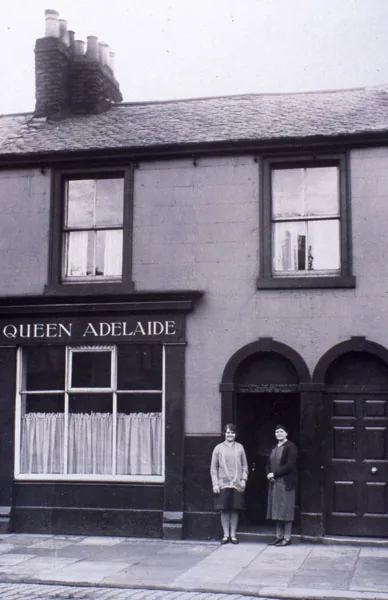
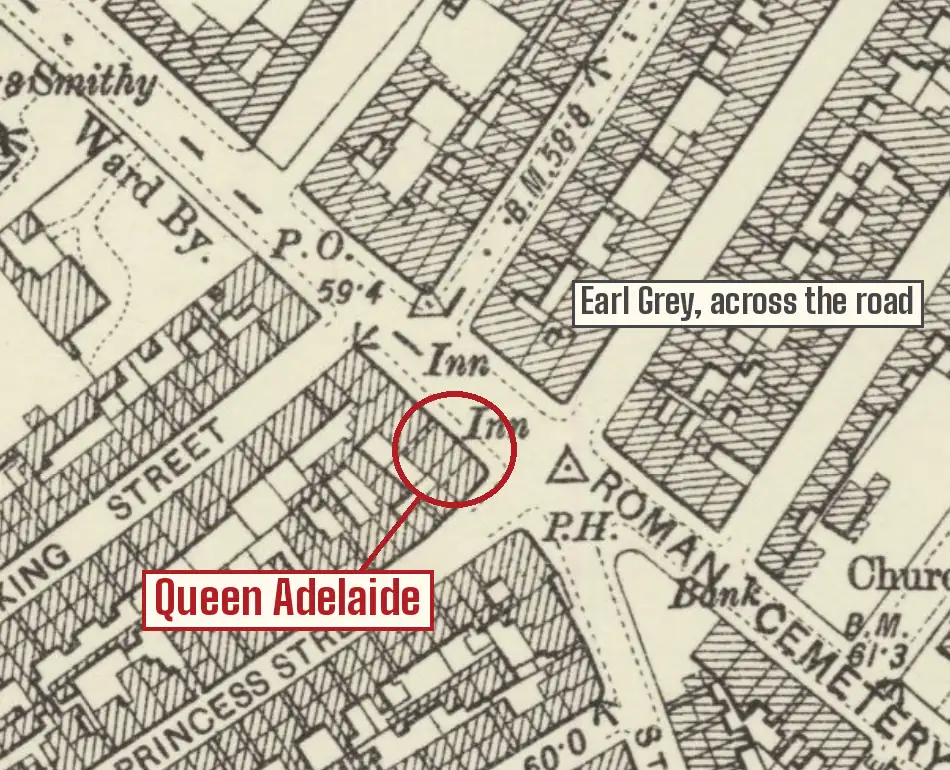
On the corner of King Street and Botchergate, at the London Road end, and a pub with two names in use at once for most of its life: the Queen Adelaide on paper and in parliamentary evidence, the Queen Inn, or the Queen's, in the street and in the court reports. It was a beerhouse by 1830, the year William IV came to the throne and Adelaide became queen, which is very likely where the name came from, though no record says so. The directories have it from 1844 at 13 London Road, then as 130 Botchergate in 1869 and 1884, 128 and 130 in the 1890s, and 142 from about 1906, as this stretch was renamed and then renumbered around it. The Ordnance Survey's 25-inch map revised in 1899 marks it 'Inn' on the corner, with the Earl Grey across the road.
It became a full inn in October 1839. John Forster, a joiner, had for some years rented two rooms here at nine guineas a year; his landlord, Mr Black, a clothier, then took in the premises next door, put up new buildings at a cost of about £200 'with the view to let the whole as an inn', and let it to Forster at £30 a year. Forster's daughter Jane died at 'the Queen Inn, London Road' that April, aged nine, and his wife Elizabeth there in November 1846, aged 53. In the bribery inquiry into the Carlisle election of 1847 a witness was asked whether he knew 'a person of the name of Foster, who keeps a public-house called the Queen Adelaide', and whether he had sent in a bill to the party agents. He had, for about £40. In 1848 Black sued to put Forster out.
By 1850 it was 'Fortunate George's, the Queen inn', kept by George Blackwell, where the backers of Charles Haywood, 'the Lancashire Pet', lodged for a £200 quoiting match for the championship of Britain that September. That November Blackwell was summoned for a very disorderly night, which he blamed on a party of the 81st Regiment billeted on him; the officer said Blackwell and his friends had used the soldiers very badly.
In 1853 a vagrant woman robbed the bar. Edward Sharp, of the Queen Inn, gave notice in January 1855 that he would not be answerable for his wife Hannah's debts, and by June Mary Biglands had the house, when a constable who came in by the back door on a Sunday night found one man standing in the stable 'with a glass before him on the ground' (laughter). She said her brother and his wife had only called for supper. In August 1856 an old labourer, Thomas Higgins, died after a fight with railwaymen on the road between Crown Street and Tait Street, and his son saw three of them at the door of the Queen public-house, where the landlady opened the door and let them in.
Richard Crossland kept it by 1880, when he was on the police black list. When he died, in 1886, it passed to his daughter Mary Graham Crossland, and in 1889 she married George Watt, eldest son of George Watt of North Bank, Eamont, near Penrith; the licence went from Margaret Ann Crossland to George Watt in September 1890, and he is the innkeeper of the 1891 census. That was the year a seller of parrots and cages was knocked down outside after a quarrel in the bar; asked in court whether he was sober now, he said, 'I am. What do you think of me?' 'Not much.' It was a Carlisle New Brewery house by 1889, when the brewery's plans to turn a beer cellar at the back into a kitchen and two bedrooms were turned down twice. In 1894 the licence passed from Mary Graham Watt to John R. Boone.
Under Boone it was a trade house. The Carlisle and District Licensed Victuallers' Association held its annual meeting there in October 1897, with Boone on the committee, and spent the evening resenting the magistrates' advice not to serve children under thirteen; the publicans had offered eleven. In 1900 the licence was renewed only after a caution, because a boy had been served whisky there. Mrs Ann Boone kept it in 1901, and John Telford, who also had the Albion, in 1914.
The scheme acquired it from the New Brewery in August 1916 and shut its off-sales in 1918. In September 1917 a soldier who had been drinking in the Queen Adelaide crossed to the Earl Grey, was refused at the door, and hit the barman; he told the bench that 'a soldier's pay did not allow him to get too much' (laughter), and, given a month's hard labour, 'That's what you get for fighting for your country.' A 1931 photograph survives showing the pub with its landlady, Mrs Ruell. It closed in 1935, the same year the new, Redfern-built Earl Grey opened directly across the road: one pub for another, in the same year. The building survives, and Historic England's gazetteer found it in commercial use in 2018.
Photograph
Sources 36
- Carlisle from the Kendall Collection, p97 (photo, 1931, with Mrs Ruell)
- S. Davidson, Carlisle Breweries and Public Houses 1894-1916, p61
- Carlisle Encyclopaedia, "Q" page
- CARLISLE_PUBS_Ver_3.xls (Mike Tuer's pub database)
- Historic England, Countering the 'deadliest of foes': public houses of the Central Control Board and the State Management Scheme, 1916-73 (Clare Howard, Research Report 89-2018): Appendix C, gazetteer of scheme premises
- Carlisle Journal, 20 April 1839, p. 3: deaths, Jane Forster (via British Newspaper Archive)
- Carlisle Journal, 21 November 1846, p. 3: deaths, Elizabeth Forster (via British Newspaper Archive)
- Carlisle Journal, 3 March 1848, p. 2: the Carlisle election inquiry (via British Newspaper Archive)
- Carlisle Journal, 26 May 1848, p. 2: the Carlisle election inquiry, evidence (via British Newspaper Archive)
- Carlisle Journal, 25 August 1848, p. 2: the Carlisle election inquiry, evidence (via British Newspaper Archive)
- Carlisle Journal, 1 December 1848, p. 3: County Court, 'Ejectment', Black v. Foster (via British Newspaper Archive)
- Carlisle Journal, 7 September 1850, p. 3: 'Great quoiting match for £200 and the championship' (via British Newspaper Archive)
- Carlisle Patriot, 23 November 1850, p. 4: Borough Magistrates' Office (via British Newspaper Archive)
- Carlisle Patriot, 9 July 1853, p. 8: 'A strolling thief' (via British Newspaper Archive)
- Carlisle Journal, 2 February 1855, p. 4: notice, Edward Sharp (via British Newspaper Archive)
- Carlisle Patriot, 2 June 1855, p. 6: Mary Biglands charged (via British Newspaper Archive)
- Carlisle Journal, 8 August 1856, p. 5: 'Alleged manslaughter in Botchergate' (via British Newspaper Archive)
- Carlisle Patriot, 9 August 1856, p. 5: inquest on Thomas Higgins (via British Newspaper Archive)
- Carlisle Express and Examiner, 11 September 1880, p. 8: Brewster Sessions, the black list (via British Newspaper Archive)
- Carlisle Patriot, 11 June 1886, p. 3: 'Carlisle Police Court', transfer of licences (via British Newspaper Archive)
- Carlisle Patriot, 15 March 1889, p. 5: marriages, Watt and Crossland (via British Newspaper Archive)
- Carlisle Express and Examiner, 21 December 1889, p. 5: 'The breach of the bye-laws in Botchergate' (via British Newspaper Archive)
- Carlisle Patriot, 27 December 1889, p. 3: plans, the Queen Inn (via British Newspaper Archive)
- Carlisle Journal, 2 September 1890, p. 2: Brewster Sessions, transfers (via British Newspaper Archive)
- North Cumberland Reformer, 4 September 1890, p. 8: Brewster Sessions, transfer of licences (via British Newspaper Archive)
- North Cumberland Reformer, 17 September 1891, p. 8: 'Charge of assault and robbery' (via British Newspaper Archive)
- North Cumberland Reformer, 8 September 1894, p. 2: Brewster Sessions, transfers (via British Newspaper Archive)
- Carlisle Journal, 15 October 1897, p. 5: 'The Carlisle and District Licensed Victuallers' Association' (via British Newspaper Archive)
- East Cumberland News, 29 September 1900, p. 8: 'Carlisle adjourned licensing sessions' (via British Newspaper Archive)
- Cumberland Evening News, 24 September 1917, p. 2: 'Carlisle barman assaulted' (via British Newspaper Archive)
- Ordnance Survey 25-inch map, Cumberland XXIII.8, revised 1899, via the National Library of Scotland
- Bulmer's History, Topography and Directory of East Cumberland (1884), Carlisle: hotels, inns and taverns, beerhouses, and wine and spirit merchants (University of Leicester digital copy)
- Kelly's Directory of Cumberland (London: Kelly and Co., 1897), Carlisle: street directory and public houses (University of Leicester digital copy)
- Bulmer's History, Topography and Directory of Cumberland (1901), Carlisle: trades and alphabetical directory (University of Leicester digital copy)
- Kelly's Directory of Cumberland (London: Kelly and Co., 1906), Carlisle: street directory and public houses (University of Leicester digital copy)
- Kelly's Directory of Cumberland and Westmorland (London: Kelly and Co., 1914), Carlisle: street directory and public houses (University of Leicester digital copy)
Also lost on Botchergate
- The Albert Hotel
- The Midland Railway Tavern
- Deakin's Vaults
- The Albion Tavern
- The Earl Grey
- Mood
- The Las Vegas Strip
- Buzz Bingo
- The Crown
- BrewDog Carlisle
- Terminal
- The Hare & Hounds
- Talk of the Border
- The Robin Hood Inn
- The Albert Tavern
- The Golden Quoit
- The Waggon and Horses
- The Northumberland Arms
- The Saddle Inn
- United Services Club
9 other lost pubs stood within 250 m of here. See them on the map
Still serving, near where it stood
-
30 maway
-
160 maway
-
170 maway
-
210 maway