Lost pub · St Cuthbert's Lane
Farmers Arms
- Built
- In local directories 1855-1902/03
- Gone
- Gone from the directories after 1902-03
- There now
- Not established
- Address
- 9 St Cuthbert's Lane
- Where exactly
- Placed by house number on the south side of St Cuthbert's Lane, counting from the English Street end, from the order in Kelly's directory of 1897. The position is approximate.
A beerhouse and free house at 9 St Cuthbert's Lane, trading from about 1849, also known as the Three Jolly Farmers, and one that ran a cowshed alongside the bar. A separate pub from the Farmer's Arms on Irish Damside. The Cumberland News's check at the Lanes Library in 1991 found it first in the directories in 1855, under Samuel Harper, as a beerhouse.
R. Bell signed the innkeepers' memorial of February 1867 for the Farmers Arms, and in August 1868 the city bench withdrew the licence of Robert Bell of the 'Jovial Farmer's Inn, St Cuthbert's Lane' as a black-list case; the Jovial Farmer fits the Three Jolly Farmers name. He said it was a mistake and was told to apply again at the adjourned sessions. He is the beer retailer at 11 in 1873 and the keeper at 9 in Bulmer's directory of 1884, the lane having been renumbered between, and the 1891 census gives Robert Bell, 54, as innkeeper and cowkeeper both. The city council minutes of 1892-93 record an order to the owner of a cowshed at the back to end a nuisance, and those of 1899-1900 a notice requiring its use to be discontinued. In 1894 one Robert Little was stated to be the licensee.
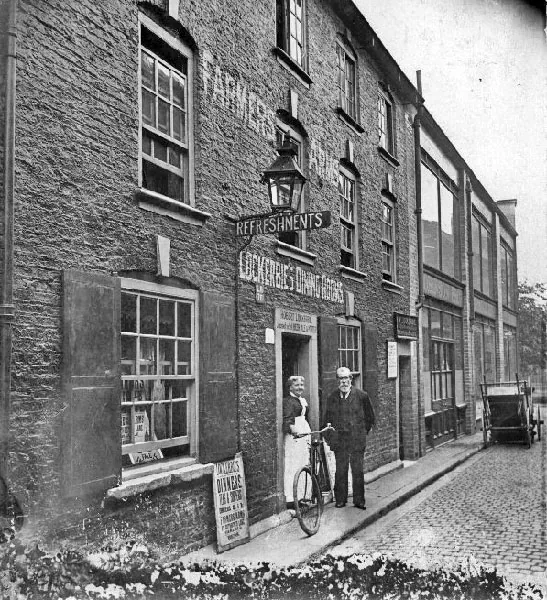
The Cumberland News of 15 February 1991 printed a photograph sent in by Mrs Gladys Trickett of London Road, whose grandfather Robert Bell kept the house from 1880 to 1901 and whose grandmother stands outside it, and a photo caption that year remembered the detail: 'Farmers Arms had a cowshed.' The column put the pub where the Casanova menswear shop and Stephen Rowe the opticians stand, but a week later Bill Boak of Lowry Hill wrote that the directories of 1880 and 1894 and the Ordnance Survey map surveyed in 1863 show it on the south side of the lane, one of five adjoining inns or taverns, directly opposite that site. Kelly's directory of 1897 bears him out, listing the south side as 5 the Shakespeare, 7 refreshment rooms and 9 the Farmers' Arms.
A 1902 photograph survives, with Robert Lockerbie named as tenant. It is in the local directories until 1902 or 1903. The column has it in use as a beerhouse until about 1905, and the licence finished in 1906, when it had not been used as a beerhouse for over a year.
Photograph
Sources 10
- Carlisle Encyclopaedia, "F" page
- Cumberland News, 15 February 1991: photo caption
- CARLISLE_PUBS_Ver_3.xls (Mike Tuer's pub database)
- The Cumberland News, 15 February 1991, p. 4: 'Lore and More' (Norman Nicholson), 'Farmers' Arms had a cowshed' (via newspapers.com)
- The Cumberland News, 22 February 1991, p. 4: 'Lore and More' (Norman Nicholson), 'Unsavoury types at old city pubs' (with Bill Boak's correction) (via newspapers.com)
- Carlisle Patriot, 22 February 1867, p. 7: 'Carlisle Town Council: the Public House Closing Act', with the innkeepers' memorial (via British Newspaper Archive)
- Carlisle Patriot, 28 August 1868, p. 7: 'Annual Brewster Sessions' (via British Newspaper Archive)
- Post Office Directory of Durham, with the principal towns of Northumberland, Cumberland and Westmorland (London: Kelly and Co., 1873), Carlisle: street directory and publicans (University of Leicester digital copy)
- Bulmer's History, Topography and Directory of East Cumberland (1884), Carlisle: hotels, inns and taverns, beerhouses, and wine and spirit merchants (University of Leicester digital copy)
- Kelly's Directory of Cumberland (London: Kelly and Co., 1897), Carlisle: street directory and public houses (University of Leicester digital copy)
Also lost on St Cuthbert's Lane
- The Robert Burns Inn
- The Duke of Wellington
- The Fish and Dolphin
- The Golden Lion
- The Town Crier
- The Lowther Arms
- The City Arms
76 other lost pubs stood within 250 m of here. See them on the map
Still serving, near where it stood
-
30 maway
-
50 maway
-
80 maway
-
110 maway