Lost pub · St Alban's Row
The Old Queens Head
- Gone
- Licence ended April 1903
- There now
- The building stands, grade II listed; in commercial use in 2018
- Address
- 12 St Albans Row
- Where exactly
- Placed from the Ordnance Survey grid reference, NY4007155985, in Historic England's gazetteer of the scheme's premises. The building's use in 2018: commercial.
At 12 St Albans Row, trading before 1785 and until 1902, when it drops out of the directories: well over a century. It was known at first simply as the Queens Head. The building survives, grade II listed and dated by Historic England's gazetteer to the early or middle eighteenth century.
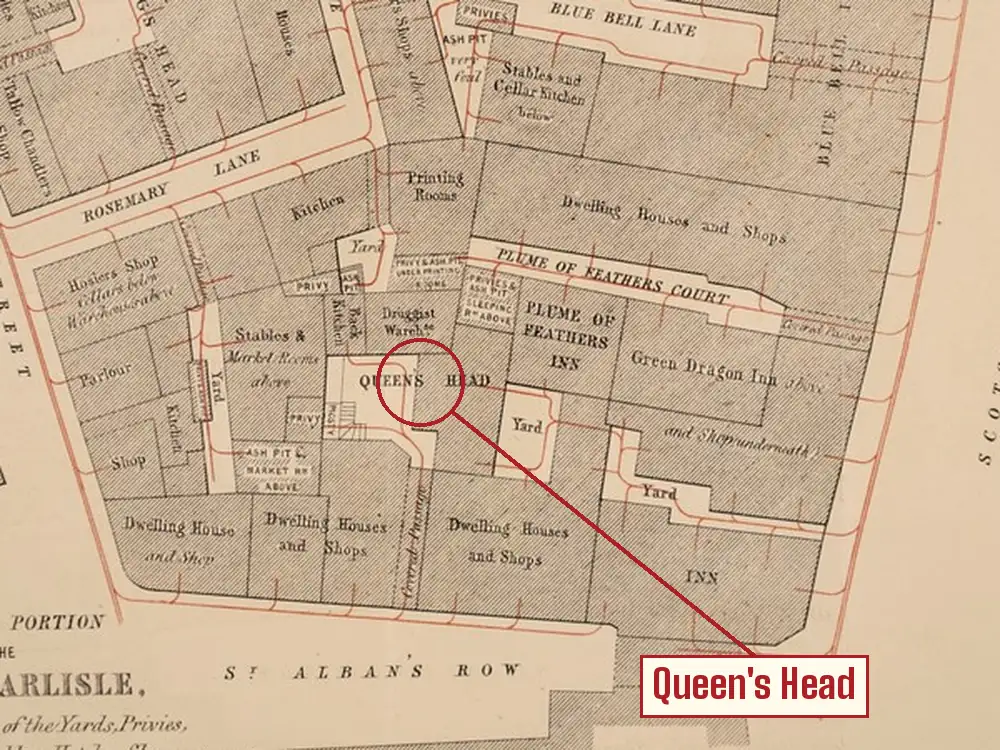
Rawlinson's plan of 1850 for the General Board of Health shows the Queen's Head in the middle of the block between Fisher Street and Scotch Street, reached from St Alban's Row by a covered passage, with stables and market rooms beside it and the Plume of Feathers next door to the east. The Cumberland News of 1 November 1991 puts it behind the Town Hall, one of the older licensed houses and one that catered for the travelling public with stables, probably throughout most of the nineteenth century. Not the Old Queens Head on Church Street in Caldewgate.
The Cumberland News of 4 February 1922 suggests it is the Queen's Head Inn whose long room hosted the first meeting of the Carlisle Choral Society on 1 June 1824. The columnist reasoned that it was the one in St Alban's Row, known as the Old Queen's Head, so described in 1829 to tell it from two other Queen's Heads, both in Caldewgate. The report he found describes a modest affair: about a hundred people, a president, R. Lowry, a leader, Mr Hill, and about seventeen other singers, some of them boys, and the first music of Handel the city had heard in seventeen years; Robert Anderson wrote verses addressed to the society after hearing it.
Mr Hill, the cathedral organist, knew the inside of a public house. The Chapter minutes of June 1817 record him fined five guineas and threatened with dismissal 'for tippling at ale-houses and frequenting the cock-pit'.
Thomas Mason kept it in June 1849, when he was fined 20s for permitting disorderly conduct in the house at one o'clock on a Monday morning, his second offence. In June 1881 the licence passed temporarily from Mr Temple to George Hall, and the transfer was made full at the brewster sessions that September. In February 1866 the licence passed from Frederick Kennedy to James Bewley, who had kept the Fish and Dolphin. Francis C. Harker kept it in 1884 and 1894, with a music licence for the hiring days in 1890, and passed it to Eleanor Parker in December 1896; Sanderson Carey had it in 1901, the last keeper before the licence ended.
The house itself came up for auction in August 1874. Mr Hardy offered it at the Coffee House on Monday the 31st, with the shop in front, Mr Lancaster's the confectioner's, and a warehouse let to Huthart and Co. The shop was copyhold under the Dean and Chapter at 5s 10d a year and the rest freehold, and the whole brought in £132 a year in rent. The only offer was £2,000, from Mr Graham, a coal agent, and it was withdrawn.
James Graham kept it in 1876. He had been fined 10s for refusing to let the police in at half past one on a Sunday morning in November 1875, and at the licensing day that September the Mayor said the fine was not heavy, but they could not let the licence go without a caution. It was renewed.
In March 1877 C. P. Hardy advertised the freehold for sale, reaching back to Rosemary Lane, with 'Mr. J. Graham as landlord of the Old Queen's Head'. That autumn James Graham 'of the Old Queen's Head, Carlisle' took the Royal Oak at Scotby, whose licence had just been refused to Joseph Ritson, and the county bench transferred it to him in October.
By about 1900 it had outlived its usefulness and fell below the accepted standard of sanitation. At the licensing sessions of August 1901 the police opposed renewal because it was in a very insanitary condition: it had only two public rooms, both dingy and badly ventilated and partly surrounded by stables of a most objectionable nature, with no proper ventilation and paved with cobbles. The justices did not renew at once but adjourned the matter to the September sessions, when they granted the licence for another year.
The 1991 column notes that it last appeared in the directories in 1902-03, so it seems to have been forced to close then. That fits: the Carlisle Journal's report of the adjourned licensing sessions of March 1903 lists it among six city licences that would cease after April that year. Historic England's gazetteer has the pub closing in 1918 instead, and found the building in commercial use in 2018.
Photograph
Sources 20
- CARLISLE_PUBS_Ver_3.xls (Mike Tuer's pub database)
- Historic England, Countering the 'deadliest of foes': public houses of the Central Control Board and the State Management Scheme, 1916-73 (Clare Howard, Research Report 89-2018): Appendix C, gazetteer of scheme premises
- The Cumberland News, 4 February 1922, p. 7: 'Odds and Ends: our casual column' (via newspapers.com)
- The Cumberland News, 4 February 1922, p. 7: 'Odds and Ends' (via newspapers.com)
- The Cumberland News, 1 November 1991, p. 4: 'Pubs of yesteryear', The Old Queen's Head Hotel (via newspapers.com)
- Carlisle Journal, 3 March 1903, p. 6: adjourned licensing sessions for Carlisle, the Cumberland Ward and Brampton (via British Newspaper Archive)
- Carlisle Express and Examiner, 11 June 1881, p. 5: 'Transfer of licences' (via British Newspaper Archive)
- Bulmer's History, Topography and Directory of East Cumberland (1884), Carlisle: hotels, inns and taverns, beerhouses, and wine and spirit merchants (University of Leicester digital copy)
- Kelly's Directory of Cumberland (London: Kelly and Co., 1894), Carlisle: street directory and public houses (University of Leicester digital copy)
- Bulmer's History, Topography and Directory of Cumberland (1901), Carlisle: trades and alphabetical directory (University of Leicester digital copy)
- Carlisle Journal, 22 June 1849, p. 2: 'Caution to publicans' (via British Newspaper Archive)
- Robert Rawlinson, Report to the General Board of Health on ... the City of Carlisle (London: HMSO, 1850), plan of a portion of the city between Fisher Street and Scotch Street (Wellcome Collection, Public Domain Mark)
- Carlisle Journal, 9 February 1866, p. 5: Petty Sessions, transfer of publicans' licences (via British Newspaper Archive)
- North Cumberland Reformer, 20 November 1890: music and dancing licences (British Library plain-text edition)
- Northern News, 12 December 1896: transfer to Eleanor Parker (British Library plain-text edition)
- Carlisle Express and Examiner, 5 September 1874, p. 4: sale of the Old Queen's Head, St Alban's Row, withdrawn (via British Newspaper Archive)
- Carlisle Express and Examiner, 9 September 1876, p. 8: 'Carlisle Brewster Sessions' (via British Newspaper Archive)
- Carlisle Journal, 23 and 30 March 1877, p. 1: extensive and valuable freehold property in Carlisle, for sale (via British Newspaper Archive)
- Carlisle Journal, 9 October 1877, p. 3: adjourned brewster sessions (via British Newspaper Archive)
- Carlisle Journal, 13 September 1881, p. 2: 'Petty Sessions: Brewster Sessions', 9 September: the Chief Constable's report, applications and transfers (via British Newspaper Archive)
Also lost on St Alban's Row
More lost pubs nearby
- The Plume of Feathers, Scotch Streetgone about 1869
- The Green Dragon, Scotch Streetgone about 1861
- The Blue Bell Hotel, Scotch Streetgone 1973
- Duncan's Hotel, Market Place
79 other lost pubs stood within 250 m of here. See them on the map
Still serving, near where it stood
-
30 maway
-
40 maway
-
70 maway
-
80 maway