Longtown, Carlisle
Graham Arms Inn
A coaching stop on the road to Edinburgh, named for the Grahams, the reiving clan that ran the Debatable Land around it.
Sold in 1973 to Kenneth Holden, of Bromley Cross near Bolton for £38,100. Who bought the rest
Longtown's main inn, with rooms and a busy bar. Open from nine for breakfast, late licence Friday and Saturday. Closed Mondays.
- Today
- See opening hours
- Address
- English Street, Longtown, Carlisle CA6 5SE
- Phone
- 01228 791213
History
Opened Late 18th century
- Dates from
- 18th century; the inn claims 17th-century origins
- Was
- A coaching stop on the Carlisle-Edinburgh road
A genuine coaching inn on the great road north. It sits on the A7, the old coaching road from Carlisle to Edinburgh, and it existed because of it: horses were put out to graze in the fields behind or rested in the stables, and once the coaches had been cleaned and serviced they were garaged in one of two coaching stables at the back before going on to Edinburgh or London. The stables are still there.
The inn is as old as the town and no older. It stands in Arthuret parish, and Longtown was laid out afresh from 1757 by Robert Graham of Netherby. In 1794 Hutchinson's History of Cumberland said of the town, 'Here is as commodious an inn as any in the north of England, built by the late Dr. Graham', almost certainly this inn and presumably the same man. Mike Tuer's records start it around 1750 as the New Inn, and Historic England describe it as late eighteenth century, Grade II, listed on 15 June 1984 as list entry 1280958. The hotel's own material claims seventeenth-century origins and several listings repeat it, but the statutory description does not support that. Around 250 years old, as CAMRA put it, is right.
The name is pure Border history. The Grahams were the dominant surname of the Debatable Land, the lawless strip around Longtown and the Esk that England and Scotland argued over for centuries, and one of the most notorious of the reiving families. So this inn carries the name of the clan that actually ran this ground, which is a good deal more pointed than the Reiver back in Carlisle. The games room is called the Reivers Tavern, so they know it.
It was not the only one. There were at least six Graham Arms across this district, all for the same family: this one; the Graham's Arms at Westlinton, now the Lyne Bank Guest House; the Graham Arms west of Gelt Bridge at Hayton, dated 1771; one at Middle Cliff in Kirklinton; one at Gretna Station in Kirkandrews-on-Esk; and a short-lived one at 23 High Cross Street in Brampton, trading from about 1831 to 1853. The other five are all in this archive.
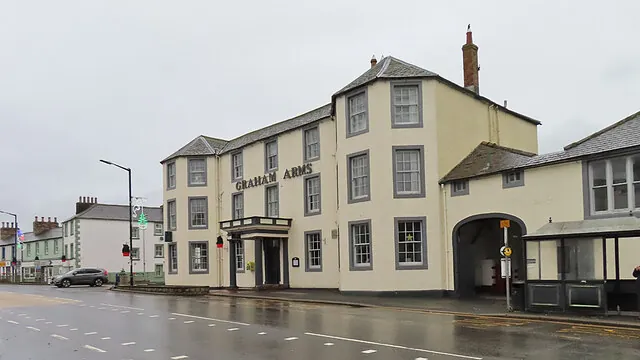
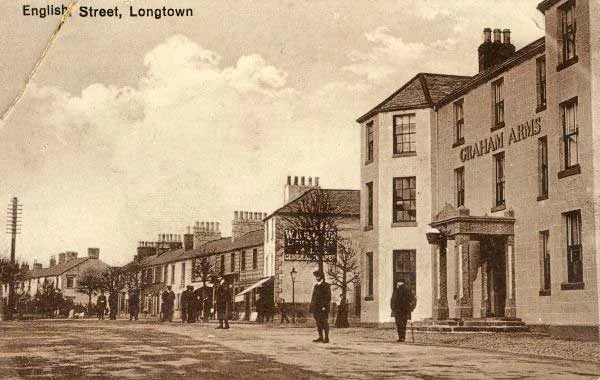
There is a picture of it from 1802, a drawing of Longtown by Harden held at Carlisle Library, which the listing notes shows the inn clearly, twenty-odd years after it went up. The building can still be read the same way: three storeys and five bays, the central three recessed with canted three-storey bays either side, painted render on a chamfered stone plinth, a lead-hipped graduated green slate roof, and double panelled doors under a glazed fanlight in a shouldered architrave inside a Doric porch. On the right is a mid nineteenth-century bar extension, two storeys and three bays, with an archway through to the L-shaped stables behind.
By 1814 it was the Grahams' Arms Inn, kept by J. Teather, who thanked 'the Nobility, Gentry, and the Public' for their encouragement and offered post horses and chaises 'served with dispatch'. In 1818 a man went to Carlisle gaol for stealing one of Teather's horses. In 1901 W. H. Mulcaster left for an inn at Wigton, and Mr Bell of the Tufton Arms, Appleby, took a long lease.
Then came the Gretna munitions works, and the inn changed character. The Board's own reports say that when it took over, the hotel was given up almost entirely to drink for the navvies who lived in and around Longtown; in 1916 it was 'practically a drinking house only'. The scheme took it in October 1916, first under the Board's Scottish control office by Historic England's gazetteer, and Longtown had seven licensed houses when the Board arrived, of which four were closed.
The Board turned its outbuildings into a coffee house, opened on Thursday 2 November 1916 by Sir Robert Allison of its local committee: no drink stronger than 'shell beer', a dining hall for sixty and a reading room, fitted out under the Board's assistant architect Basil Oliver. Allison used the day to claim the inn's past. Wordsworth, his sister Dorothy and Coleridge had lodged at the Graham Arms, he said, and perhaps Scott too. The coffee house fed the construction workers through 1916 and 1917, until the new Globe, now the Tavern, opened in the town and took on the food trade.
By 1920 the drinking bars had gone and a new smoking room had opened, and the hotel was 'chiefly frequented by fishermen and motorists'. The gazetteer has the scheme improving it again in 1928-9, and in 1961 turned the public bar and smoking room into a single lounge bar, with a new service counter and new lavatories. A directory of the district's public houses records the Graham Arms Hotel, English Street, Longtown, as sold in 1973 to Kenneth Holden for £38,100, comfortably the largest price paid for any of the six Graham Arms, which is what a fifteen-bedroom coaching hotel was worth against a village bar.
It is still a hotel: fifteen en-suite rooms including a four-poster, a spacious bar with real ale and food all day, a restaurant seating thirty-six and a function room for fifty, with Billy's Sports Bar alongside refurbished into the function space. It is popular with motorbike touring groups, with secure parking and drying facilities, and won the Best Bar None rural award for the Carlisle district in 2011 and 2012.
- Food
- Historic interior
- Hotel bar
- Open late
- Traditional
- listed
- Rooms
Photographs
Opening hours
| Mon | Closed |
| Tue | 09:00–23:00 |
| Wed | 09:00–23:00 |
| Thu | 09:00–23:00 |
| Fri | 09:00–01:00 |
| Sat | 09:00–01:00 |
| Sun | 09:00–midnight |
Hours last checked August 2026, about 2 months ago.
Hours are kept by hand and change without warning. Ring ahead if it matters.
More like this
- Food pubs in Carlisle
- Historic interior pubs in Carlisle
- Hotel bar pubs in Carlisle
- Open late pubs in Carlisle
- Rooms pubs in Carlisle
- Country pubs near Carlisle
- All pubs in Longtown
Nearest to here
-
70 maway
-
80 maway
-
4.6 kmaway
-
7.4 kmaway
Lost in Longtown
- The Bush Hotel gone 2009
- The White Swan Hotel gone 1917
- The Wheatsheaf Hotel gone 1917
- The Scotch Arms Hotel gone 1909
- The George & Dragon gone 1909
- The Marquis of Granby gone 1909
- Monkhouse's Spirit Vaults gone
7 lost pubs stood within 400 m of here. See what used to be around it
Sources
- Historic England list entry 1280958, listed 15 June 1984
- The State Management Story
- CAMRA WhatPub
- Graham Arms Inn
- Harden, drawing of Longtown, 1802, Carlisle Library
- SOLWAY_PUB_DIRECTORY_Excl_Carlisle_Ver1.xls (Solway CAMRA / Stirling's list of Cumberland public houses, 1829-1938)
- Mike Tuer, "Pubs of Carlisle" Day 196, Old Photos of Carlisle and Surrounding Area (Facebook)
- Historic England, Countering the 'deadliest of foes': public houses of the Central Control Board and the State Management Scheme, 1916-73 (Clare Howard, Research Report 89-2018): Appendix C, gazetteer of scheme premises
- The State Management Story documents: H. B. Wilson, History of the Carlisle State Management Scheme 1916-1974 (Home Office, about 1975)
- The State Management Story documents: General Manager's report to the Board for 1920 (Cmd. 1252)
- The Cumberland News, 4 November 1916, p. 5: 'Longtown's associations: Sir Robert Allison's interesting sketch; opening of a State coffee house' (via newspapers.com)
- The Cumberland News, 4 November 1916, p. 5: 'The Control Board: progress of the Carlisle scheme' (E. C. Sanders's report of 1 November) (via newspapers.com)
- Carlisle Journal, 10 September 1814, p. 2: 'Grahams' Arms Inn, Longtown', J. Teather (via British Newspaper Archive)
- Carlisle Patriot, 4 July 1818, p. 3: horse stolen from Mr Teather, of the Graham's Arms Inn (via British Newspaper Archive)
- East Cumberland News, 7 September 1901, p. 3: Longtown brewster sessions, Graham Arms transfer (via British Newspaper Archive)
- W. Hutchinson, The History of the County of Cumberland, vol. II (Carlisle: F. Jollie, 1794), p. 548: Longtown, 'as commodious an inn as any in the north of England'
- Cumbria County History Trust: Arthuret township ('Town laid out afresh from 1757 by Robert Graham of Netherby')
Know more about this one?
History, a story, a correction, or just what it was called before: Graham Arms Inn is better on this site when locals fill it in.