Lost pub · Lowther Street
The Bowling Green Hotel
- Built
- First in the local directory for 1837
- Gone
- Sold out of the scheme about 1971
- There now
- A probation and bail hostel
- Where exactly
- Placed from the Ordnance Survey grid reference, NY4022356142, in Historic England's gazetteer of the scheme's premises. The building's use in 2018: probation hostel.
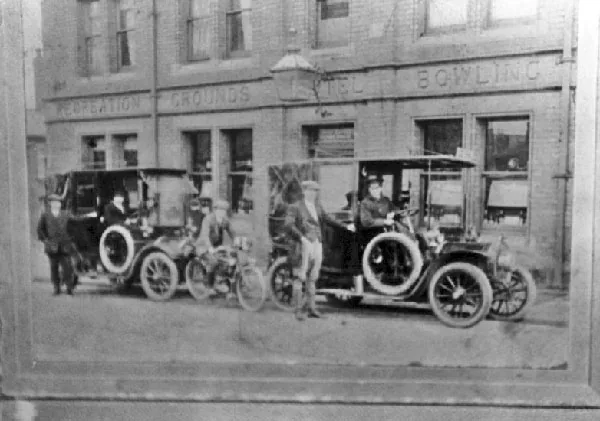
One of the first four pubs the scheme took over in July 1916, alongside the Apple Tree, the Malt Shovel and the Board Inn, and number four on its 1920 roll. It first appears in the local directory for 1837 and is believed to stand on the site of an older pub, the Shakespeare Tavern, so this address has swallowed two pubs rather than one. The Cumberland News of 21 February 1992 puts the house at the junction of Spring Gardens Lane and Lowther Street and says its name changed from the Shakespeare Tavern to the Bowling Green Inn about 1837, when John Carruthers was landlord.
The site goes back further than that. Denis Perriam, writing in Lowther Street (2022, p8), follows it to a Spring Garden House recorded as early as 1713, renamed the Shakespeare Tavern by 1803 and rebuilt as the Bowling Green Hotel in 1885. The green was said to be one of the finest in the city, sheltered by a high hedge until 1745, when the hedges were cut back so they could not shelter Highlanders attacking the city.
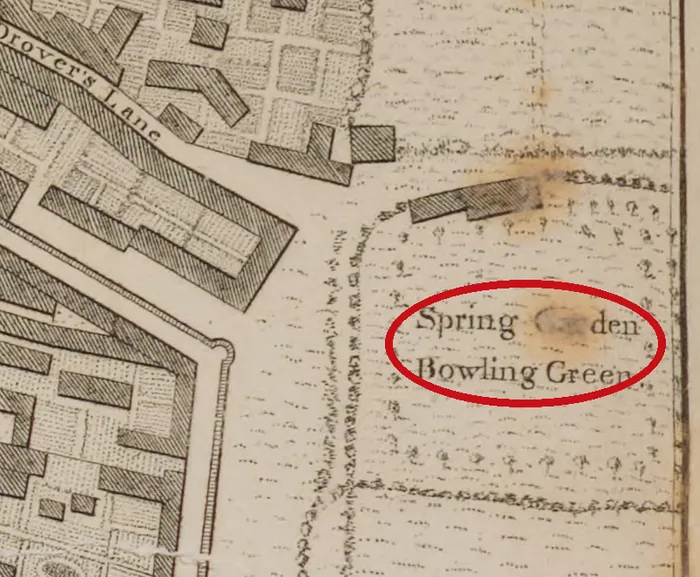
The Cumberland Pacquet of 15 December 1774 advertised it for sale as part of the Spring Gardens estate of the late John Pearson, with a garden on the east side of the house and part of the great garden beyond, which at one stage included a strawberry garden. The plan of the city in Hutchinson's History of Cumberland, printed in 1794, shows it as the Spring Garden Bowling Green, in open ground outside the city wall beyond Drovers Lane, before Lowther Street was laid out, and Jollie's Cumberland Guide of 1811 describes the bowling green and tea gardens of the Shakespeare Tavern offering the citizens 'innocent amusement and gratification'.
Mrs Carruthers of the Spring Gardens bowling green died suddenly one Friday night in August 1864: she had cleared the house at eleven, 'with her accustomed regularity', gone up to bed, and was dead within a couple of hours. G. Peascod signed the innkeepers' memorial of February 1867 for the Bowling Green. Joseph Thompson of the Bowling Green Inn was on the police black list in September 1880, and Thomas Walsh kept it in 1884.
The 1992 column prints a picture of players on the green in 1887 showing a thatched roof, and says the old house was finally demolished towards the end of the century, with council minutes of the mid-1880s granting permission for the Bowling Green Hotel. In September 1886 a transfer of the licence from John Harrison to Andrew Tait was put back three weeks because notice had not been given; Tait, a 61-year-old Scottish-born hotel keeper, is recorded running it in the 1891 census. John Currie kept it in 1906.
It also has a footnote in football history. William Blyth, known as Billy, who had played for Carlisle United, Preston and Portsmouth, ran the Bowling Green from about 1916 until his death in 1950, by his granddaughter's account, and became a director of Carlisle United. His nephew was Bill Shankly. Shankly signed for Carlisle in 1932, aged eighteen, and according to the family he lodged at the Bowling Green with his uncle for the season he played there, before Preston took him and Liverpool, much later, made him famous. The hotel was a haunt of actors from the nearby Her Majesty's Theatre, and in 1945 the Home Secretary, Herbert Morrison, who was visiting the city to look at its State Management Scheme, had a game on the green.
The state took it on 24 July 1916, and kept it for more than half a century. The green went in 1970 when the Georgian Way section of the new ring road was built, which also took nearby George Street, and in April 1971 the Evening News and Star observed drily that the pub had lost its bowling green but kept its name. The scheme sold it around 1971, or in 1972 before it went to auction by Historic England's gazetteer; the 1992 column ties the hotel's closure to the sell-off, which it dates to 1976. It opened as a probation hostel in 1974 and still serves as one, a Cumbria Probation Service hostel by the 1992 column's account. What was left of the bowling green was destroyed in a riot there in 1999.
Photograph
Sources 14
- geograph.org.uk
- Carlisle Encyclopaedia: directories, census and newspaper index
- D. Perriam, Lowther Street (2022), p8
- Karen Lewton, née Blyth, July 2018, recollection of her grandfather Billy Blyth at the Bowling Green, via the Closed Pubs project, reposted in 'Last orders at the bar - Carlisle's lost pubs' (Facebook group)
- Wikipedia: Bill Shankly (uncle William Blyth a Carlisle United director; joined Carlisle 1932 aged 18)
- Historic England, Countering the 'deadliest of foes': public houses of the Central Control Board and the State Management Scheme, 1916-73 (Clare Howard, Research Report 89-2018): Appendix C, gazetteer of scheme premises
- The Cumberland News, 21 February 1992, p. 4: 'Pubs of yesteryear', Bowling Green, Lowther Street (via newspapers.com)
- Carlisle Patriot, 22 February 1867, p. 7: 'Carlisle Town Council: the Public House Closing Act', with the innkeepers' memorial (via British Newspaper Archive)
- Carlisle Patriot, 10 September 1886, p. 3: 'Carlisle Brewster Sessions' (via British Newspaper Archive)
- Carlisle Journal, 30 August 1864, p. 2: 'Fatalities in Carlisle' (via British Newspaper Archive)
- Carlisle Express and Examiner, 11 September 1880, p. 8: Brewster Sessions, transfers and the black list (via British Newspaper Archive)
- W. Hutchinson, The History of the County of Cumberland, vol. II (Carlisle: F. Jollie, 1794), Plan of the City of Carlisle and Places Adjacent, facing p. 585: the 1794 town plan
- Bulmer's History, Topography and Directory of East Cumberland (1884), Carlisle: hotels, inns and taverns, beerhouses, and wine and spirit merchants (University of Leicester digital copy)
- Kelly's Directory of Cumberland (London: Kelly and Co., 1906), Carlisle: street directory and public houses (University of Leicester digital copy)
Open question
A date we can't pin down
When did the Bowling Green stop being a pub, and when was it rebuilt? The Cumberland News of 21 February 1992 gives the 1976 scheme sell-off and a hostel of about ten years, against about 1971 and 1974 elsewhere on this page, and shows a thatched Shakespeare in 1887 although the rebuild is dated 1885.
If you know the answer, or where it might be found (an old photograph, a family story, a document), tell us and it goes into the story above.
Also lost on Lowther Street
53 other lost pubs stood within 250 m of here. See them on the map
Still serving, near where it stood
-
90 maway
-
160 maway
-
210 maway
-
210 maway