Lost pub · Lowthians Lane
The Rose and Crown
- Gone
- Closed 1911 under the compensation scheme, reported at the licensing session in February 1912
- There now
- Still standing: No. 1 Lowthian Lane, at the back of 5-9 Bank Street, listed Grade II in 1993
- Where exactly
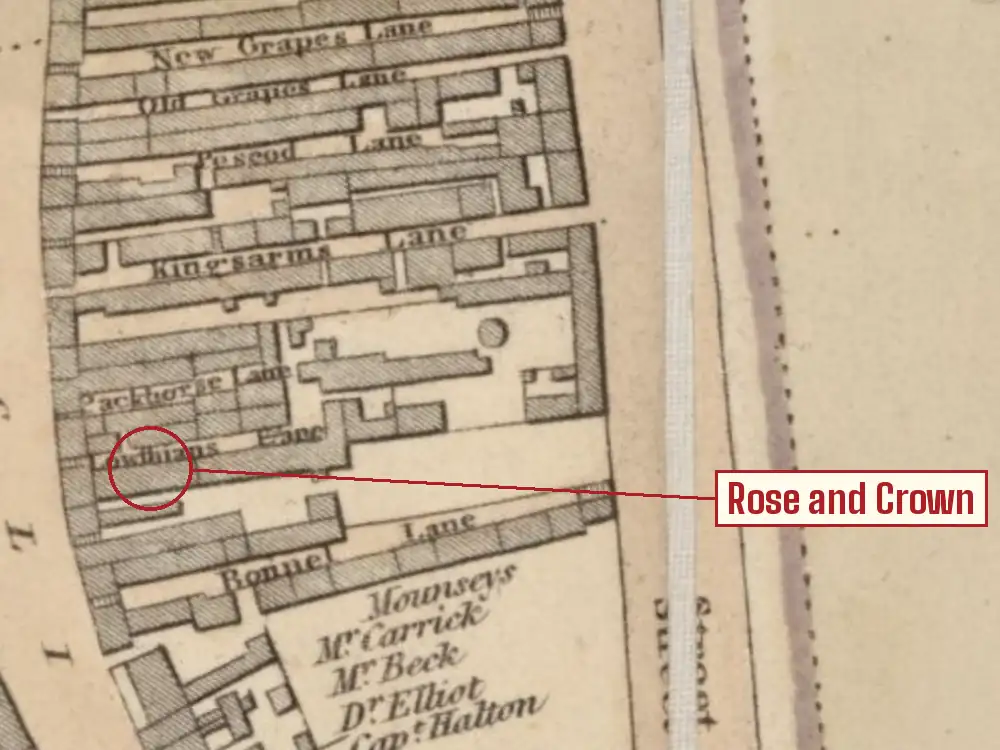
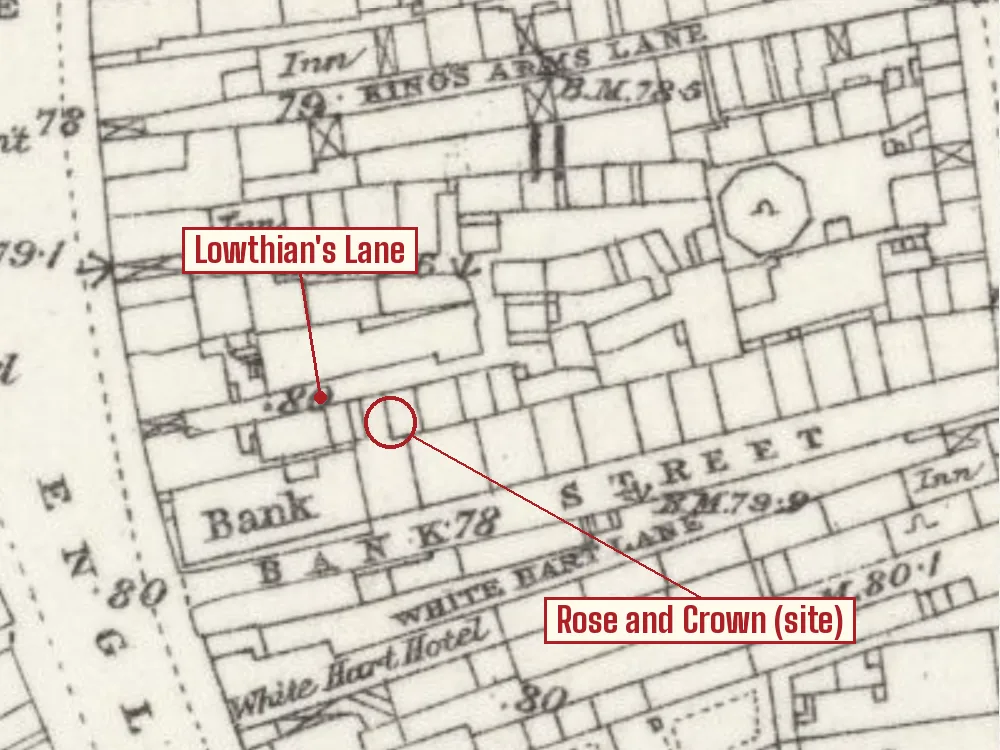
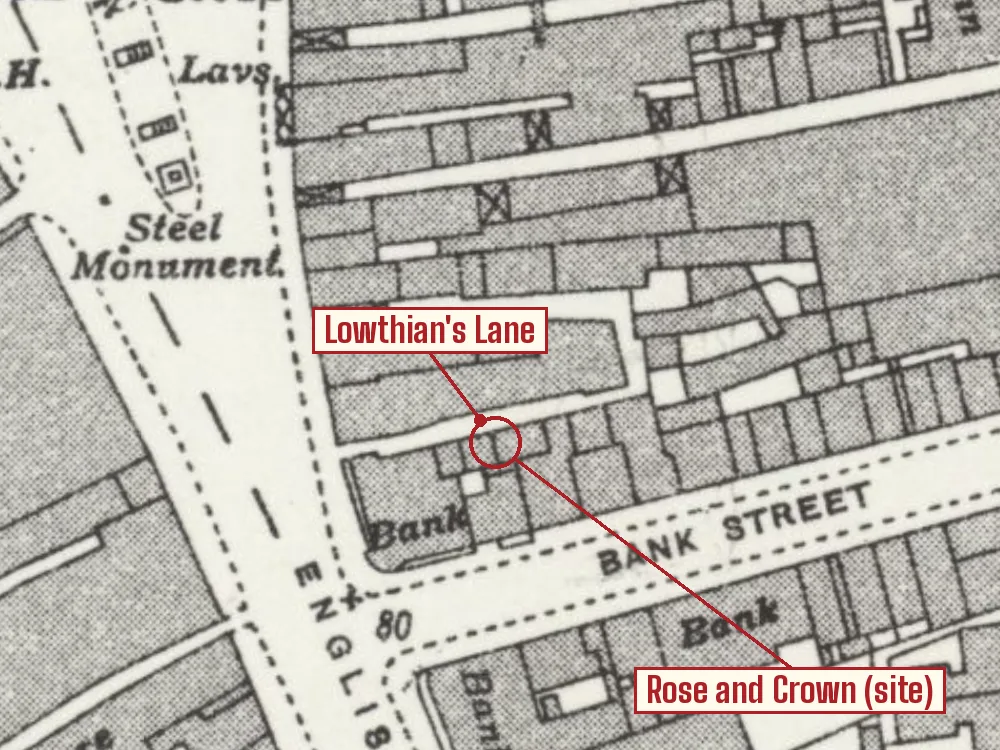
- Lowthian's Lane is the narrow lane running east off English Street just above Bank Street. The house is No. 1, at the back of 5-9 Bank Street, by its listing of 1993, and the second on the right going in, by the Cumberland News of 1992. The pin marks roughly where that is, not the building. The position is approximate.
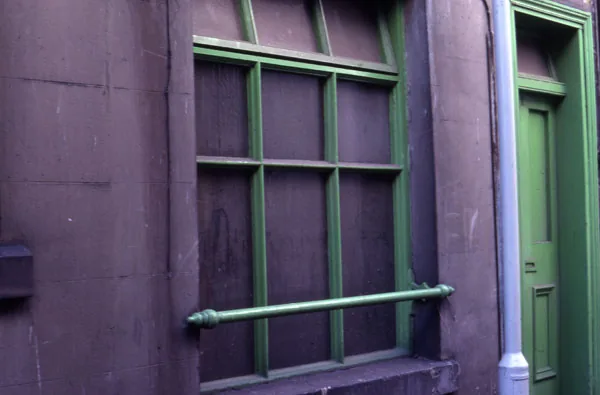
A small house in Lowthian's Lane, one of the lanes running east off English Street (on John Wood's plan of 1821, the next lane south of Packhorse Lane), and one of the longest-lived pubs in that part of the city: trading before 1800 and still trading in 1911, when it was closed and its owners compensated. It had four rooms on two storeys, a cellar and a back yard, and a brass bar outside a window, where customers, no doubt farmers in their market-day boots among them, could lean and buy a drink from the lane without going in. The holes where the bar was fixed could still be seen in 1992, and the bar itself is in Tullie House Museum.
John Armstrong kept it in 1828-29. He died at West Walls in May 1835, aged 66, 'formerly keeper of the Rose and Crown public-house, Lowthian's Lane, English-street'. Robert Dodds followed, and stayed 'for many years', by the notice of his death in October 1859 at 68. In May 1842 a young man 'of a gentleman-like appearance' breakfasted at Dodds's, said he was off the coach, and got Dodds to introduce him to Mr Milburn of the Lion and Lamb, who hired him a horse for the day 'to go to Wigton'. He sent his bag on to Newcastle, turned back at the Raffles toll bar, rode to Hexham and took the train. Milburn followed and found the horse sold to a Newcastle dealer, who gave it up when he saw the handbills.
John Norman had the house in 1847. His infant daughter Mary died there in October 1849, and in March 1850 he advertised that he had 're-entered' the premises after a spell away, thanking his friends for 'the very liberal encouragement he has had in Business'. By 1853 it was kept by a widow, Isabella Morley, who that October married William Gordon of Haltwhistle at St Cuthbert's. The Carlisle Tailors' Society held its supper 'at Mr. William Gordon's, Rose and Crown' in January 1854, and presented a silver case to its secretary.
In the spring of 1858 Gordon moved to the Cumberland Hotel on Botchergate, the predecessor of the Cumberland Inn, and Margaret Workman took the house 'lately occupied by Mr. Gordon', offering 'Comfortable BEDS and REFRESHMENTS of First Quality'. In June she was summoned for having seven men in on a Sunday morning at half-past eleven, making a great disturbance; she said they were not drinking but disputing over Bell's Life, the sporting paper, and the charge was dismissed. That summer she married John Bell, who took over the licence.
Its neighbours tried to close it at the brewster sessions that August. Alexander Davidson of the City and District Bank and Hudson Scott, a bookseller, complained of late singing, a Sabbath-morning disturbance and 'women screeching and men swearing', in a house that had been well conducted until the last twelve months. Bell's solicitor, told the singing went on as late as eleven, answered: 'Why, that's the time singing generally begins.' When he suggested one objector was a teetotaller, the other replied, 'But I am not a teetotaller,' to laughter.
The bench was divided and put the case off for a fortnight. At the adjourned sessions Scott objected to 'the class of men' who came, working men, many of them married, spending their earnings there, and Davidson said the singing was not so bad, 'if it was not for the thumping on the tables which follows the songs'. 'I suppose that's the encore,' said the Mayor, to laughter. The Chief Constable had had no complaints since the last sitting, and the licence was renewed, with a warning that the next complaint would cost it.
Bell left early in 1860 for the Crown in King's Arms Lane, the house later called the Kings Arms, advertising 'that old-established PUBLIC HOUSE' to let. Joseph Cowan came in that February and was trying to let it again by July. By the summer Robert and Agnes Rickerby had it, and in November Robert gave public notice that he would not be answerable for any debts his wife contracted.
It was at the Rickerbys' that Jane Davidson of the King of Prussia in Penrith stayed for a week in August 1860, on one of the visits she made to Carlisle to see her son-in-law, William Horsley, a young draper's assistant at Hyslop's whose wife and child had died. Her letters to him, read at the inquest, named the house as their meeting place: 'You must meat me to-morrow at the rose and crown and wich is first thare has to wate.' In April 1861 he was found strangled at the Pack Horse in Water Street, which she had taken at Candlemas, and she died of arsenic the same day. The coroner's jury found her guilty of his wilful murder and of self-murder.
Agnes Rickerby, by then at the Liddesdale in Peascod's Lane, swore that the two had never been at the Rose and Crown together. 'I don't believe you are telling the truth,' said the coroner, and threatened her with a prosecution for perjury. 'Well, do, sir,' she answered. A juror gave up: 'It is no use asking her questions.'
In the autumn of 1861 Corporal Wills of the Second Life Guards was recruiting from the house, for single young men of six feet and under twenty-five. A John Wills, perhaps the same man, had the licence by 1866. In October that year he was fined 5s after a constable found two men hiding in the parlour on a Sunday morning and, in another room, two drunken men and a prostitute, who Wills said had only come to ask about her husband; he protested against the fine 'in the most vehement manner'. He signed the innkeepers' memorial of February 1867.
In July 1871 the freehold was auctioned, with Richard Carruthers its yearly tenant at £26: four rooms, cellaring and a back yard, licensed for spirits and ale, where 'a successful trade has been carried on continuously for many years'. Carruthers died at the inn in April 1872, aged 48, and the licence passed to his widow, Jane. John Reay had it by 1880, a landlord with money: he bought Bleaberry Hall at Belle Vue that year, bid against the solicitors for the White Swan on English Street in 1882, and by 1884 also kept the Elephant Vaults on Botchergate, the later Midland Railway Tavern.
Its last owner was Thomas George Routledge Nanson, spirit merchant of Nanson's Vaults in West Tower Street and councillor for Rickergate, who also bought the Globe at Caldew Bridge and 'improved all these properties to suit the changed conditions of the trade'. His trustees said in 1910 that he bought it in 1866, which sits awkwardly with the auction of 1871. He put in managers. In 1890 his barman, William McGeary, watched a man walk off with three grain sacks a Longtown dealer had left in his charge ('I'll speak the truth, I took them'), and in December 1894 the barman Robert Dixon took three counterfeit sixpences in an evening from a couple living in Pack Horse Lane.
Nanson died of consumption in January 1897, and the licence went to his manager, Archibald Moffat, and that December to John Hodgson of Liverpool; a John Hodgson was still behind the bar in 1908. The directories kept Nanson's name on it to 1910. By then the licensee was Mrs Edith Young, whose husband ran the house for her and her brothers, very probably Nanson's children.
In July 1910 it came before the county's Compensation Authority, the most important case on the list. It had sold 346½ barrels of beer in 1907, 271 in 1908 and 289 in 1909, about 1,000 dozen bottles of ale and stout a year, 345 gallons of spirits and 67 of wine, and takings averaged £24 10s a week. Without its licence, as a two-storey house, it would have let for about £15 a year. The trustees claimed £2,355. The committee offered £900, and their counsel answered: 'We do not accept it.' The figure went to the Inland Revenue to settle.
The house closed in 1911: at the licensing sessions of February 1912 the Chief Constable, George Hill, reported that the Rose and Crown, under the Compensation Committee's consideration at the time of his last report, had closed during the year. The Cumberland News of 15 May 1992 put it as the second property down Lowthian's Lane on the right-hand side, a few yards off English Street, and thought it had gone as below the standard expected and surplus to the city's needs. It is not the Rose and Crown on Irishgate Brow, a short-lived house of the 1850s.
The building survives. In December 1993 it was listed at Grade II with the Bank Street terrace it backs onto, as No. 1 Lowthian Lane, 'the former early C19 Rose and Crown Inn': lower than the terrace, two storeys and two bays, cement rendered, with its door on the right and a shop window on the left, where the brass bar was fixed. The listing gives 1916 for its closing, against the 1911 of the licensing reports, and dates the building to the early nineteenth century, though the house was licensed before 1800, so it may have been rebuilt.
Photograph
Sources 47
- Carlisle Encyclopaedia, "R2" page
- CARLISLE_PUBS_Ver_3.xls (Mike Tuer's pub database)
- The Cumberland News, 15 May 1992, p. 4: 'Pubs of yesteryear', Rose and Crown, Lowthian's Lane (via newspapers.com)
- Carlisle Patriot, 4 September 1858, p. 8: 'Brewster Sessions for the Borough of Carlisle' (via British Newspaper Archive)
- Carlisle Patriot, 22 February 1867, p. 7: 'Carlisle Town Council: the Public House Closing Act', with the innkeepers' memorial (via British Newspaper Archive)
- Pigot & Co.'s National Commercial Directory (1828-29), p. 71: Rose & Crown, Lowthian's lane, John Armstrong (University of Leicester digital copy)
- Carlisle Journal, 30 May 1835, p. 3: death of John Armstrong, formerly of the Rose and Crown, Lowthian's Lane (via British Newspaper Archive)
- Carlisle Patriot, 7 May 1842, p. 2: 'Horse stealing. Caution', at Mr R. Dodd's, the Rose and Crown, Lowthian's Lane (via British Newspaper Archive)
- Mannix & Whellan, History, Gazetteer and Directory of Cumberland (1847), p. 169: Rose & Crown, Lowthian lane, John Norman (University of Leicester digital copy)
- Carlisle Journal, 5 October 1849, p. 3: death of Mary, infant daughter of John Norman, at the Rose and Crown inn (via British Newspaper Archive)
- Carlisle Journal, 22 March 1850, p. 2, and Carlisle Patriot, 23 March 1850, p. 1: John Norman has re-entered the Rose and Crown (via British Newspaper Archive)
- Carlisle Journal, 14 October 1853, p. 5: marriage of William Gordon and Mrs Isabella Morley, of the Rose and Crown Inn (via British Newspaper Archive)
- Carlisle Journal, 6 January 1854, p. 5: Carlisle Tailors' Society at Mr William Gordon's, Rose and Crown (via British Newspaper Archive)
- Carlisle Examiner, 13, 20 and 23 March 1858, p. 2: Margaret Workman has entered the Rose and Crown, English Street (via British Newspaper Archive)
- Carlisle Patriot, 3 and 24 April 1858, p. 4: William Gordon removed from the Rose and Crown to the Cumberland Hotel (via British Newspaper Archive)
- Carlisle Examiner, 8 June 1858, p. 3: Margaret Workman, Rose and Crown, Sunday company (via British Newspaper Archive)
- Carlisle Examiner, 12 August 1858, p. 1: John Bell has entered the Rose and Crown Inn, Lowthian's Lane (via British Newspaper Archive)
- Carlisle Journal, 31 August 1858, p. 4: brewster sessions (via British Newspaper Archive)
- Carlisle Examiner, 14 September 1858, p. 2, and Carlisle Patriot, 18 September 1858, p. 3: adjourned brewster sessions (via British Newspaper Archive)
- Post Office Directory of Cumberland (1858), p. 206: Rose & Crown, Lowthian's lane, Mrs M. Workman (University of Leicester digital copy)
- Carlisle Journal, 25 October 1859, p. 4: death of Robert Dodds, for many years landlord of the Rose and Crown (via British Newspaper Archive)
- Carlisle Journal, 31 January 1860, p. 1, and 7 February 1860, p. 1: the Rose and Crown to let; John Bell to the Crown, King's Arms Lane; Joseph Cowan has entered (via British Newspaper Archive)
- Carlisle Examiner, 10 July 1860, p. 1, and Carlisle Journal, 20 July 1860, p. 1: the Rose and Crown Inn, English Street, to let (via British Newspaper Archive)
- Carlisle Journal, 30 November 1860, p. 4: notice by Robert Rickerby, of the Rose and Crown Inn, Lowthian's Lane (via British Newspaper Archive)
- Carlisle Examiner, 23 April 1861, p. 3, Carlisle Journal, 26 April 1861, p. 5, and 3 May 1861, p. 5, and Carlisle Patriot, 4 May 1861, p. 4: the inquest on William Horsley and Jane Davidson (via British Newspaper Archive)
- Carlisle Journal, 6 September 1861, p. 4, and 8 November 1861, p. 4: recruits for the Second Life Guards, apply to Corporal Wills, Rose and Crown (via British Newspaper Archive)
- Carlisle Patriot, 23 October 1866, p. 3: 'Disorderly house', John Wills, of the Rose and Crown (via British Newspaper Archive)
- Carlisle Patriot, 28 July 1871, p. 1: sale of the Rose and Crown, Lowthian's Lane (via British Newspaper Archive)
- Carlisle Patriot, 12 April 1872, p. 5: death of Richard Carruthers at the Rose and Crown Inn (via British Newspaper Archive)
- Carlisle Patriot, 31 May 1872, p. 3: licence transfers, the Rose and Crown to Jane Carruthers (via British Newspaper Archive)
- Post Office Directory of Durham, Northumberland, Cumberland and Westmorland (1873), p. 205: Rose & Crown, 4 Lowthian's lane, Mrs Jane Carruthers (University of Leicester digital copy)
- Carlisle Express and Examiner, 9 October 1880, p. 5: sale of Bleaberry Hall to Mr Reay, Rose and Crown Inn (via British Newspaper Archive)
- Carlisle Journal, 29 September 1882, p. 5: sale of the White Swan Inn and the Raffles Fields (via British Newspaper Archive)
- Bulmer's History, Topography and Directory of East Cumberland (1884), pp. 228-229: Rose and Crown, Lowthian's lane, and Elephant Vaults, John Reay (University of Leicester digital copy)
- North Cumberland Reformer, 18 July 1890, p. 6: 'Stealing grain sacks' from the Rose and Crown Inn, Lowthian's Lane (via British Newspaper Archive)
- Carlisle Journal, 29 September 1891, p. 1: lost scarf pin, W. McGeary, Rose and Crown Inn (via British Newspaper Archive)
- Carlisle Patriot, 4 January 1895, p. 3, and 15 February 1895, p. 5: 'Bad money', Robert Dixon, barman at the Rose and Crown Inn (via British Newspaper Archive)
- Kelly's Directory of Cumberland (1894, 1897, 1906, 1910): Rose & Crown, Lowthian's lane, Thomas George Routledge Nanson (University of Leicester digital copies)
- Carlisle Patriot, 29 January 1897, p. 5: death of T. G. R. Nanson (via British Newspaper Archive)
- Carlisle Patriot, 5 March 1897, p. 2: transfers of licences (via British Newspaper Archive)
- Carlisle Journal, 21 December 1897, p. 4: transfer of licence, Archibald Moffat to John Hodgson (via British Newspaper Archive)
- Carlisle Journal, 22 January 1909, p. 6: Assizes, John Hodgson, barman at the Rose and Crown Inn (via British Newspaper Archive)
- Carlisle Journal, 29 July 1910, p. 6: Cumberland Licensing Committee, compensation, the Rose and Crown, Carlisle (via British Newspaper Archive)
- Historic England, list entry 1208743: Nos 5-51 Bank Street, including No. 1 Lowthian Lane (listed 22 December 1993)
- Ordnance Survey 25-inch map, Cumberland XXIII.3, surveyed 1865 and revised 1937-38 (National Library of Scotland)
- John Wood, Plan of the City of Carlisle from actual survey, 1821, engraved by Robert Walker (National Library of Scotland, EME.b.4.26)
- John Wood, Plan of the City of Carlisle from actual survey, 1821, engraved by Robert Walker (National Library of Scotland)
77 other lost pubs stood within 250 m of here. See them on the map
Still serving, near where it stood
-
80 maway
-
90 maway
-
90 maway
-
90 maway