Lost pub · Annetwell Street
The Hound and Otter
- Built
- In local directories from 1850; marked on the 1865 Ordnance Survey map
- Gone
- Licence refused 7 September 1891; appeal dismissed October 1891
- There now
- A provision shop by 1895; the spot is now by Tullie House, at the edge of Castle Way
- Address
- 23 Annetwell Street
- Where exactly
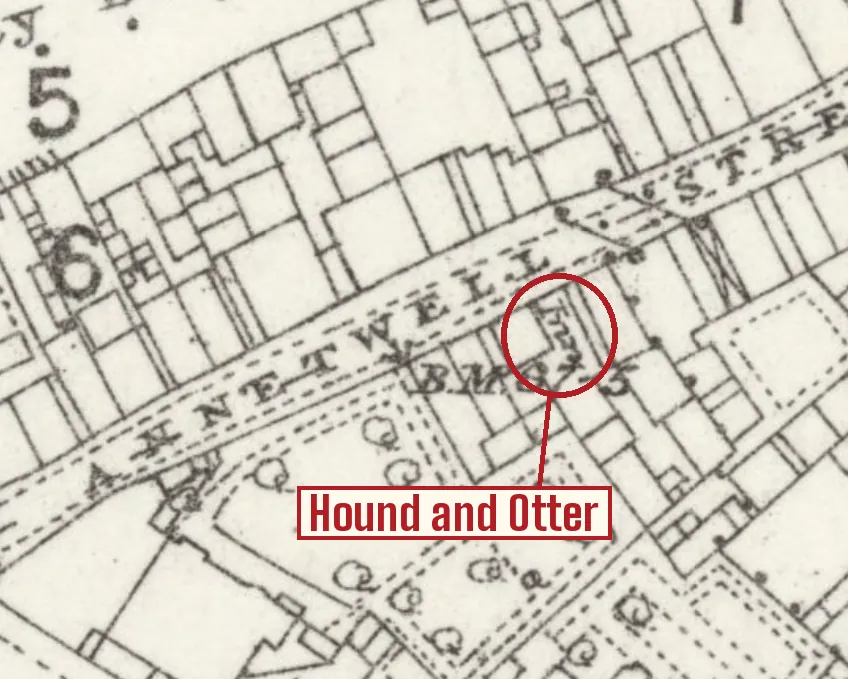
- On the south side of Annetwell Street, beside the Hound and Otter Lane that led back to Annet Square, where the Ordnance Survey's 25-inch map surveyed in 1865 marks it 'Inn'. The pin is placed by lining that map up with today's, by Tullie House on the edge of Castle Way; the building has gone, so the position is approximate.
At 23 Annetwell Street, on the south side, beside the Hound and Otter Lane that ran back to Annet Square, and for forty years the place in Carlisle where wrestlers and runners lodged, trained and left their stake money. It began as a beerhouse and took its first full licence in 1840. It is in the local directories from 1850 to 1884, though one record has it trading from 1837 to 1891, and it is marked on the 1865 Ordnance Survey map.
Richard Park had it by 1848, when a licence suspended for irregularities was granted back to him. Under Park it was a sporting house. When Thomas Craig of Newcastle came to race William Hind of Carlisle over 440 yards for £30 at the Todhills in December 1851, before about two thousand people, he 'took up his quarters at Mr. Richard Park's, Hound and Otter inn' and was trained there by the well-known Bob Sterling; the next spring Sutton of Kenton and Riley of Newcastle trained there too, while the Carlisle men used the Golden Quoit and the Rose and Castle.
In 1863 Thomas Davidson of Castleside left the stakes for a £25 wrestling match 'at Mr. Richard Park's, Hound and Otter, Annetwell Street'. It was also the last stop of the night: in a sheep-stealing trial of 1857 Park told the court that the accused had come in about eleven 'fresh in drink' and left at twelve 'so drunk that he could hardly carry himself'. In 1864 a thief had Park change a £5 note stolen at Penrith hiring. Park went to bed one Sunday night that August without complaint and was found dead in the morning.
His widow, Elizabeth, kept it on. In May 1865 she was fined £1 for allowing dancing without leave and harbouring prostitutes; there were no prostitutes, she told the bench, 'they were all married women, and the fiddler was a blind man "looking" for a living'. She signed the innkeepers' memorial against the Public House Closing Act in 1867, was fined 5s that August for having a company drinking in church time, and in May 1868 handed the licence to Jim Scott. She died at Silloth in 1886, aged 80, still 'relict of Richard Park, late of the Hound and Otter Inn'.
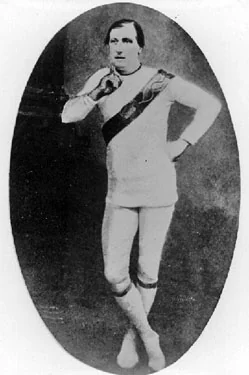
Scott was the champion eleven-stone wrestler of the north, 'a wrestler of considerable celebrity, who has retired upon his laurels'. He had won the eleven-stone prize at Whitehaven ten years running, from 1857 to 1866, 'a feat unprecedented in the annals of wrestling', and as landlord he put up the prize money for wrestling and foot-racing in the Castle Field every Easter: in 1871 the 130-yard handicap drew 78 runners, and the September sports 'a large and somewhat unruly company'. He died at the inn in March 1873, and his funeral was perhaps the largest the Cemetery had ever seen: four or five thousand in the procession, headed by the Oddfellows, as many again lining the streets, and the coffin carried from the gates by champions of the day, Davidson of Castleside among them.
Mrs Scott carried on. When the inn, a shop, a bakehouse and nine tenements behind were auctioned at the Victoria Hotel in March 1880 she bid £900 for it, and was outbid; Owen Hancock of Annetwell Street was declared the purchaser at £1,200. In 1881 it was let by tender, and the licence went from Emily Scott to Joseph Turnbull, who held it while a new tenant was found. A death notice of 1885 calls a daughter of the house 'the late Alexander Scott, Hound and Otter Inn', which does not fit Jim Scott and is not explained.
In 1884 the licence went from George Hall to Joseph Walsh, and in March 1885 the freehold was sold again, under an order of the Court of Chancery in the estate of a William Sewell, deceased, with Walsh in occupation and a rental for the whole block of £80 14s 4d. The buyer was John Smith, who paid over £1,000, let the inn to Walsh at £35 a year and owned the ten tenements in the lane. Walsh's father-in-law, Owen Hancock, lived with them.
Under the Walshs it was a working men's house. A tramp spent a stolen florin there in 1885; when a chimney brick blew down on a passing pork butcher in 1889 he was carried in, and 'Mr. and Mrs. Walsh did their utmost' until the doctor came; that August a Liverpool innkeeper with £15 in gold stood the house drinks and was robbed on the Castle Bank on his way out. The police were sure it sold drink on Sunday mornings, and for a year sent plain-clothes men to watch it almost every week.
At the Brewster Sessions of 7 September 1891 the Chief Constable and the Carlisle Temperance Federation both objected. The constables told of Owen Hancock appearing at ten one Sunday morning with a glass of rum and inviting one of them into the kitchen with 'Come on, old particular'; of a woman on the stairs who said she had been at the free breakfast in Peter Street (laughter); of a convicted thief, Henry McNeil, who lived up the yard and stood at the end of the lane signalling when the police came; and of men going over the seven-foot wall from Annet Square, where a city surveyor found footholds worn in both sides and the glass worn off the top.
For Walsh, Mr McKeever said there had been two convictions in fifty years; the house sold table beer to the neighbourhood and invalid stout to the married quarters of the barracks, it was the only licensed house left on the south side of the street, and 'working men could not go to the County Hotel and pay 6d or 1s a glass'. The bench refused the licence unanimously.
Walsh appealed to the county Quarter Sessions in October. Neighbours from the lane swore they had never seen Sunday drinking or anyone climb the wall, and the owner said sergeants from the Castle used the house. Against them Ellen Crane of Rayson's Court said she had seen Hancock with a pint in each hand one Sunday morning, and that he would not serve her whisky. Asked what she wanted whisky for, she said: 'When you get as old as me you will perhaps want two-pennorth and all,' and, told she could go and get it now, 'I will get three-pennyworth now.' The magistrates were divided, but the appeal was dismissed, with costs.
Of the four city licences refused that September, only the Railway Tavern won its appeal. The Carlisle Journal noted that the Hound and Otter had had seven tenants since 1840, which is exactly the run above, and that some twenty licensed houses round about had gone since the north side of Annetwell Street was pulled down, among them the Cordwainers' Arms, Cunningham's Vaults, Ivison's Vaults, the Black Swan and the Rose and Castle. By 1895 it was a provision shop. Emily Scott was on the police black list in September 1880.
Photograph
Sources 42
- Carlisle Encyclopaedia, "H" page
- CARLISLE_PUBS_Ver_3.xls (Mike Tuer's pub database)
- Carlisle Journal, 22 September 1848, p. 2: 'Licensing' (via British Newspaper Archive)
- Carlisle Journal, 26 December 1851, p. 3: 'More foot racing: Hind and Craig' (via British Newspaper Archive)
- Carlisle Journal, 6 February 1852, p. 2: 'Foot racing' (via British Newspaper Archive)
- Carlisle Patriot, 28 November 1857, p. 6: sheep-stealing case, evidence of Richard Park (via British Newspaper Archive)
- Carlisle Journal, 21 August 1863, p. 8: 'Wrestling challenge' (via British Newspaper Archive)
- Carlisle Journal, 1 July 1864, p. 6: Cumberland Midsummer Sessions (via British Newspaper Archive)
- Carlisle Journal, 30 August 1864, p. 2: 'Fatalities in Carlisle' (via British Newspaper Archive)
- Carlisle Journal, 9 May 1865, p. 4: 'Harbouring prostitutes' (via British Newspaper Archive)
- Carlisle Patriot, 22 February 1867, p. 7: 'The Public House Closing Act', with the innkeepers' memorial (via British Newspaper Archive)
- Carlisle Examiner, 20 August 1867, p. 3: Elizabeth Park fined (via British Newspaper Archive)
- Carlisle Patriot, 29 May 1868, p. 5: 'Transfer of public-house licences in Carlisle' (via British Newspaper Archive)
- Carlisle Patriot, 2 April 1869, p. 6: 'Sports in Carlisle' (via British Newspaper Archive)
- Carlisle Patriot, 14 April 1871, p. 3: 'Wrestling, &c., in Carlisle' (via British Newspaper Archive)
- Carlisle Patriot, 8 September 1871, p. 6: 'Sports in Carlisle' (via British Newspaper Archive)
- Carlisle Express and Examiner, 5 April 1873, p. 5: 'A wrestler's funeral' (via British Newspaper Archive)
- Carlisle Express and Examiner, 6 March 1880, p. 8: 'Public house and cottages in Carlisle' (via British Newspaper Archive)
- Carlisle Journal, 1 April 1881, p. 8: 'Public house in Annetwell Street, Carlisle, to let' (via British Newspaper Archive)
- Carlisle Express and Examiner, 11 June 1881, p. 5: 'Transfer of licences' (via British Newspaper Archive)
- Carlisle Express and Examiner, 8 October 1881, p. 5: 'Licence transfers' (via British Newspaper Archive)
- Carlisle Express and Examiner, 31 May 1884, p. 5: 'Licence transfers' (via British Newspaper Archive)
- Carlisle Express and Examiner, 6 September 1884, p. 5: 'City Brewster Sessions' (via British Newspaper Archive)
- Carlisle Patriot, 6 March 1885, p. 1: Chancery sale of the Hound and Otter Inn (via British Newspaper Archive)
- Carlisle Journal, 5 June 1885, p. 3: deaths, Sarah Scott (via British Newspaper Archive)
- Carlisle Patriot, 18 September 1885, p. 2: 'Theft from an old woman' (via British Newspaper Archive)
- Wigton Advertiser, 17 July 1886, p. 5: deaths, Elizabeth Park (via British Newspaper Archive)
- Carlisle Patriot, 22 March 1889, p. 5: 'Serious accident in Carlisle' (via British Newspaper Archive)
- Carlisle Express and Examiner, 23 March 1889, p. 8: 'Hurt by a falling brick' (via British Newspaper Archive)
- Carlisle Patriot, 18 October 1889, p. 9: 'A word of caution' (via British Newspaper Archive)
- Carlisle Express and Examiner, 5 September 1891, p. 4: 'Opposition to innkeepers' licences in Carlisle' (via British Newspaper Archive)
- Carlisle Journal, 8 September 1891, p. 2: Carlisle Brewster Sessions (via British Newspaper Archive)
- North Cumberland Reformer, 10 September 1891, p. 8: Carlisle Brewster Sessions, 'The Hound and Otter: how the police were defeated' (via British Newspaper Archive)
- Carlisle Express and Examiner, 12 September 1891, p. 6: 'Brewster Sessions: four licences withdrawn in Carlisle' (via British Newspaper Archive)
- North Cumberland Reformer, 17 September 1891, p. 6: 'Notice of appeal' (via British Newspaper Archive)
- Carlisle Journal, 29 September 1891, p. 3: 'The refused licences in Carlisle: the appeals' (via British Newspaper Archive)
- North Cumberland Reformer, 22 October 1891, p. 6: Cumberland Quarter Sessions, licensing appeal cases (via British Newspaper Archive)
- Carlisle Journal, 23 October 1891, p. 4: the disestablishment of the Hound and Otter (via British Newspaper Archive)
- West Cumberland Times, 24 October 1891, p. 3: 'Licensing appeal: another licence refused' (via British Newspaper Archive)
- North Cumberland Reformer, 31 December 1891, p. 6: 'Temperance progress' (via British Newspaper Archive)
- North Cumberland Reformer, 16 February 1895, p. 6: temperance meeting, Carlisle (via British Newspaper Archive)
- Carlisle Express and Examiner, 11 September 1880, p. 8: Brewster Sessions, transfers and the black list (via British Newspaper Archive)
Open question
An unsolved mystery
Who was 'the late Alexander Scott, Hound and Otter Inn', named in his daughter's death notice of 1885? The landlord from 1868 until his death in 1873 was the wrestler James, Jim, Scott, and the licence then passed to Emily Scott. And did Owen Hancock's purchase at the 1880 auction ever go through, given that the freehold was sold again in 1885 under a Chancery order?
If you know the answer, or where it might be found (an old photograph, a family story, a document), tell us and it goes into the story above.
Also lost on Annetwell Street
32 other lost pubs stood within 250 m of here. See them on the map
Still serving, near where it stood
-
130 maway
-
150 maway
-
190 maway
-
200 maway