Lost pub · Annetwell Street
Irish Gate Tavern
- Built
- Opened October 1917
- Gone
- Closed 18 April 1971; demolished 1972-73 for Castle Way
- There now
- Castle Way
- Where exactly
- Placed from the Ordnance Survey grid reference, NY3966856072, in Historic England's gazetteer of the scheme's premises. The building has since been demolished.
The scheme's 'super pub', created by knocking down the wall between the Saracen's Head and the Black Bull Vaults, at the junction of Annetwell Street and Irishgate Brow. It took its name from the ground it stood on, the site of the medieval Irish Gate, the city's western gateway, which was pulled down in 1811. The Cumberland News column of 4 October 1991 describes it as in effect a facelift of the Saracen's Head and an adjoining pub or hotel whose name the writer did not know. It says the two original houses had a reputation for being not quite desirable, with trouble caused by a clientele 'rough in type'.
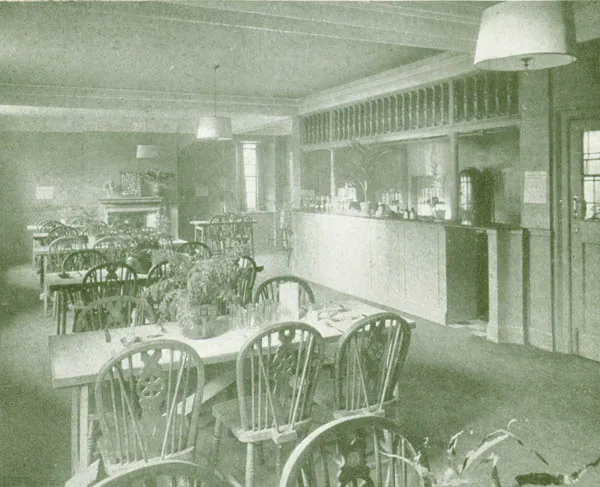
The Cumberland News of 13 October 1917 puts the opening on 1 October. It was meant for workers, railwaymen and butchers, and Mr Lewis, formerly butler at Holm Hill, ran it with his wife. It opened as a food tavern, with a separate dining room and a billiard room, and food could be bought there to take away. The general features of the Saracen's Head were still recognisable, but the ground floor frontage changed, and one feature was lost: the red glass barrel that hung above the front entrance, lit at night by gas, which had given the corner its nickname, the Blazing Barrel. The 1991 column puts the barrel on the Saracen's Head; a News and Star photograph caption of 1952 put it on the Black Bull.
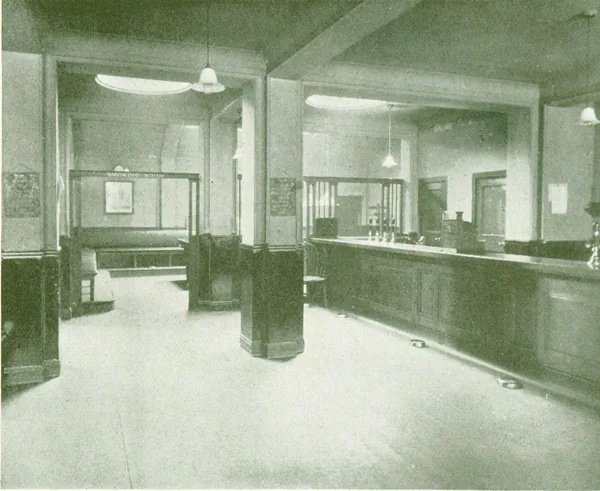
Inside, most of the old partitions came out to make one big room, with a glass screen at one part for a women's department. On entering there were two bays, one on either side of the doorway, then the bar, with a billiard table at one end and the women's department. A small adjoining dining room was well used by people from the houses in the courts and alleys around it. There was also an off-sales food department selling cooked food in pennyworths, with an entrance separate from the bar, and most of its customers were apparently children.
It worked. Reviewing 1917, the scheme's general manager, E. C. Sanders, reported that the Irish Gate had 'proved exceedingly popular' and that the room for people wanting a meal was already too small. No meal in the scheme's food taverns cost more than 1s 3d, under the Food Controller's rules. The Irish Gate was one of four Carlisle houses, with the London, the Pheasant and the Goliath, that sold cooked food to take away, and between them they were making more than 800 sales a day. Children whose parents were out at work could get hot soup, stews and puddings there at midday and tea time for a small sum, and buy them without ever coming into contact with anyone drinking.
It was one of Redfern's first jobs for the scheme, and nobody thanked him for it. Writing in 1951, the scheme's superintendent remembered 'the first efforts of Mr Redfern at places like the Irishgate Tavern and the Albion', for which 'we certainly never received any credit and we did receive a lot of adverse criticism'. The lesson learned was that 'men and women will not sit in smoking rooms on plain wooden seats'. The 1991 column also quotes Wilson Stuart's report on Drink Nationalisation in England and its Results (1927), which found plenty of drunken men on Carlisle's streets in the years just after the war, and says the Cumberland News of August 1920 reported a rise in drinking in the city, among women and young people in particular.
The scheme's friends saw it differently. One Saturday night in the autumn of 1926, A. F. Harvey of the Temperance Legislation League walked Caldewgate and English Street with another investigator to watch what happened at closing time. At the Irish Gate Tavern, 'in a very poor quarter of the city', he found 'some excitement', but nobody who could be described as drunk. He was answering a Mr Hardie, who wanted the pubs back in private hands, with 119 licences in the city instead of the 65 there were then, and the snugs and back doors along with them.
The Second World War brought a new crowd. In May 1942 a 23-year-old steel erector from Londonderry, one of the young Irishmen in Carlisle on public work, came in very drunk, was refused, and broke the glass of a show case in the tavern, cutting his forearm; the police collected him from the Infirmary. The damage came to 3s 6d. Chief Inspector Walker told the magistrates that this sort of thing was happening practically every weekend, and Mrs Isa Graham, in the chair, fined him £3 and said the bench was determined to put a stop to 'this rowdyism'.
Joseph Curran died at the tavern on 20 April 1946. His death notice gives no job, but it was his and his wife Madge's home, so they were very probably its managers. By 1958 the name had stood on the corner long enough to be taken for an old one: a reader recalling the city's inns of fifty years before, around 1908, took his circuit down Annetwell Street to 'drift with the tide through the Irish Gate Tavern, the Saracen's Head', nine years before there was any such tavern. For that date he very probably meant the Black Bull.
Near the end, in February 1971, a barmaid was fined £12 for serving two girls of 15 and 16, who had been drinking in the tavern for three hours and were both drunk. Her solicitor said they had told her they were over 18, and had been whisked away into a corner by some boys.
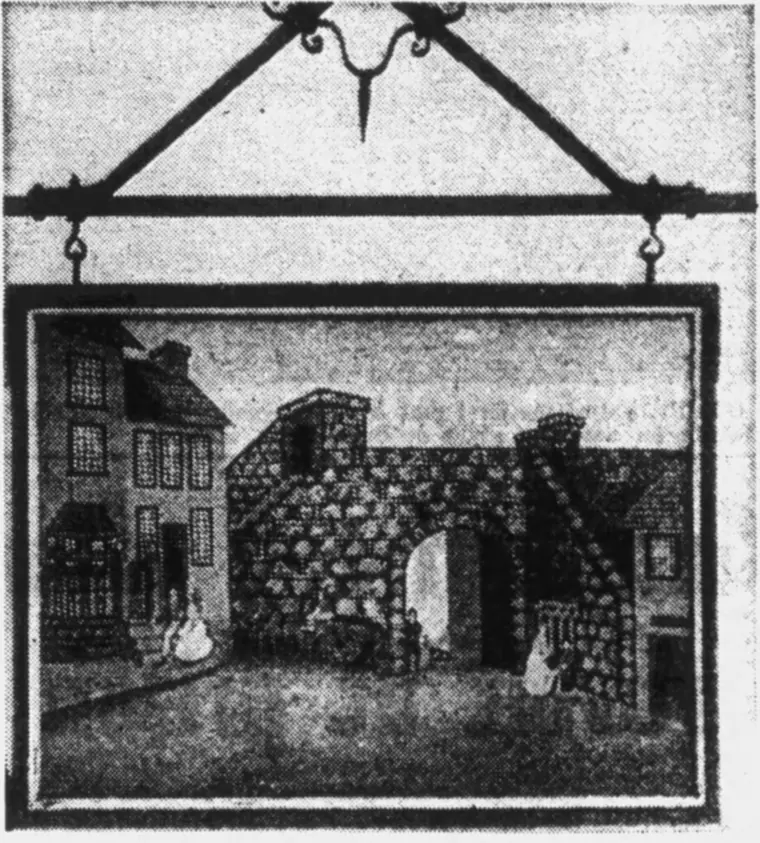
Time was called on the night of Sunday 18 April 1971, and on the Monday the Evening News and Star reported that it had 'served its last pint at the weekend'. Its sign, hanging from a wrought-iron bracket outside, was a painting of the Irish Gate itself, and the city museum's curator, Robert Hogg, hoped it would now be given to the museum. It was: the Cumberland News reported on 19 May 1972 that it had been rescued for Tullie House's collection, and it was still there in 2018, one of only three of the scheme's pub signs the museum holds.
The tavern was demolished with the entire north side of Annetwell Street in 1972 and 1973 for the city's new inner ring road past the Castle, so there's no trace of any of the three houses. The ground gave up one last thing. In 1996 the demolition contractor Gerry Cole, whose firm did most of the city's demolition work, remembered finding a treasure trove of coins from the 1800s, florins and half-crowns, while working at the Irish Gate Tavern. 'We couldn't keep the coins, unfortunately.' The 1991 column's photograph of the tavern is from the Templeton Collection.
Photograph
Sources 15
- Geograph: photograph 5440768
- Historic England, Countering the 'deadliest of foes': public houses of the Central Control Board and the State Management Scheme, 1916-73 (Clare Howard, Research Report 89-2018): Appendix C, gazetteer of scheme premises
- Historic England, Countering the 'deadliest of foes': public houses of the Central Control Board and the State Management Scheme, 1916-73 (Clare Howard, Research Report 89-2018)
- The Cumberland News, 13 October 1917, p. 5: 'Control Board's restaurant scheme complete' (via newspapers.com)
- The Cumberland News, 4 October 1991, p. 4: 'Pubs of yesteryear', Irishgate Tavern (via newspapers.com)
- Historic England, 'City Walls and Tile Tower, Carlisle, Cumbria' (the Irish Gate demolished in 1811)
- The Cumberland News, 2 March 1918, p. 5: 'Control in Carlisle: past year's work reviewed' (E. C. Sanders's report for 1917) (via newspapers.com)
- The Cumberland News, 30 October 1926, p. 9: A. F. Harvey's letter, 'State management of the liquor trade' (via newspapers.com)
- News and Star, 18 May 1942, p. 2: 'Week-end disturbances by Irishmen' (via newspapers.com)
- The Cumberland News, 27 April 1946, p. 1: death notice, Joseph Curran (via newspapers.com)
- News and Star, 23 June 1952, p. 3: photograph caption, 'The Blazing Barrel' (via newspapers.com)
- News and Star, 9 August 1958, p. 5: S. Keiling's letter, 'Carlisle inns of 50 years ago recalled' (via newspapers.com)
- News and Star, 9 February 1971, p. 5: 'Carlisle barmaid fined £12' (via newspapers.com)
- News and Star, 19 April 1971, p. 7: 'Inn closes, but sign may be museum piece' (via newspapers.com)
- The Cumberland News, 27 December 1996, p. 3: Victoria Brenan on Gerry Cole and the city's tunnels (via newspapers.com)
Open question
An unsolved mystery
Who ran it between Mr and Mrs Lewis, its first managers in 1917, and its closing in 1971? Joseph and Madge Curran were very probably there until his death in April 1946; no other manager is known.
If you know the answer, or where it might be found (an old photograph, a family story, a document), tell us and it goes into the story above.
Also lost on Annetwell Street
27 other lost pubs stood within 250 m of here. See them on the map
Still serving, near where it stood
-
200 maway
-
210 maway
-
260 maway
-
260 maway