Lost pub · Fisher Street
The Half Moon Inn
- Gone
- Demolished 1887
- There now
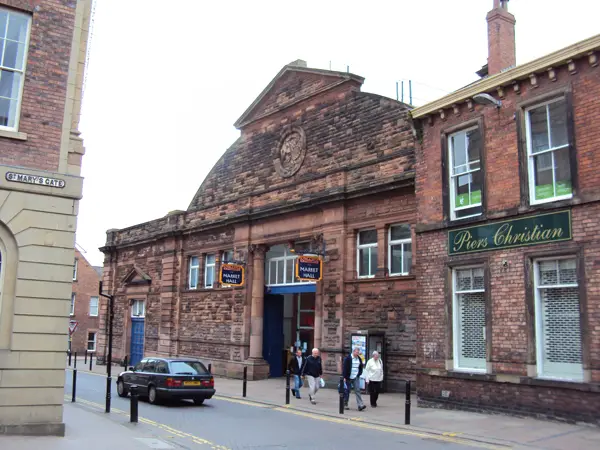
- The Covered Market
- Address
- 15 Fisher Street
- Where exactly
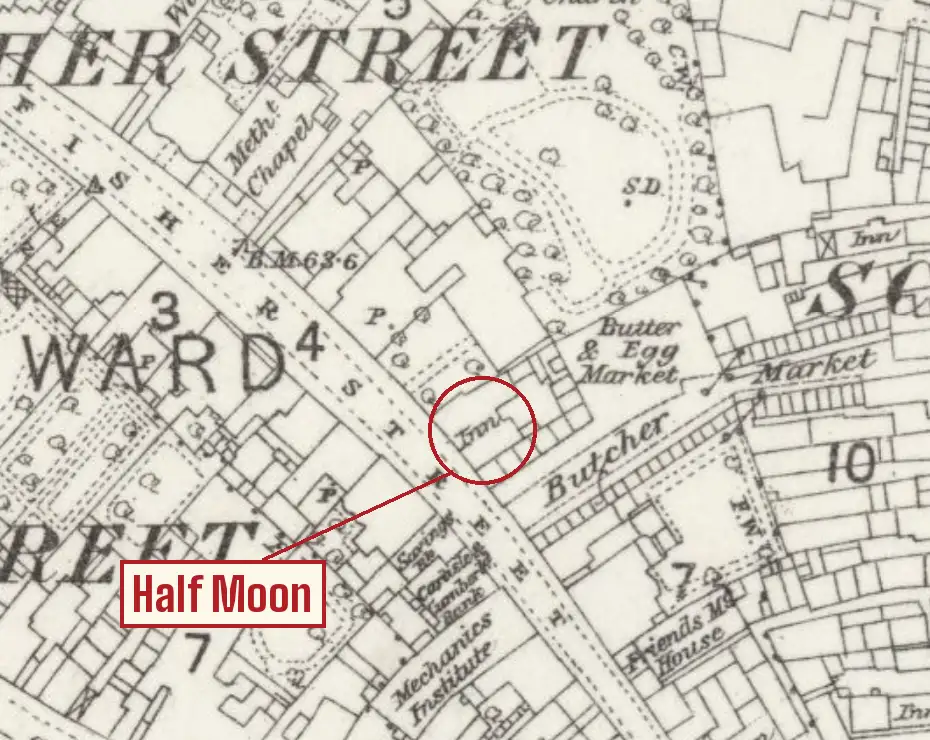
- On the east side of Fisher Street at the end of the Butcher Market, where the Ordnance Survey's 25-inch map surveyed in 1865 marks an 'Inn'; newspapers of 1843 and 1864 place the Half Moon 'adjoining' the shambles and the Butcher Market. The pin is placed by lining that map up with today's, under the Fisher Street end of the Covered Market; the building has gone, so the position is approximate.
The Half Moon stood at 15 Fisher Street, on the east side, 'adjoining the Butcher Shambles', and was trading by 1785. For a century it was the market's pub, kept for a while by a butcher, and from about 1850 it belonged to the town, which had bought it for a market scheme and in the end pulled it down for one. Its corner is under the Fisher Street end of the Covered Market.
William Cail was an innkeeper in Fisher Street in Jollie's directory of 1811, very probably here, and Mrs Cail had it in 1818, when the new tenant of Scugger Houses, a 152-acre farm in St Cuthbert's parish, was declared at her house on 2 January 1819. Joseph Hall was there by 1824 and Mary Hall by 1829, when Parson and White's directory names her as keeper. Thomas Blaylock, a butcher, had it in 1834, when closes near Scotby were auctioned there; his widow Grace died in Rickergate in 1850, aged 56, 'formerly of the Half Moon Inn'.
On the afternoon of 29 May 1830 James Nicholson, who had the contract for digging the foundations of the new buildings opposite the Bush, went with his foreman Kelley to the Half Moon, where the six or seven men came to be paid. They had some ale, and Nicholson went on to Kelley's lodgings in Jollie's Buildings for whiskey. There Isabella Brocklebank sat down beside him on the bed, and his pocket-book went. He found it on her, but not the half-sovereign, which he saw between her teeth. The lodging-house keeper gave her a character as 'a most chaste, honest, and virtuous young lady'; the jury took a very short time, and she got twelve months' hard labour.
In April 1843 'that well-known and well-accustomed public house' was advertised to let, with John Graham as tenant. Thomas Douglas had it in 1846, when the creditors of John Sharp, a Fisher Street wine and spirit merchant, met there to settle his affairs, and William Threlkeld in 1851, when he was taking enquiries for a whipthong maker wanted in Toronto.
By then the Corporation owned it. A councillor in 1861 recalled the caution once urged over 'the purchase of the Half Moon property for the purpose of carrying out the market scheme', and in 1860 the gas committee handed over £1,000 of gas profits to pay off a mortgage on it, which a letter-writer complained came out of the gas consumers' pockets. In May 1854 the council resolved to let it at £50 a year with the front shop fitted up as a spirit bar, and in 1856 it ordered a kitchen range for the tenant, Mrs Grey.
Elizabeth Grey of the Half Moon married G. Glaister, a Caldewgate tailor, by special licence at St Mary's in June 1858, and by 1862 he was the tenant. That spring the council argued at length over whether to paint and paper 'its own property', and offered him paper at cost to hang himself. Glaister wrote that it only covered five rooms and that unless the house was papered and painted he would give notice. The Health Committee gave way and put the Half Moon in with the Town Hall, the Butcher Market and its other pub, the Malt Shovel, and Thomas Watson painted the lot for £58 2s.
In March 1861 Robert Aimes, about twenty, sent by his master, a Rickergate Brow spirit merchant, to hire a horse, was let one from Mr Sawyer the druggist's stable that was known to be dangerous. Near the Half Moon it reared for the third time and threw him, and his head hit the pub's doorstep, or the pavement by the other paper's account. He was carried inside insensible, and two surgeons saw him there before he was taken home in a cab. In October 1863 the inquest on James Ratcliffe, a youth fatally injured on the railway at Port Carlisle, was held at the Half Moon. Mrs Stephenson had it in 1864, and in 1867 the tenant told the Board that the kitchen needed improvements which were 'indispensable'.
Frederick Kennedy kept it from about 1868 to 1876, and called it the Half Moon Hotel. In March 1868 he was fined 10s for a company drinking at twenty to two in the morning; the men, he said, had got in 'by knocking at the door like a policeman'. During the races of July 1870 a man was found in one of his bedrooms while two of his companions drank in the bar, and charged with being there for an unlawful purpose. In 1871 the council laid a sewer to the urinals behind the inn 'to remedy a nuisance', and on Hospital Sunday 1873 over a hundred members of the Independent United Order of Mechanics met at the Half Moon and walked to Christ Church.
Henry Pearce took the licence in May 1876, and auctions were still held there; in 1878 a Belle Vue house with a four-loom weaving shop went for £252. In 1881 Pearce was in the county court over a dog. He had bought it in June and had it seven weeks when Haswell, a Bank Street tailor, picked it up in the Butter Market as one he had lost; the next day it came to Pearce when he called it in the street. The judge told Pearce he had bought it at his own risk, and he had to pay the £3 or give the dog up. In January 1885 four Border Regiment recruits knocked down Isaac Parker of Linstock under a gas lamp 'below the Half Moon Inn' and took his watch, which turned up in the ticking of a spare bed in the Castle. They got twelve months' hard labour.
By then the market scheme had come round to it. The surveyor's plan of 1885 brought a new street out onto Fisher Street 'between the Town Clerk's offices and the Half Moon Inn', and in the design competition of 1886 the second-placed architect, Mr Oliver, was proudest of his handling of 'the corner at Fisher Street, upon the site of the Half Moon Inn'. In 1887 the rent from the Half Moon, the Butcher Market and the Butter Market came to £582 a year, and they were handed to the town's sanitary authority so the new market could be its own.
When the foundation stone was laid in December 1887 the Patriot listed the Half Moon, with Mushroom Hall, the Town Clerk's house, and the Captain Cook in Scotch Street, among the Corporation property that 'has been, or is about to be demolished'; one record gives 1890. When the market opened in 1889 the paper reckoned that, counting the site and the buildings pulled down for it, it had cost over £50,000. The Covered Market still stands on Fisher Street, and the Half Moon is one of the few lost pubs on the street whose site you can walk straight to and know exactly what replaced it.
Photograph
Sources 41
- Carlisle Patriot, 23 December 1887, p. 6: 'Carlisle new markets: laying the foundation stone' (via British Newspaper Archive)
- Carlisle Encyclopaedia, "H" page
- CARLISLE_PUBS_Ver_3.xls (Mike Tuer's pub database)
- Carlisle Patriot, 25 September 1891, p. 6: 'Public houses in Carlisle sixty years ago', reprinting the 1829 Parson and White directory list (via British Newspaper Archive)
- Carlisle Patriot, 12 December 1818, p. 2: Scugger Houses farm to let, tenant to be declared at Mrs Cail's, the Half Moon (via British Newspaper Archive)
- Carlisle Patriot, 31 January 1824, p. 1: cottage at Wetheral to let, apply Joseph Hall, Half Moon (via British Newspaper Archive)
- Carlisle Patriot, 17 July 1830, p. 4: 'Pocket picking', Isabella Brocklebank (via British Newspaper Archive)
- Carlisle Journal, 4 January 1834, p. 2: closes near Scotby for sale at Thomas Blaylock's, Half Moon Inn (via British Newspaper Archive)
- Carlisle Patriot, 22 April 1843, p. 1: the Half Moon to let (via British Newspaper Archive)
- Carlisle Journal, 22 April 1843, p. 2: the Half-Moon to let (via British Newspaper Archive)
- Carlisle Patriot, 20 February 1846, p. 1: 'John Sharp's estate', creditors to meet at Thomas Douglas's, Half-Moon Inn (via British Newspaper Archive)
- Carlisle Journal, 31 May 1850, p. 3: death of Grace Blaylock (via British Newspaper Archive)
- Carlisle Journal, 18 April 1851, p. 2: 'To whipthong makers', William Threlkeld, Half Moon Inn (via British Newspaper Archive)
- Carlisle Journal, 12 May 1854, p. 8: council resolves to let the Half Moon Inn (via British Newspaper Archive)
- Carlisle Journal, 28 November 1856, p. 6: kitchen range for the Half Moon, Mrs Grey (via British Newspaper Archive)
- Carlisle Examiner and North Western Advertiser, 8 June 1858, p. 4: marriage of G. Glaister and Mrs Elizabeth Grey (via British Newspaper Archive)
- Carlisle Journal, 2 November 1860, p. 8: letter, 'Reduction of the price of gas' (via British Newspaper Archive)
- Carlisle Journal, 26 March 1861, p. 2: 'Serious accident' (via British Newspaper Archive)
- Carlisle Examiner and North Western Advertiser, 26 March 1861, p. 2: 'Serious accident' (via British Newspaper Archive)
- Carlisle Journal, 17 May 1861, p. 6: council debate on a corn exchange (via British Newspaper Archive)
- Carlisle Examiner and North Western Advertiser, 1 April 1862, p. 3: 'Painting and papering' (via British Newspaper Archive)
- Carlisle Patriot, 12 April 1862, p. 3: Health Committee tenders for painting Corporation properties (via British Newspaper Archive)
- Carlisle Journal, 29 April 1862, p. 2: 'Health Committee', letter from Mr Glaister (via British Newspaper Archive)
- Carlisle Examiner and North Western Advertiser, 3 October 1863, p. 2: inquest on James Ratcliffe (via British Newspaper Archive)
- Carlisle Journal, 3 May 1864, p. 1: shop to let, apply Mrs Stephenson, Half Moon (via British Newspaper Archive)
- Carlisle Journal, 21 May 1867, p. 3: 'Half-Moon Inn', kitchen (via British Newspaper Archive)
- Carlisle Patriot, 27 March 1868, p. 6: 'Breach of the licensing laws', F. Kennedy (via British Newspaper Archive)
- Carlisle Journal, 8 July 1870, p. 3: 'Arrest of suspicious persons' (via British Newspaper Archive)
- Carlisle Patriot, 26 May 1871, p. 5: 'Carlisle Health Committee', sewer to the urinals behind the Half Moon (via British Newspaper Archive)
- Carlisle Express and Examiner, 17 May 1873, p. 5: 'Hospital Sunday' (via British Newspaper Archive)
- Carlisle Express and Examiner, 6 May 1876, p. 8: 'Transfer of licences' (via British Newspaper Archive)
- Carlisle Journal, 31 May 1878, p. 5: 'Property sale in Carlisle' (via British Newspaper Archive)
- Carlisle Express and Examiner, 10 September 1881, p. 7: 'Claim for a dog', Haswell v. Pearce (via British Newspaper Archive)
- Carlisle Patriot, 17 April 1885, p. 6: 'Charge of highway robbery by soldiers' (via British Newspaper Archive)
- Carlisle Journal, 4 September 1885, p. 5: the covered market scheme (via British Newspaper Archive)
- Carlisle Journal, 10 December 1886, p. 5: the market designs, Mr Oliver's plan (via British Newspaper Archive)
- Carlisle Patriot, 10 December 1886, p. 9: the market designs (via British Newspaper Archive)
- Carlisle Patriot, 16 September 1887, p. 7: 'The new market' (via British Newspaper Archive)
- Carlisle Patriot, 27 September 1889, p. 7: opening of the new markets (via British Newspaper Archive)
- Ordnance Survey 25-inch map, Cumberland XXIII.3, surveyed 1865, published 1874, via the National Library of Scotland
- Jollie's Cumberland Guide & Directory (Carlisle: F. Jollie & Sons, 1811), Carlisle directory, pp. i-xxii: Cail William, innkeeper, Fisher-street (Google Books scan of the Bodleian copy)
Also lost on Fisher Street
- The Carlisle Cross Inn
- The City Vaults
- The Front Page Club
- Fisher Street Social Club
- TC's
- The Regency
- Abstrakt
- The Klondyke
- The Saddle Inn
80 other lost pubs stood within 250 m of here. See them on the map
Still serving, near where it stood
-
40 maway
-
40 maway
-
40 maway
-
50 maway