Lost pub · Bridge Street
The Waggon and Horses
- Gone
- Closed 1917; demolished 1924 for the widening of Caldew Bridge
- There now
- Demolished
- Address
- 1 Bridge Street
- Where exactly
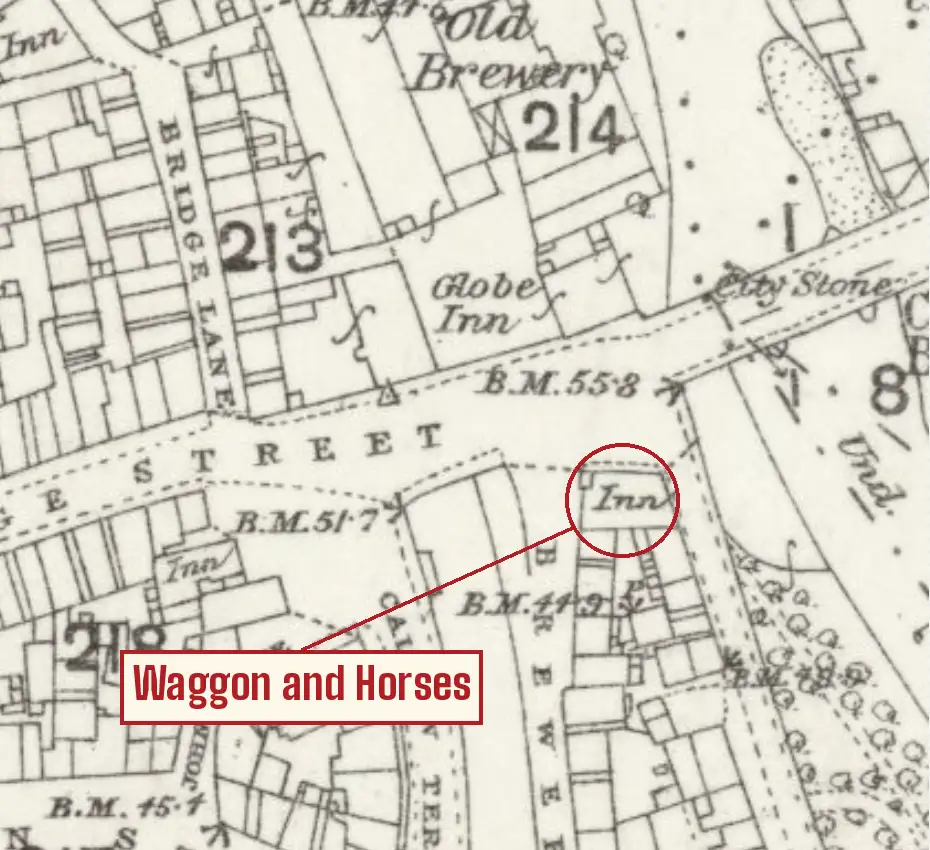
- Placed from the Ordnance Survey grid reference, NY3952556000, in Historic England's gazetteer of the scheme's premises. The building has since been demolished. The Ordnance Survey's 25-inch map surveyed in 1865 marks an 'Inn' on the south side of Bridge Street at the bridge end, east of Brewery Row and opposite the Globe, which fits number 1 and the Cumberland News's description.
At 1 Bridge Street, at Caldew Bridge. The Cumberland News of 14 June 1991 places it on the south side of the street, at the eastern end of Caldewgate and about opposite where the Globe Inn stands today, and gives the directories' first mention as 1829; other records run from 1822 to 1914. A second, unrelated Waggon and Horses stood on Botchergate, closing decades earlier in the 1850s.
In March 1848 a Caldewgate grocer named Gawthorp left the Waggon and Horses after drinking with two friends and was knocked down crossing the road by the Vicar of Thursby's phaeton, driven 'at a furious rate'; the county court gave him the full £20 he claimed. In December 1850, as the Waggon and Horses, Caldew Bridges, under Thomas Atkinson, it was where the first of Carlisle's clubs for the Great Exhibition of 1851 was formed, a fortnight before the Carlisle Journal reported it on 20 December. The 1861 census gives James Dinwoodie as innkeeper, and A. Dinwoodie signed the innkeepers' memorial of February 1867 for the 'Wagon & Horses'.
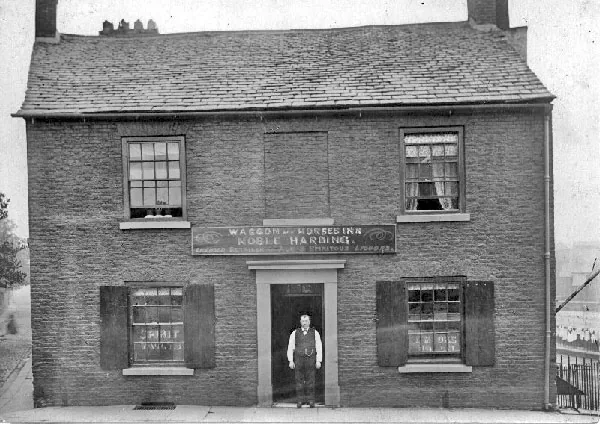
Noble Harding is first listed in the 1896 directory, and the column's photograph, taken about the turn of the century, is from his time. It had a mark against it: at the licensing sessions of September 1897 every existing licence in the city was renewed except this one, because he had been convicted during the year of permitting drunkenness, and he had to attend the adjourned sessions. By 1901 E. J. Bulman was there, a former barman at the pub who had been a railway fireman; the column adds that he took the Bricklayers Arms in Caldewgate in 1895 before becoming licensee here.
By 1916 it was a Jennings Brothers house. The State Management Scheme acquired it in August 1916, declared it surplus and closed it in 1917. The building survived for some years more, because it stood in the way of the city council's scheme to widen Caldew Bridge, and the council bought it from the scheme for about £1,000. It was pulled down in 1924 by one record; the column has the demolition about ten years after the closure, when the bridge scheme went ahead in 1926-27.
Photograph
Sources 9
- Carlisle Encyclopaedia, "W-Z" page
- CARLISLE_PUBS_Ver_3.xls (Mike Tuer's pub database)
- Historic England, Countering the 'deadliest of foes': public houses of the Central Control Board and the State Management Scheme, 1916-73 (Clare Howard, Research Report 89-2018): Appendix C, gazetteer of scheme premises
- The Cumberland News, 14 June 1991, p. 4: 'Pubs of yesteryear', Waggon and Horses, Bridge Street (via newspapers.com)
- Carlisle Patriot, 10 September 1897, p. 3: 'Licensing Sessions: City of Carlisle' (via Findmypast)
- Carlisle Journal, 20 December 1850, p. 2: 'Exhibition of 1851', Carlisle exhibition clubs (via British Newspaper Archive)
- Carlisle Patriot, 22 February 1867, p. 7: 'Carlisle Town Council: the Public House Closing Act', with the innkeepers' memorial (via British Newspaper Archive)
- Ordnance Survey 25-inch map, Cumberland XXIII.3, surveyed 1865, published 1874, via the National Library of Scotland
- Carlisle Journal, 23 June 1848, p. 3: County Court, 'Gawthorp v. Huntley, Clerk: furious driving' (via British Newspaper Archive)
Open question
A date we can't pin down
When was the Waggon and Horses on Bridge Street pulled down? The Cumberland News of 14 June 1991 says the council bought it from the scheme for about 1,000 pounds and demolished it in 1926-27, but the site has 1924, and the column's account of E. J. Bulman's career is out of order (Bricklayers Arms in 1895, then here, but 'a former barman at the pub').
If you know the answer, or where it might be found (an old photograph, a family story, a document), tell us and it goes into the story above.
Also lost on Bridge Street
24 other lost pubs stood within 250 m of here. See them on the map
Still serving, near where it stood
-
170 maway
-
290 maway
-
340 maway
-
370 maway