Lost pub · Bridge Street
The Old Anchor Inn
- Gone
- Pulled down for the Caldewgate street improvement, by May 1901
- There now
- The widened road; the building came down in 1901 to make room for it
- Address
- 39 Bridge Street
- Where exactly
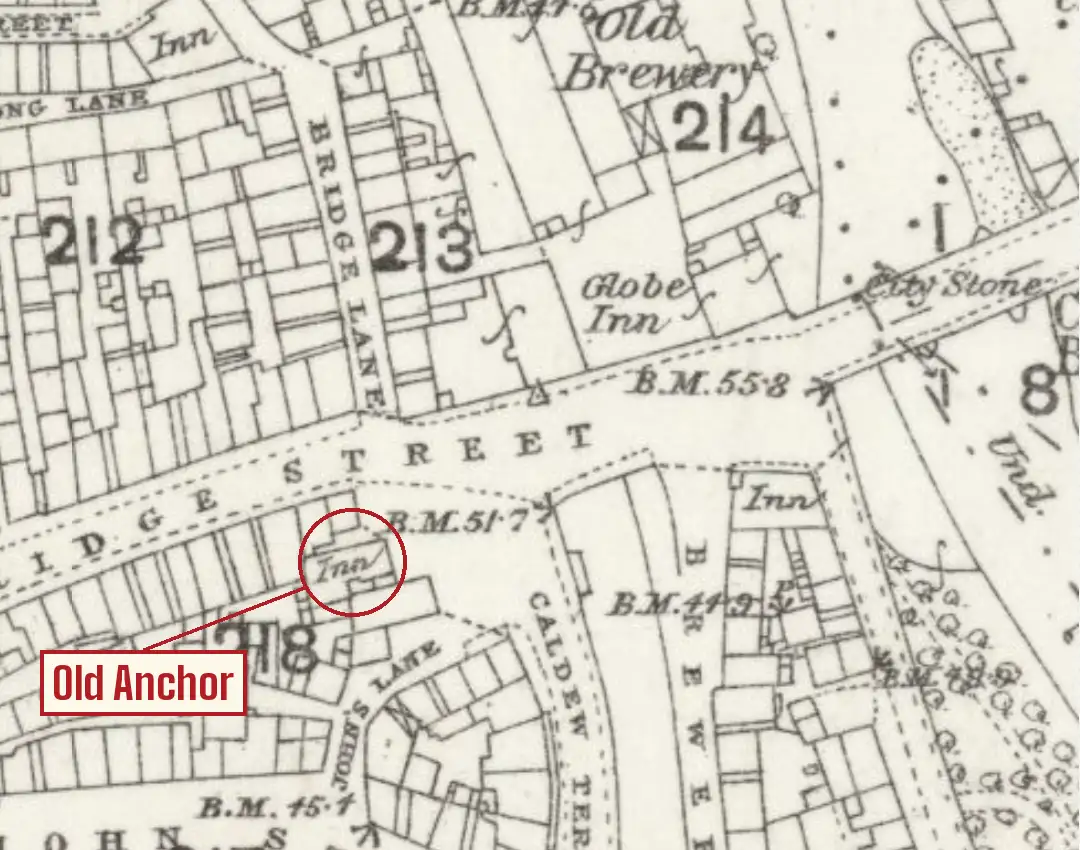
- On the south side of Bridge Street. The street was numbered odd on the south side, from the Waggon and Horses at number 1 by Caldew Bridge, and even on the north, where the Globe was number 6, so number 39 stood on the south side; the Ordnance Survey's 25-inch map surveyed in 1865 marks an 'Inn' there just west of Caldew Terrace, which is the likeliest match. The building has gone, so the position is approximate.
At 39 Bridge Street, on the road from Caldew Bridge into Caldewgate, from before 1820 until 1901, when it was pulled down for the Caldewgate street improvement. It had a large room that working men's societies used, and a long line of landlords, several of whom ended up before the bench.
Mrs Taylor kept it in 1836, when the Journal admired her crop of Italian rye grass on the Willow Holm, nearly thirty inches high and sown after potatoes; cattle, it said, ate it 'with great avidity'. T. Taylor had it by 1856, when about sixty members of the Bread Street Adult School sat down to a Christmas Eve supper there 'of a most substantial character', and in 1858 the Brewery Row Adult School and Reading Room held its social meeting and supper in the large room. It was to let in 1858, 1859 and 1862, with enquiries to Joseph Matthews of the Rickergate weighing machine.
In December 1859 the coroner sat there on James Gilbertson, killed in the Caledonian goods yard. He had jumped on a buffer while the train was moving and fallen, two waggons went over him, and he told the surgeon before he died that no one was to blame but himself. The jury found accidental death and asked the company to fit a handle or step to its waggons.
Arthur McAney had it in the 1860s, when it was a sporting house. He held rabbit coursing there at Easter 1864, and in 1866 Daniel McEwan of Bridge Street offered to match his dog Patboy, twenty-one inches high, against any dog in Cumberland of his height, the best of 21 or 31 live rabbits for £10 or £20 a side on Burgh Marsh: 'a match can be made any night by calling at Mr Arthur McAnney's'. McAney signed the innkeepers' memorial of February 1867.
Thomas McCulley had it by 1878. In March that year, in the disputed Caldewgate ward election, voters were treated in the house and one of the candidate's friends told the company to 'sup off and begin all over again'; the 3s 6d was paid, 'but it would be difficult to prove who paid it'. That winter McCulley sat on the publicans' committee for Caldewgate collecting for the city's poor. His mother Ann died at the inn in 1880, aged 85, and in 1882 the bench let a dancing master, Richard Robinson, move his class there from the Queen's Head, three nights a week from half past seven to ten, once McCulley had laid a new floor.
The Ancient Order of Foresters' Court Star of the West met in the inn's Court-room; in 1885 they gave a purse of gold to their old Chief Ranger, Thomas McKenzie, who was leaving for Australia. McCulley died at the inn on the last day of that year, aged 57, and his widow Sarah took the licence; the Foresters thanked her as hostess at their supper in 1888.
In April 1890 two constables found four drunk men in her bar, a pint in front of each, and a hawker named Watson caught hold of a glass and said 'I will have this any way'. Her daughter told the court it was his father's pint, and Mrs McCulley was fined 21s. In June the Chief Constable hoped the incoming tenant 'would conduct the house better than Mrs McCully, who had recently been convicted, and probably thought it convenient to leave the house'. She died in Milbourne Street in 1897.
The next tenant, John Smith, who worked for a draper in English Street, lasted a year: in May 1891 his furniture and bar requisites, 'including 60 good pints and gills', were sold under legal process at the City Hall. Adam Dinwoodie, late of the Spinners' Arms, followed, and in November 1891 he was fined 20s after a constable found a drunk woman with a glass of beer in the small bar. 'Yes; she is drunk, very,' said Dinwoodie. 'I did not serve her, this little girl did.' The girl was thirteen. His solicitor protested that the police let drunken people into public houses and gave them time to be served before 'making a capture'.
John H. Wilson took the licence in 1894 and was given an extra hour on Jubilee Day in 1897. He was the last landlord. By May 1901 the Old Anchor had been 'demolished by the Caldewgate improvement', and Wilson moved to the Bricklayers Arms on John Street. The Chief Constable's report for the year counted one licence fewer in the city, 'the Old Anchor Inn, Bridge Street, Caldewgate, having been pulled down for street improvement'.
Photograph
Sources 36
- CARLISLE_PUBS_Ver_3.xls (Mike Tuer's pub database)
- Carlisle Patriot, 22 February 1867, p. 7: 'Carlisle Town Council: the Public House Closing Act', with the innkeepers' memorial (via British Newspaper Archive)
- North Cumberland Reformer, 25 September 1890, p. 2: 'The Adjourned Brewster Sessions' (via British Newspaper Archive)
- North Cumberland Reformer, 8 September 1894, p. 2: Brewster Sessions, transfers (via British Newspaper Archive)
- Carlisle Journal, 30 April 1836, p. 3: 'Italian rye grass', Mrs Taylor, of the old Anchor (via British Newspaper Archive)
- Carlisle Journal, 26 December 1856, p. 5: 'Supper', Bread Street Adult School at Mr T. Taylor's Old Anchor inn (via British Newspaper Archive)
- Carlisle Examiner and North Western Advertiser, 25 May 1858, p. 1: the Old Anchor to be let (via British Newspaper Archive)
- Carlisle Examiner and North Western Advertiser, 23 October 1858, p. 2: 'Brewery Row Adult School and Reading-room' (via British Newspaper Archive)
- Carlisle Journal, 25 March 1859, p. 1: 'Public house to let', the Old Anchor (via British Newspaper Archive)
- Carlisle Journal, 6 December 1859, p. 2: 'The accident at the Caledonian goods yard' (via British Newspaper Archive)
- Carlisle Journal, 3 October 1862, p. 8: 'Public house to let', the Old Anchor (via British Newspaper Archive)
- Carlisle Journal, 18 March 1864, p. 8: 'Rabbit coursing', Arthur McAney (via British Newspaper Archive)
- Carlisle Journal, 26 January 1866, p. 8: 'Challenge', Daniel McEwan (via British Newspaper Archive)
- Carlisle Journal, 21 September 1877, p. 6: the decorations for the royal visit (via British Newspaper Archive)
- Carlisle Journal, 31 May 1878, p. 5: 'Caldewgate election petition: inquiry before the Commissioner' (via British Newspaper Archive)
- Carlisle Journal, 31 December 1878, p. 3: 'Subscriptions by brewers, publicans, &c.' (via British Newspaper Archive)
- Carlisle Express and Examiner, 14 August 1880, p. 5: death of Ann McCulley (via British Newspaper Archive)
- Carlisle Journal, 1 April 1881, p. 7: 'Sales by public auction' (via British Newspaper Archive)
- Carlisle Journal, 14 March 1882, p. 2: 'New dancing school' (via British Newspaper Archive)
- Carlisle Journal, 13 October 1885, p. 2: 'Ancient Order of Foresters' (via British Newspaper Archive)
- Carlisle Patriot, 8 January 1886, p. 5: death of Thomas McCulley (via British Newspaper Archive)
- Carlisle Patriot, 12 March 1886, p. 3: 'Carlisle Police Court: licence transfers' (via British Newspaper Archive)
- Carlisle Journal, 22 May 1888, p. 2: 'Ancient Order of Foresters', annual supper (via British Newspaper Archive)
- North Cumberland Reformer, 18 April 1890, p. 3: 'Supplying liquor to drunken men' (via British Newspaper Archive)
- North Cumberland Reformer, 13 June 1890, p. 2: 'Police news', licence transfer (via British Newspaper Archive)
- North Cumberland Reformer, 4 September 1890, p. 8: 'Transfer of licences' (via British Newspaper Archive)
- North Cumberland Reformer, 21 May 1891, p. 4: Robert Dalton's sale, the goods of Mr J. Smith, Old Anchor Inn (via British Newspaper Archive)
- Carlisle Express and Examiner, 23 May 1891, p. 8: 'Yesterday's police news' (via British Newspaper Archive)
- North Cumberland Reformer, 26 November 1891, p. 8: 'Old Anchor Inn' (via British Newspaper Archive)
- Carlisle Journal, 6 September 1892, p. 3: brewster sessions, transfers and the black list (via British Newspaper Archive)
- North Cumberland Reformer, 8 September 1894, p. 2: brewster sessions, transfers (via British Newspaper Archive)
- Carlisle Patriot, 25 June 1897, p. 9: 'The Jubilee', extensions (via British Newspaper Archive)
- Carlisle Journal, 22 October 1897, p. 3: death of Sarah McCulley (via British Newspaper Archive)
- East Cumberland News, 4 May 1901, p. 5: 'Carlisle Police Court', temporary transfer of the Bricklayers' Arms (via British Newspaper Archive)
- Carlisle Journal, 14 February 1902, p. 7: the Chief Constable's annual report (via British Newspaper Archive)
- Ordnance Survey 25-inch map, Cumberland XXIII.3, surveyed 1865, published 1874, via the National Library of Scotland
Also lost on Bridge Street
24 other lost pubs stood within 250 m of here. See them on the map
Still serving, near where it stood
-
100 maway
-
330 maway
-
340 maway
-
410 maway