Lost pub · Lowther Street
The Gretna Tavern
- Built
- Post office, 1863
- Gone
- Sold out of state hands on 13 November 1972; the building has stayed a pub since
- There now
- The Last Zebra. The building has never stopped being a pub, just kept changing its name
- Address
- 8 Lowther Street
- Where exactly
- The site of the Last Zebra, the pub there now.
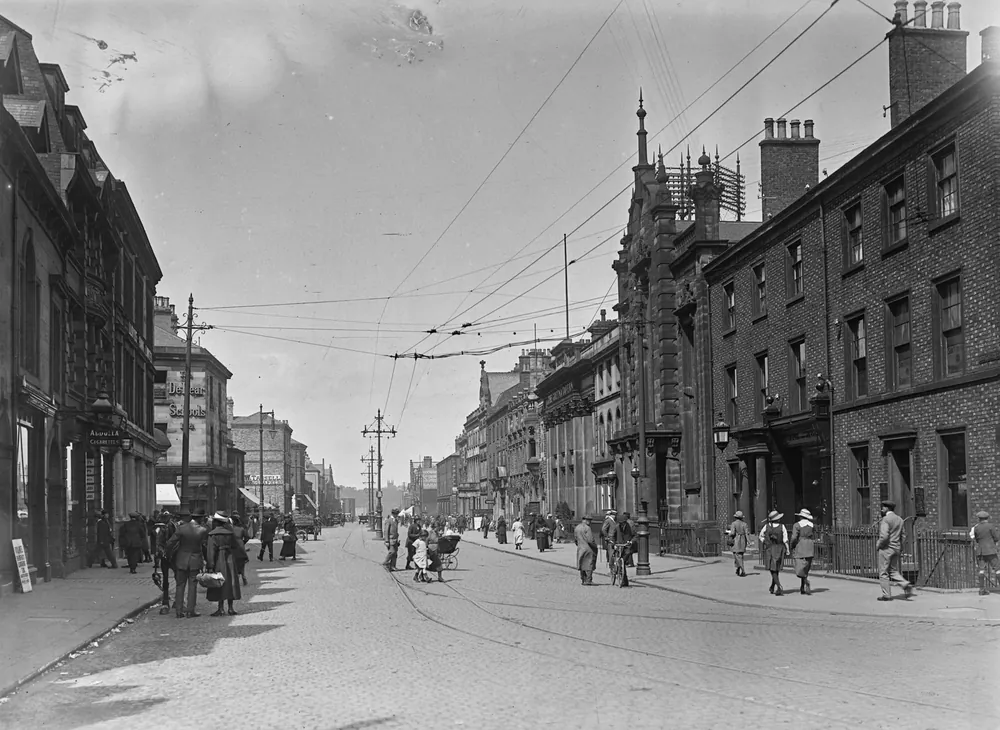
The first pub the state opened itself. It had already bought existing pubs at Enfield that January; this was the first it made. The building had gone up in 1863 as Carlisle's main post office, to a design by J. Williams of London. Historic England's study of the scheme's pubs tells the building's story differently: the Athenaeum, built in 1840 to designs by Arthur and George Williams of Liverpool, into which the post office next door had spread by the end of the nineteenth century. As the Athenaeum it was already a dining room for the drink trade's friendly societies: the Carlisle District of the Oddfellows dined there after their Easter Monday procession of 1848, at two shillings a head, and the Carlisle Mechanics' Band planned a concert there that year for the Cumberland Infirmary.
Carlisle's post office moved on from this building to a grander replacement on Warwick Road in 1916, itself now a hotel bar, the Halston: two former Carlisle GPOs, both now pouring drinks.
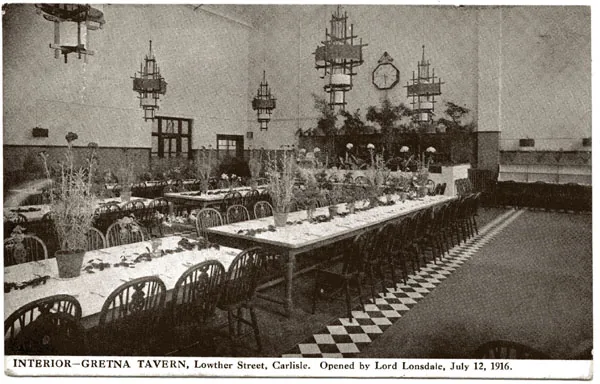
The Central Control Board converted the old one in a ten-day job, its first commission for Harry Redfern, who designed the interior. The Cumberland News announced it beforehand as 'the Gretna Tavern and Coffee House': the ceremony at four in the afternoon of 12 July 1916, opened formally by the Earl of Lonsdale himself with Lord D'Abernon presiding, the doors open for business at six, when the general manager hoped the Gretna workmen would come in, and the two lords back at seven for informal speeches. Both used the same homely metaphor for it, as Sir Robert Allison reminded a temperance meeting that October: they were 'laying an egg'.
The old counter hall, where public postal business had been transacted, became a bar selling beer and wines, but not spirits. The former sorting office became a 180-seat restaurant, described at the time as airy and light and decorated in a cheerful fashion. Historic England's survey describes it as a refreshment room: long tables, wheelback chairs and a platform with a piano and a gramophone, more licensed restaurant than pub, and as popular with women as with men. The first colour scheme inside, chosen by George Walton, Redfern's assistant, was battleship grey, and it was so unpopular it did not last. Repainted a warmer pink, the rooms began to pull in custom, which Basil Oliver held up as proof of what colour can do.
Six weeks after it opened, the Cumberland News reported that it had become 'the rendezvous of many Carlisle citizens' but had largely failed to draw the Gretna workmen it was built for, except on Sundays, when it was the only refreshment house open in the city. Parents were taking their children into the big dining room, and the paper set out why that was lawful: the Children Act kept under-fourteens out of 'open drinking bars' only, which at the Gretna Tavern meant the stand-up bar alone. The Board was also about to take over Hope and Bendle's wine and spirit stores a few yards along Lowther Street, from 4 September 1916, as the central depot for the bottled trade, which gave it a large block of the street with an imposing frontage.
It was busy enough that by early 1917 a second refreshment room had opened in the neighbouring premises, 8 Lowther Street. King George V and Queen Mary paid it a royal visit on Friday 18 May 1917, not a year after it opened, the day of their ceremonies in Carlisle during a tour of the North-West. Expecting crowds, the Board's local committee ruled that no spirits were to be sold, on or off the premises, in any house it managed from noon to 2.30 that day.
By 1920 food had made up just on sixty per cent of everything it had taken since it opened. It drew its critics too: a prohibitionist worker spent at least a week sitting in it, talking to customers and collecting stories against the scheme. By 1922 the Board could count only three houses in the city that it had licensed from scratch, premises that held no licence before it came: the Gretna Tavern, the London Tavern and the St Nicholas Arms.
Between the wars it had dancing, with an orchestra on Friday and Saturday evenings. The interior was remodelled in 1926, when the front half became a bank; Historic England's survey dates the bank to 1929, when part of the tavern was partitioned off as a savings bank. Its gazetteer adds an alteration of 1931-2, which brought a new lounge and a retiring room. The pub closed for refurbishment twice more, in 1939 and again in 1956, and a proposal of 1961-2 would have turned the smoking room and public bar into one lounge with a new servery.
The state sold it on 13 November 1972, and it never stopped serving: it stayed the Gretna until 1979, then became the Shambles until 1986, the Post until 1997, Finnegan's Irish pub, Churchill's from 2003 and the Gilded Lily from 2008, and since 2014 it has been the Last Zebra. The building was listed Grade II in 1974. Where the whole experiment started is exactly where you can still get a pint.
Photograph
Sources 16
- Co-Curate: State Management of Public Houses 1916-1971
- Historic England: 8 Lowther Street, list entry 1218057
- CARLISLE_PUBS_Ver_3.xls (Mike Tuer's pub database)
- Co-Curate: Former Gretna Tavern, the first State Management commission for Harry Redfern
- Historic England, Countering the 'deadliest of foes': public houses of the Central Control Board and the State Management Scheme, 1916-73 (Clare Howard, Research Report 89-2018)
- Historic England, Countering the 'deadliest of foes': public houses of the Central Control Board and the State Management Scheme, 1916-73 (Clare Howard, Research Report 89-2018): Appendix C, gazetteer of scheme premises
- The State Management Story documents: Temperance Legislation League papers: unsigned essay for state purchase, 1920
- The State Management Story documents: H. B. Wilson, History of the Carlisle State Management Scheme 1916-1974 (Home Office, about 1975)
- The State Management Story documents: Temperance Legislation League papers: correspondence answering Peter Chalmers, January 1923
- The Cumberland News, 19 May 1917 (the running head is misprinted 12 May; page number not legible): Carlisle Advisory Committee report of Wednesday 16 May, 'State Purchase: extension to West Cumberland' (via newspapers.com)
- The Cumberland News, 26 August 1916, p. 5: 'The Carlisle Experiment' (via newspapers.com)
- The Cumberland News, 18 November 1922, p. 9: 'Control in Carlisle', letters of Colonel Claude Lowther and G. A. Rimington (via newspapers.com)
- The Cumberland News, 21 October 1916, p. 5: 'The Carlisle Experiment: Sir Robert Allison's views' (via newspapers.com)
- The Cumberland News, 8 July 1916: 'First State tavern: to be opened by Lord Lonsdale' (via newspapers.com)
- Carlisle Journal, 14 April 1848, p. 2: advertisement, Independent Order of Oddfellows, Carlisle District (via British Newspaper Archive)
- Carlisle Journal, 7 January 1848, p. 2: 'The Carlisle Mechanics' Band' (via British Newspaper Archive)
Also lost on Lowther Street
55 other lost pubs stood within 250 m of here. See them on the map
Still serving, near where it stood
-
0 maway
-
20 maway
-
20 maway
-
30 maway