Stanwix, Carlisle
The Crown Inn
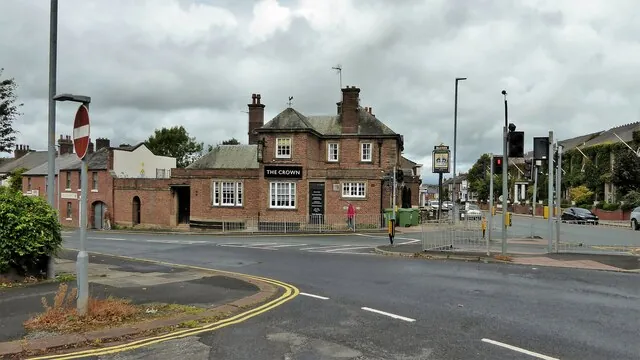
Redfern, 1937, in restrained Neo-Georgian. It opened with a public bar, refreshment room, smoking room, billiard room and off-sales.
Sold to Scottish & Newcastle as part of Group 1, handed over on 16 April 1973. Who bought the rest
Large, airy pub on Scotland Road with rooms upstairs, a wide beer range and plenty of screens for sport. Dog friendly. Check the food menu on the day rather than online.
Part of Greene King
- Today
- See opening hours
- Address
- 23 Scotland Road, Carlisle CA3 9HS
- Phone
- 01228 512789
History
Opened 1937
- Records from
- 1829, for the earlier inn
- Rebuilt
- 1937, by Harry Redfern
- Style
- Neo-Georgian
- Opened with
- Public bar, refreshment room, smoking room, billiard room, off-sales
'You are requested to admire the quiet tone of the composition,' Harry Redfern wrote of this pub. 'It is in fact an essay on respectability.' The Crown on Scotland Road is his model pub of 1937, in restrained Neo-Georgian, and it is not to be confused with the Crown & Thistle on Church Street, ten minutes' walk away. The Edinburgh and Galashiels buses still stop right outside.
The ground under it is far older than either. The corner is Scotland Road and Etterby Street, and Scotland Road is the eastern boundary of the scheduled monument that protects Hadrian's Wall through Carlisle. Stanwix, whose name means stone walls, is built on top of Uxelodunum, the largest fort on the whole Wall, garrisoned by the ala Petriana, the only thousand-strong cavalry unit in Roman Britain, whose commanding officer was the senior officer on the entire frontier. Its parade ground survives, the only one identified anywhere along the Wall. So a 1937 government pub stands at the edge of the ground where the Wall's commander had his headquarters, and nothing on its front mentions it.
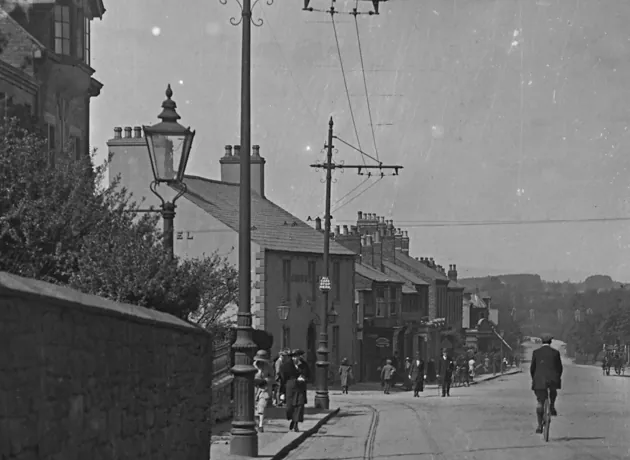
There was a small hotel on this corner long before Redfern, with records going back to 1829, and the scheme took it over from the Maryport Brewery in August 1916. Stanwix had only been part of the city since 1912, and by the mid-1930s new housing was filling it up, so the scheme wanted a bigger Crown. The old house was cleared for a purpose-built model one, the same pattern as the Apple Tree and the Andalusian.
Redfern's first drawings date from February 1934. He chose a quieter style here than the Arts and Crafts of some of his others, which may be the setting: twenty minutes north of the centre, not town, not quite suburb. The house was set back from the street to leave a small parking area. The public bar and the tea room took the Scotland Road front, each with its own door, and the billiard room and a men's smoking room sat behind, all four with counters onto a central servery, so there was little or no table service. Off-sales had its own door on Etterby Street, and the manager's flat was upstairs.
The tea room, which doubled as the mixed smoking room, got the grand central doorway under the stone cartouche of a crown and '1937', and a collapsible metal gate so it could be shut off from the rest of the pub during the day. The billiard room was a special request, rare in his new inns, made because the bowling club nearby wanted somewhere to play when the weather stopped bowls. The whole layout was designed to push drinkers towards food, games and respectable company rather than just the bar.
The furnishing was specified room by room. The tea room had silver greywood panelling and open-backed settees in walnut and hide, so the panelling showed through. The public bar had oak settees in Rexine and Lancashire spindle-back chairs with rush seats; the billiard room, walnut chairs in haircloth. John Laing and J & R Bell both tendered to build it, Bell won on price, and it was finished in December 1937. The 1972 sale particulars still list a public bar, a mixed smoking room that had been the tea room, a men's smoking room, a billiard room, an off-sales shop, cellar, spirit store and a three-bedroomed flat.
Scottish & Newcastle bought it with Group 1 of the sale on 16 April 1973, and by 1978 it carried a William Younger sign. It came back to cask beer early. That spring its manager, John Tinning, a well-known figure from the scheme's own days, persuaded the brewery to put Younger's XXPS back on handpump, and the local CAMRA branch made it Pub of the Month for May 1978, the city's newest real ale outlet. It has sold real ale ever since.
Inside, it has been reworked more than once. Historic England's survey of 2016 found the interior already heavily remodelled, probably in the late 1980s, with the original panelling and fireplaces replaced; the outside was almost intact, which the survey credited to the conservation area. A 2017 refurbishment then opened the interior into one large space and moved the bar to one side, but kept the original support pillars and added dividers so the old rooms still read. In the far-left corner a section of the old smoking room survives with its oak panelling and cabinets, though after the 1980s work it may be less 1937 than it looks.
The pub knows its own history and says so. Its website carries a page on the State Management Scheme, and when the courtyard was redesigned the centrepiece was a mural of the history of the area and the pub, the scheme included. That is rarer than it should be: most of the scheme's surviving pubs say nothing about where they came from. In 2020 the manager taking it on had lived in the building as a child, which the local paper reported as the pub having gone full circle. Greene King hold the freehold now and it trades under their Belhaven arm.
One note on the hours. Sources disagree about when it opens on weekdays, some giving four in the afternoon and others noon, so it is worth checking on the day rather than trusting a listing.
- Dog friendly
- Food
- Historic interior
- Live sport
- Quiz night
- Near Hadrian's Wall
Photographs
Opening hours
| Mon | 16:00–23:00 |
| Tue | 16:00–23:00 |
| Wed | 16:00–23:00 |
| Thu | 16:00–23:00 |
| Fri | 12:00–midnight |
| Sat | 12:00–midnight |
| Sun | 12:00–22:30 |
Hours last checked August 2026, about 2 months ago.
Hours are kept by hand and change without warning. Ring ahead if it matters.
More like this
- Dog friendly pubs in Carlisle
- Food pubs in Carlisle
- Historic interior pubs in Carlisle
- Live sport pubs in Carlisle
- Near Hadrian's Wall pubs in Carlisle
- Pub quiz nights in Carlisle
- All pubs in Stanwix
Nearest to here
-
30 maway
-
160 maway
-
460 maway
-
710 maway
Lost on Scotland Road
- Spider & Fly gone 2025
- The Angus Hotel gone 2004
- The Bird in Hand gone 1917
5 lost pubs stood within 400 m of here. See what used to be around it
Sources
- The State Management Story
- The Crown Inn's own history page
- CAMRA WhatPub
- Whitehaven News: the manager who grew up in the pub, and the courtyard mural
- Co-Curate: the scheme pub list
- Historic England: Hadrian's Wall and the Roman fort at Stanwix, scheduled monument
- Co-Curate: Stanwix
- Pub Gallery: Harry Redfern's Carlisle Legacy, a tour of the scheme's fifteen new-build pubs
- Ale Tales (Solway CAMRA), Summer 2013: Mike Tuer, State Management Scheme 40 Years On, Part 1; George Miller on the branch newsletter of 1978
- Historic England, Countering the 'deadliest of foes': public houses of the Central Control Board and the State Management Scheme, 1916-73 (Clare Howard, Research Report 89-2018): Appendix B, summaries of key State Management public houses
- Historic England, Countering the 'deadliest of foes': public houses of the Central Control Board and the State Management Scheme, 1916-73 (Clare Howard, Research Report 89-2018): Appendix C, gazetteer of scheme premises
- Historic England, Countering the 'deadliest of foes': public houses of the Central Control Board and the State Management Scheme, 1916-73 (Clare Howard, Research Report 89-2018)
Know more about this one?
History, a story, a correction, or just what it was called before: The Crown Inn is better on this site when locals fill it in.