Lost pub · Newtown Road
The Green Dragon
- Built
- The original about 1806, extended out to Newtown Road in 1860
- Gone
- Closed 1998
- There now
- A private house
- Address
- 82 Newtown Road
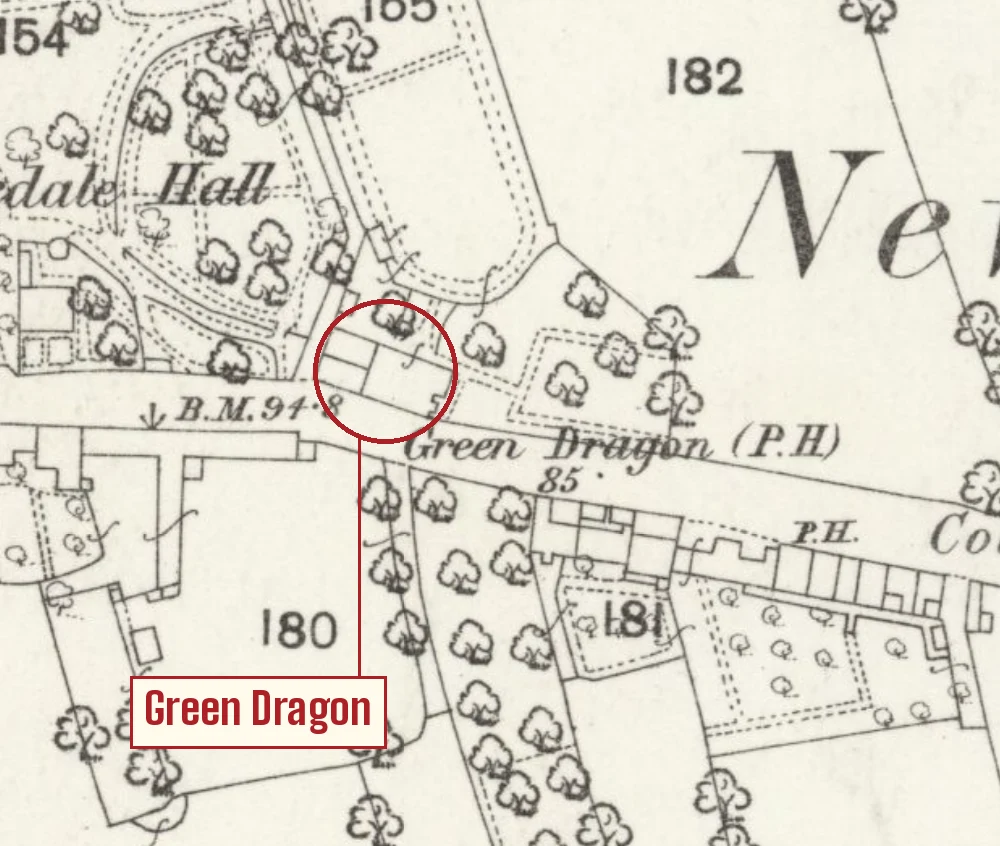
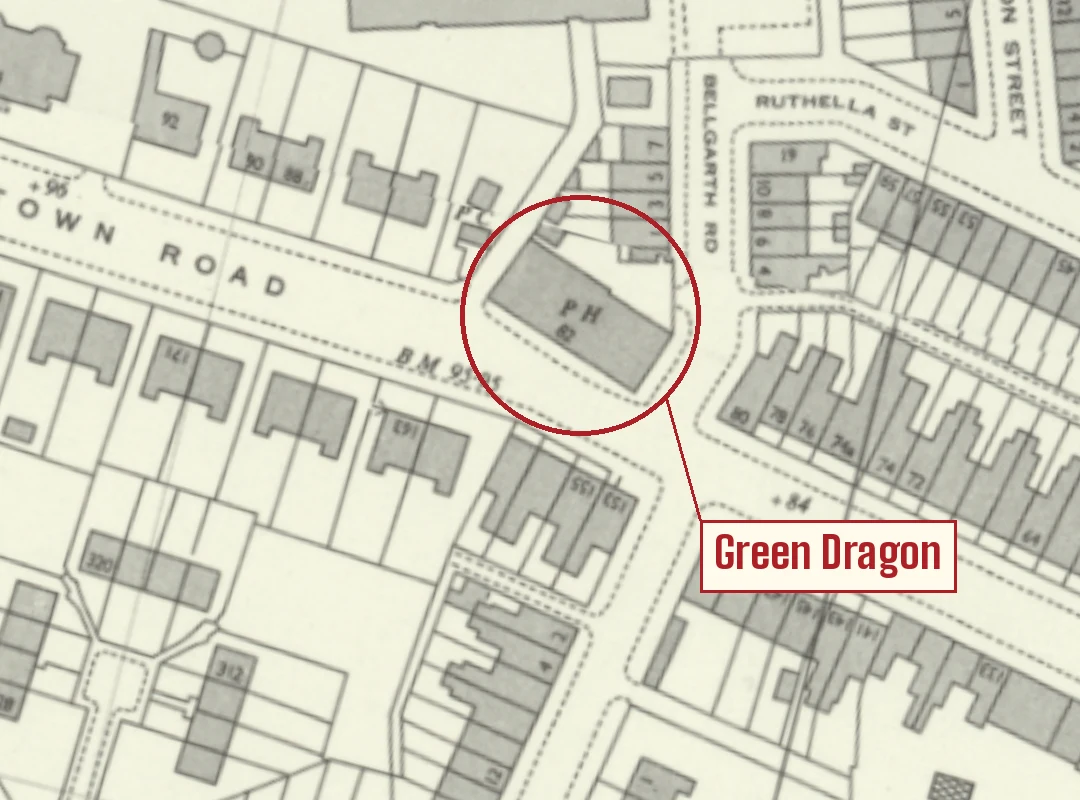
- Where exactly
- Placed from the Ordnance Survey grid reference, NY3845455987, in Historic England's gazetteer of the scheme's premises. The building's use in 2018: residential.
For most of two centuries the Green Dragon stood at the far end of Newtown Road, where Carlisle gave out into fields, and it was always more than a pub. It was a tea garden, a pleasure ground with a menagerie, a concert room, a sports ground and the place where Newtown's dead were carried for the coroner. It is remembered for the tame bear that killed a man in its yard in 1847, and by the time it closed in 1998 it was known as the roughest pub in the city.
A Green Dragon was trading here before 1780, at what became 82 Newtown Road. The building went up about 1806. An 1801 newspaper notice names Benjamin Bell as innkeeper, and William Underwood held it from 1804; Jollie's directory of 1811 calls him 'innkeeper and tea-garden, Newtown', and he was still there in 1829. It stood almost alone. A Carlisle Journal writer, remembering the town of the early 1850s, put it in a sentence: beyond the Infirmary there were 'only one or two houses including the mean-looking premises of the Green Dragon', with farm buildings nearly opposite and open ditches running through the street.
By the 1840s the landlord, Robert Cowen, kept 'a variety of wild animals' behind the inn, as many readers of the Carlisle Patriot knew. The best known was a large black bear. It had come to England as a cub with an officer of the 89th Regiment, quartered in Carlisle Castle, and lived with the regiment so long that the soldiers used to wrestle with it. The Cowens bought it from Captain Kennedy of the 89th in March 1846 and kept it on an iron chain four or five yards long, fixed to the stump of a tree in a partly open yard. They fed it porridge and milk three times a day and never any meat. Mrs Cowen used to pat it at the length of its chain, and her husband could take almost any liberty with it.
On Friday 3 September 1847 William Rawson, 39, a porter for Mr Bonnell, the chemist, called to ask whether Mr Cowen had any empty bottles. With him was George Gass, a retired ironmonger of over eighty, and the two went round to the backyard to see the bear, as Rawson had often done before. He stood where he thought he was out of its reach and fed it crumbs of bread from his pocket, from the palm of his hand, once, twice and a third time. At the third, Gass said, it 'made a click with both its paws' and drew him in.
Rawson went down shouting for help, and the bear lay on him, worrying him about the neck and head. Gass took hold of its collar and pulled with all his strength. Elizabeth Cowen ran out, took the chain and once lifted the bear off him, but her foot slipped and it got hold again, by the neck below the left ear. Her husband was away. She raised the neighbours while the old man hung on; the bear never turned on anyone but Rawson. George Snowdon came running with a pitchfork, which Mrs Cowen told him to run into the bear, and another man with a coal rake, and only when it was beaten with the rake did it let go.
They carried Rawson into the house, still able to speak, and then to the Infirmary, where he arrived all but dead, cold and without a pulse. He slept, and on the Saturday morning he asked for his brother and gave him a message, but by the evening he was being sick and struggling to breathe, and he died at about three on the Sunday morning. Robert Cowen had shot the bear early on the Saturday. The coroner, William Carrick, opened the inquest at the Green Dragon on the Monday evening, and the jury went out to see the bear's ground; Gass told them the blood nearest the bear's tree was Rawson's. Rawson, a member of the Oddfellows' City Lodge, was buried that same evening, half an hour after the inquest opened.
The inquest ended a week later at the Police Office in a quarrel. The Infirmary's house surgeon, Mr Thomas, had opened the body before the jury could view it, and the coroner complained that it was now impossible to tell which wounds were the bear's and which the knife's, and threatened to report him to the Governors. Thomas said he could 'see the drift' and walked out. The jury returned a verdict of accidental death and attached no blame to Robert Cowen.
Fifty-two years later a Carlisle Journal columnist retold the story, though by then the black bear had become a grizzly and old Gass was 79. He also remembered the sequel: bear's grease was then the favourite and dearest of hair oils, and Mr Carruthers, the hairdresser at the top of Castle Street, set off a boom in it by advertising the real, genuine bear's grease from the Newtown bear.
The gardens carried on. The same writer remembered bills on the walls announcing that a lady would appear at Newtown Gardens in full Bloomer costume, the daring new American dress, and that visitors could see 'this remarkable phenomenon' at so much a head. Newtown Gardens, he explained, were at the Green Dragon, 'where a small menagerie was kept, including a brown bear and a cage of monkeys', and the next week he told the tale 'connected with that bear'. But the costume only reached Britain in 1851, four years after the bear was shot, so he was probably remembering the menagerie as it had been before. The landlord by 1851 was John Lancaster, and that August a small boy was had up before the Mayor for stealing fruit from his garden.
Two years later the house had its first brush with the law. On 29 January 1853 John Thomlinson, a farm worker still laid up from an accident at a threshing machine, was drinking ale in the Green Dragon's kitchen, with a dancing room next door, when Joseph Mein, a tailor, asked if he was the Thomlinson who carried the milk and water in the pony cart. Thomlinson called him a 'pricky louse'. Mein left, then came back to ask if he was the Thomlinson who had set the stacks on fire, and Thomlinson went out after him.
Walking home past the pond with his brother William, he met two groups of men. One shouted 'let us murder them', and the brothers were beaten with fists and sticks and kicked on the ground. Seven men stood trial for riot at the Assizes. The defence said Thomlinson had started it by going for the wrong man, and Mein said he had been nowhere near: he had caught hold of the stirrup of a passing horseman and run alongside him to the workhouse, and the horseman swore to it. The judge ruled that an affray was not a riot, the jury acquitted all seven, and the judge told them: 'I am glad you are responsible for that verdict and not I.'
The gardens stayed busy. In January 1855 Joseph Nixson advertised from the inn for two young live foxes. In 1857 a harmonic society met every Monday in the concert room, and in August 1858 Newtown Gardens held wrestling for a ten-guinea silver cup, Highland dancing, piping and fireworks, with cheap trains from Newcastle and Sunderland; the belt for second place was on show at the Green Dragon beforehand. Mrs Nixon had the house in 1859 and George T. Holloway in 1860.
Thomas Martin had it by September 1861, when six acres of swede turnips at Newtown Gardens were sold as his property; the house had been extended out to Newtown Road the year before. His wife Margaret died at the inn the following May, and in 1867 he signed the innkeepers' memorial for the Green Dragon. Its trade by then included the North British Railway's men: on New Year's Eve 1863 Martin laid on supper for a party of them, with tea for their wives and sweethearts in the next room, then cleared the tables for a dance to see the new year in.
Rawson's was far from the only inquest at the Green Dragon; it was where Newtown's dead were brought. In September 1864 the body of Jane Turner, an eighteen-year-old servant drowned in the Eden, was carried there on a stretcher and laid in the large concert room, where the jury viewed her before going through to the inquest room. A newborn baby found in the river in 1866 was taken there to await the coroner, and inquests sat there on a drowned shoemaker in 1871, a labourer from Carr's works in 1883, a retired draper who fell down his stairs in 1886 and a street sweeper in 1891.
Martin's family kept the house. Thomas Wilson, 'of the Green Dragon' in 1867, died at the inn in February 1870, aged 34, leaving young daughters; the eldest was named Margaret Martin Wilson. Their mother then married William James Mitchell. In September 1880 the inn was auctioned on the premises with its stable, garden and about eighteen acres; Mitchell was among the bidders, the bidding stopped at £3,550 against a £5,000 reserve, and it was withdrawn. The next June the licence passed from the executors of Thomas Martin to Mitchell. The likeliest reading, though nothing states it outright, is that Wilson's wife was Martin's daughter, and the house came down through her.
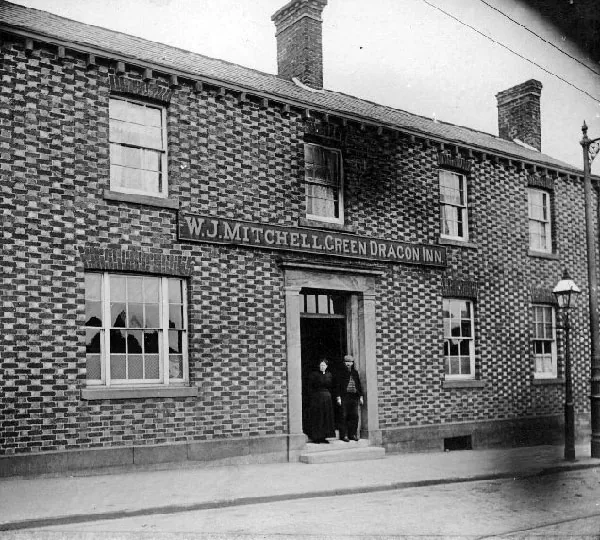
Mitchell ran it for twenty years and more, and made it a sporting house. He opened the large room for quadrille dancing in 1882, acting as master of ceremonies himself. In December 1886 he staged foot races on the track behind the inn, a 110 yards handicap for £5 and a silver cup with 36 entries, and in 1890 he and Mrs Mitchell served the West End Football Club's end-of-season dinner to more than fifty. The photograph of about 1902 shows his name over the door.
In the Scottish railway strike of 1890-91 the North British lodged its replacement crews at the Green Dragon at the company's expense. One fireman was told he would get 'a bullet through your b—— head' and slept in the engine shed offices instead. When crowds of women and boys besieged the strike-breakers' houses, banging tins, Mitchell's step-daughter Mary Wilson gave evidence for a friend: she had gone down to the driver's house with no tray, no poker and nothing to make a noise with, and someone had handed her a tray when she got there.
The trouble came to the door, too. On New Year's Day 1894 James Pattinson and the Kemp brothers fell out over the Green Dragon's servant girl and fought outside; a knife was alleged, the doctor would not swear to a stab, and the brothers were fined five shillings each, the bench thinking they had had some provocation. In November 1898 Mary, by then the widow of James McCutcheon, a butcher, was found dead in her house across the road, and her inquest was held in her step-father's pub.
The trams came out past it, and in 1901 a speeding case turned on the 186 yards from Collin Place to the Green Dragon; the next year the gas lamps were renewed 'from the railway bridge to the Green Dragon Inn'. By 1906 it was the Green Dragon Hotel, and James Nasmith, late of Manchester, died there that February, aged 54. In April 1914 an argument about Irish Home Rule in the bar ended in a punch in the road outside, and the Mayor dismissed the case but told the coppersmith who threw it to avoid debating Home Rule in public houses in future.
In November 1915 Sarah Ann Skipton, sister-in-law to the landlord, took over the licence of the Drove Inn at Stanwix. The Green Dragon was a Carlisle New Brewery house when the State Management Scheme took it in August 1916, and that November the Board chose it as one of seventeen houses in the city where spirits could still be bought to take away. The scheme improved it in 1961-2 and sold it to John Smith's on 8 May 1973, or 7 May by one record.
Its last years lived up to the old reputation. In April 1985 someone put a shotgun through a window. The landlord was declared bankrupt in March 1997 and the pub closed the following year. A 1999 bid to reopen it failed because the premises were too well known as a 'notorious trouble spot'. In April 2000 it was sold through John Taylor and Co. of Devonshire Street to become flats and a shop, and the same year there was a fresh attempt to reopen it as a cafe, billed as Carlisle's roughest pub getting a new lease of life. Whether that ever opened is not recorded. It is a private house now.
Not to be confused with two other Green Dragons the city once had: one on Scotch Street, gone by 1861, and a third, shorter-lived one on Rickergate/Solway Terrace in the 1860s and 70s.
Sold to John Smith's as part of Group 3, handed over on 8 May 1973. Who bought the rest
Photograph
Sources 50
- co-curate.ncl.ac.uk: former Green Dragon pub, Newtown Road
- Carlisle Encyclopaedia, "G" page
- CARLISLE_PUBS_Ver_3.xls (Mike Tuer's pub database)
- Historic England, Countering the 'deadliest of foes': public houses of the Central Control Board and the State Management Scheme, 1916-73 (Clare Howard, Research Report 89-2018): Appendix C, gazetteer of scheme premises
- The Cumberland News, 4 November 1916, p. 5: 'The Control Board: progress of the Carlisle scheme' (E. C. Sanders's report of 1 November) (via newspapers.com)
- The Cumberland News, 14 April 2000, p. 4: 'Drinkers call time on the local pub' (via newspapers.com)
- Carlisle Patriot, 22 February 1867, p. 7: 'Carlisle Town Council: the Public House Closing Act', with the innkeepers' memorial (via British Newspaper Archive)
- Carlisle Express and Examiner, 11 June 1881, p. 5: 'Transfer of licences' (via British Newspaper Archive)
- Jollie's Cumberland Guide & Directory (Carlisle: F. Jollie & Sons, 1811), p. xx: Underwood William, innkeeper and tea-garden, Newtown (Google Books scan of the Bodleian copy)
- W. Parson and W. White, History, Directory, and Gazetteer of the Counties of Cumberland and Westmorland (Leeds, 1829), pp. 163-164: Carlisle inns and taverns (University of Leicester digital copy)
- Carlisle Patriot, 10 September 1847, p. 3: 'A man killed by a bear', with the inquest evidence of George Gass and Elizabeth Cowen (via British Newspaper Archive)
- Carlisle Patriot, 17 September 1847, p. 2: 'Adjourned inquest' on William Rawson (via British Newspaper Archive)
- Carlisle Journal, 22 August 1851, p. 2: orchard robbing, the garden of John Lancaster, Green Dragon (via British Newspaper Archive)
- Carlisle Patriot, 19 February 1853, p. 3: 'The Newtown riot', County Magistrates' Office (via British Newspaper Archive)
- Carlisle Journal, 4 March 1853, p. 6: Cumberland Assizes, 'Affray at Newtown' (via British Newspaper Archive)
- Carlisle Journal, 4 August 1854, p. 1: auction at the house of John Lancaster, Green Dragon Inn (via British Newspaper Archive)
- Carlisle Journal, 19 January 1855, p. 4: two young live foxes wanted, Joseph Nixson, Green Dragon (via British Newspaper Archive)
- Carlisle Examiner and North Western Advertiser, 19 and 26 September 1857, p. 1: harmonic meeting, Green Dragon (via British Newspaper Archive)
- Carlisle Journal, 27 August 1858, p. 4: wrestling and Scottish games at Newtown Gardens (via British Newspaper Archive)
- Carlisle Journal, 7 January 1859, p. 5: Parham Beck School tea party at Mrs Nixon's, Green Dragon (via British Newspaper Archive)
- Carlisle Examiner and North Western Advertiser, 1 December 1860, p. 1: sports, G. T. Holloway, Green Dragon (via British Newspaper Archive)
- Carlisle Journal, 27 September 1861, p. 1: swede turnips at Newtown Gardens, property of Thomas Martin (via British Newspaper Archive)
- Carlisle Journal, 9 May 1862, p. 5: death of Margaret Martin at the Green Dragon (via British Newspaper Archive)
- Carlisle Journal, 5 January 1864, p. 2: 'Supper and ball', North British workmen at the Green Dragon (via British Newspaper Archive)
- Carlisle Journal, 27 September 1864, p. 2, and Carlisle Patriot, 1 October 1864, p. 6: inquest on Jane Turner at Mr Martin's, Green Dragon (via British Newspaper Archive)
- Carlisle Journal, 24 December 1866, p. 2: 'Body of a child found' (via British Newspaper Archive)
- Carlisle Journal, 6 August 1867, p. 3: County Court, McMurray v. Milburn, Thomas Wilson of the Green Dragon (via British Newspaper Archive)
- Carlisle Express and Examiner, 4 March 1870, p. 5: death of Thomas Wilson at the Green Dragon (via British Newspaper Archive)
- Carlisle Patriot, 14 July 1871, p. 5: inquest on Thomas Stubbs at the Green Dragon (via British Newspaper Archive)
- Carlisle Express and Examiner, 31 March 1877, p. 7: 'The charge of incendiarism' (via British Newspaper Archive)
- Carlisle Express and Examiner, 18 September 1880, p. 5: 'Public-house at Carlisle', sale of the Green Dragon (via British Newspaper Archive)
- Carlisle Express and Examiner, 1 April 1882, p. 4: quadrille dancing, W. J. Mitchell, M.C. (via British Newspaper Archive)
- Carlisle Journal, 23 February 1883, p. 5: inquest on James Kelly at the Green Dragon (via British Newspaper Archive)
- Carlisle Patriot, 17 April 1885, p. 5: marriage of Margaret Martin, eldest daughter of the late Thomas Wilson, Green Dragon (via British Newspaper Archive)
- Carlisle Patriot, 3 September 1886, p. 5: inquest on Joseph Havanagh at the Green Dragon (via British Newspaper Archive)
- Carlisle Patriot, 31 December 1886, p. 2: 'Footracing at Newtown' (via British Newspaper Archive)
- North Cumberland Reformer, 18 April 1890, p. 2: 'West End Football Club' (via British Newspaper Archive)
- North Cumberland Reformer, 22 January 1891, p. 6; Carlisle Patriot, 23 January 1891, p. 3; Carlisle Express and Examiner, 24 January 1891, p. 6: the railway strike cases (via British Newspaper Archive)
- North Cumberland Reformer, 31 December 1891, p. 5: inquest on Adam Beaty at the Green Dragon (via British Newspaper Archive)
- North Cumberland Reformer, 9 February 1893, p. 4: marriage of Mary, second daughter of the late Thomas Wilson, Green Dragon (via British Newspaper Archive)
- North Cumberland Reformer, 6 January 1894, p. 2, and Carlisle Journal, 9 January 1894, p. 4: 'The alleged stabbing at Newtown' (via British Newspaper Archive)
- East Cumberland News, 26 November 1898, p. 6: 'Sad end of a widow in Carlisle' (via British Newspaper Archive)
- Carlisle Journal, 3 October 1899, p. 2: 'Local jottings' by Crayon, the first Bloomers in Carlisle and the Newtown Gardens menagerie (via British Newspaper Archive)
- Carlisle Journal, 10 October 1899, p. 2: 'Local jottings' by Crayon, the Green Dragon bear of 1847 (via British Newspaper Archive)
- East Cumberland News, 9 March 1901, p. 8: tramcar speed cases at Newtown (via British Newspaper Archive)
- Carlisle Journal, 5 September 1902, p. 4: 'Improvements in public lighting' (via British Newspaper Archive)
- Carlisle Journal, 27 February 1906, p. 5: death of James Nasmith at the Green Dragon Hotel (via British Newspaper Archive)
- Carlisle Journal, 31 March 1914, p. 8: reminiscences of Carlisle, 'The churchyards as burial grounds' (via British Newspaper Archive)
- Carlisle Journal, 21 April 1914, p. 6: 'A dangerous subject for discussion' (via British Newspaper Archive)
- Cumberland Evening News, 22 November 1915, p. 2: 'A Stanwix transfer' (via British Newspaper Archive)
Location from britishlistedbuildings.co.uk. The pin marks the site.
Open question
An unsolved mystery
How did the Green Dragon pass from Thomas Martin to William James Mitchell? Thomas Wilson, 'of the Green Dragon', died at the inn in 1870 and named his eldest daughter Margaret Martin, after Martin's wife; his widow married Mitchell, who took the licence from Martin's executors in 1881. Was Wilson's wife Martin's daughter? And did the cafe planned for the building in 2000 ever open?
If you know the answer, or where it might be found (an old photograph, a family story, a document), tell us and it goes into the story above.
Also lost on Newtown Road
2 other lost pubs stood within 250 m of here. See them on the map
Still serving, near where it stood
-
680 maway
-
810 maway
-
900 maway
-
1.2 kmaway