Lost pub · Milbourne Street
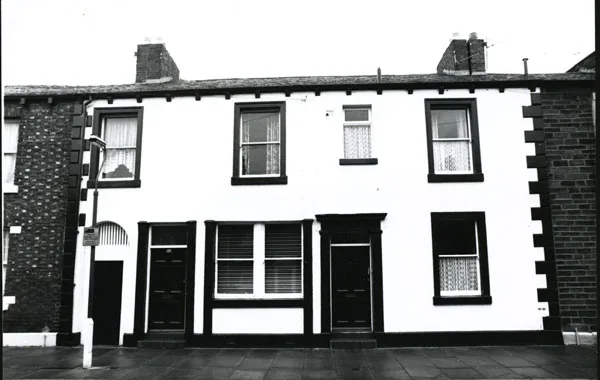
The Spinners Arms
- Built
- In local directories from 1854
- Gone
- Closed 1917 (acquired by the state, September 1916)
- There now
- In residential use by 2018
- Address
- 57 Milbourne Street
- Where exactly
- Placed from the Ordnance Survey grid reference, NY3964155726, in Historic England's gazetteer of the scheme's premises. The building's use in 2018: residential.
Trading from 1854, and in the local directories from 1858 to 1914. It took its name from the nearby Dixon's textile factory, the same firm the Milbourne Arms, a short walk away, also nods to. On 5 November 1856 about fifty of the city's Orangemen met at Brother Brown's, the Spinners' Arms, to mark William III's landing and the Gunpowder Plot, and held a ball. It was one of four houses granted a new full licence at the Brewster Sessions of August 1857, when the bench would license nothing without stabling; the report spells the street Milbourne and gives Joseph Bell as the licensee.
I. Potts signed the innkeepers' memorial of February 1867 for the Spinners Arms. Adam Dinwoodie kept it until May 1891, when he took the Old Anchor in Caldewgate, and Ruth Allison Harding, born in Carlisle, was publican in the 1901 census. It was a Meadow Brewery house and later a Maryport Brewery one.
Its landlord in 1914 was George Boak. On Wednesday 7 October that year his body was found in the Eden on the old racecourse, below the end of Catholic Lane. He was 43 and had been unwell for some time, and the inquest jury returned a verdict of found drowned, adding that nothing showed how he came to be in the river. As a young man he had played three-quarter for Cummersdale Hornets, and after a Cumberland and Yorkshire match he went to Huddersfield with a club-mate, 'Jock' Forsyth.
The Rugby Union's inquiry into their move found Huddersfield had been paying its players and suspended the club, which by the paper's account led in time to the Northern Union, the code that became rugby league. He had won sprint handicaps too, and was still playing bowls at the Turf Subscription club.
The house was sold to the Central Control Board in September 1916, or August by Historic England's gazetteer, and the scheme closed it in 1917, by the gazetteer as well as one other record, though 1919 and 1920 are also given. It had certainly gone by the spring of 1919: on 30 April the Board put number 57 Milbourne Street, 'formerly known as the Spinners Arms Inn', up for auction at the Victoria Hotel, with its large shop or bar, a dwelling house, a two-roomed cottage and a large yard. The site was residential by 2018.
Photograph
Sources 10
- D. Perriam, Denton Holme
- Carlisle Encyclopaedia, "S2" page
- CARLISLE_PUBS_Ver_3.xls (Mike Tuer's pub database)
- Historic England, Countering the 'deadliest of foes': public houses of the Central Control Board and the State Management Scheme, 1916-73 (Clare Howard, Research Report 89-2018): Appendix C, gazetteer of scheme premises
- Carlisle newspaper, 8 October 1914: 'Found in the river: Carlisle innkeeper's tragic end' (via newspapers.com)
- The Cumberland News, 19 April 1919, p. 10: Fred Telford's advertisement of the Central Control Board's auction of fourteen Carlisle properties, Victoria Hotel, 30 April 1919 (via newspapers.com)
- Carlisle Patriot, 5 September 1857, p. 5: 'The Brewster Sessions' (via British Newspaper Archive)
- Carlisle Patriot, 22 February 1867, p. 7: 'Carlisle Town Council: the Public House Closing Act', with the innkeepers' memorial (via British Newspaper Archive)
- Carlisle Express and Examiner, 23 May 1891, p. 8: 'Yesterday's police news' (via British Newspaper Archive)
- Carlisle Journal, 7 November 1856, p. 5: 'The fifth of November' (via British Newspaper Archive)
Also lost on Milbourne Street
4 other lost pubs stood within 250 m of here. See them on the map
Still serving, near where it stood
-
150 maway
-
150 maway
-
340 maway
-
350 maway