Lost pub · Newtown Road
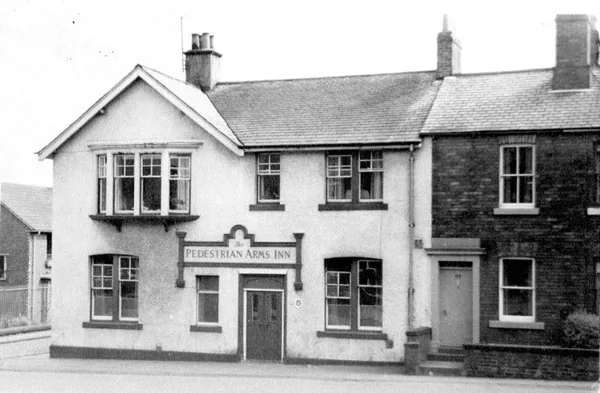
The Pedestrian Arms
- Built
- Trading by 1861; enlarged into the two houses next door in 1905
- Gone
- Closed 30 September 2012; demolished August 2014
- There now
- An empty plot, put up for sale in October 2026
- Where exactly
- Placed from the Ordnance Survey grid reference, NY3865655917, in Historic England's gazetteer of the scheme's premises. The building has since been demolished.
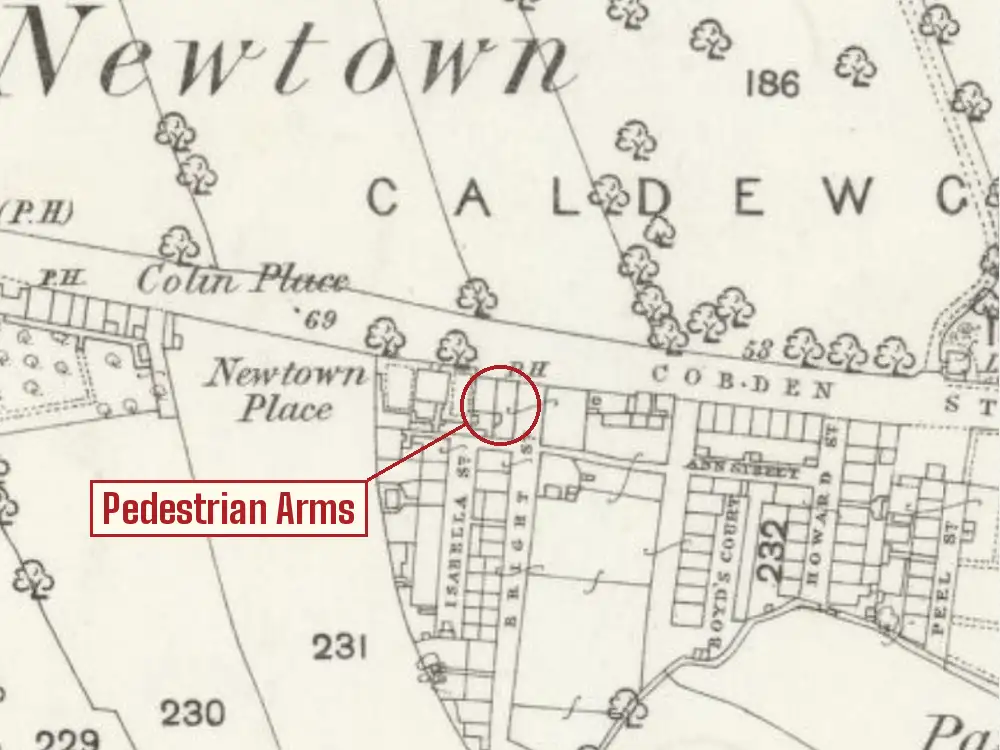
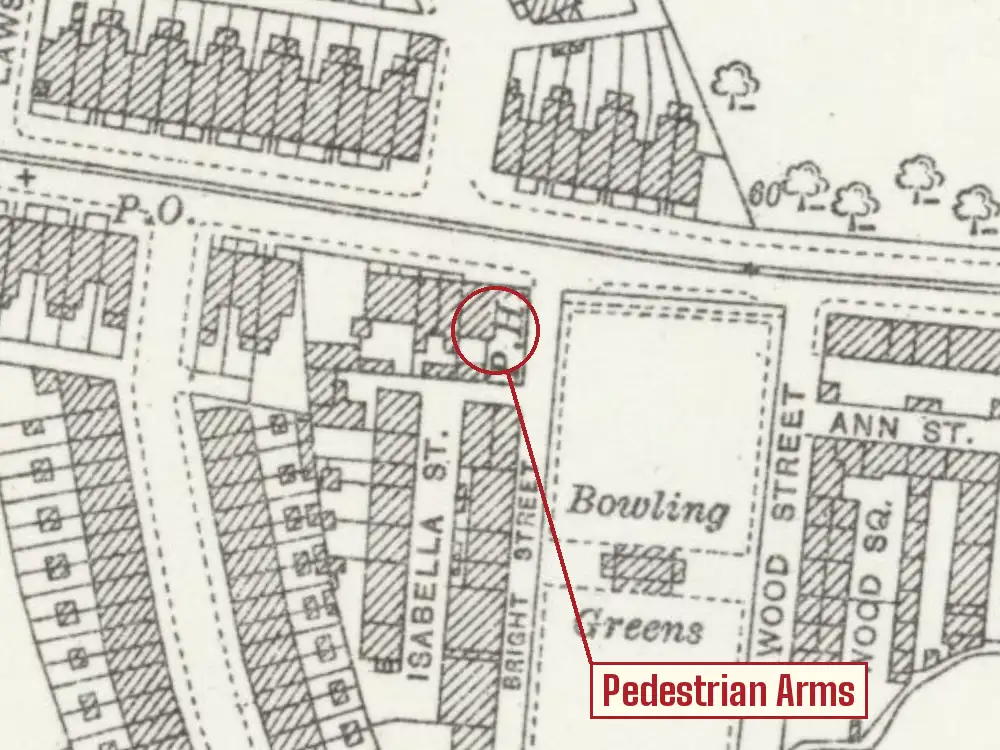
It stood on the corner of Bright Street, on the south side of Newtown Road, across the road from the Cumberland Infirmary. In Victorian England a pedestrian was more than someone on foot: it was a professional walker or runner, and pedestrianism, races for a purse and side bets, drew crowds and heavy betting. The Pedestrian Arms was named for the sport, and its landlords staged it on the road outside.
It was trading under that name by September 1861, when Thomas Thompson of 'the Pedestrian's Arms, Parham Beck' was cautioned for having company in at one o'clock on a Sunday morning. Parham Beck was the papers' name for the streets round Cobden, Bright and Isabella Streets. Three weeks later Thompson put up a £1 prize for a 150-yard handicap on the road near the site of the old canal reservoir. Thirteen ran, and a novice called Dalton, with fifteen yards' start, won it. Bulman, an old hand backed all week at 2 to 1 against the field, was beaten easily by another novice, and a £1-a-side match between two young men drew more betting than the race itself.
In 1866 the Board of Health was told, to laughter, that someone near the Pedestrian Arms had blocked a gully on purpose to make a duck pond. A Thompson signed the innkeepers' memorial for the house in February 1867, and that October the coroner held an inquest there on John Cowie, a North British Railway brakesman from Newtown with a wife and four children. He had been killed in the Canal Station yard the evening before, when he fell from a waggon's buffer and was run over. The yardsman put the waggons at eight miles an hour; the stationmaster told the coroner they were very likely doing no more than four. The verdict was accidental death.
The races went on. On Boxing Day 1867 four young men, a clogger, a labourer, a factory hand and a Bridge Street innkeeper, raced at Parham Beck before a crowd that blocked the road, and were each fined 2s 6d for obstructing it. The constable said the runners were 'in a nude and indecent condition'. One told the bench he had worn a shirt and a pair of drawers; the constable said another had worn only a handkerchief round his body. Their spokesman said the landlord of the Pedestrian's Arms had offered a handicap, and he saw no harm in it.
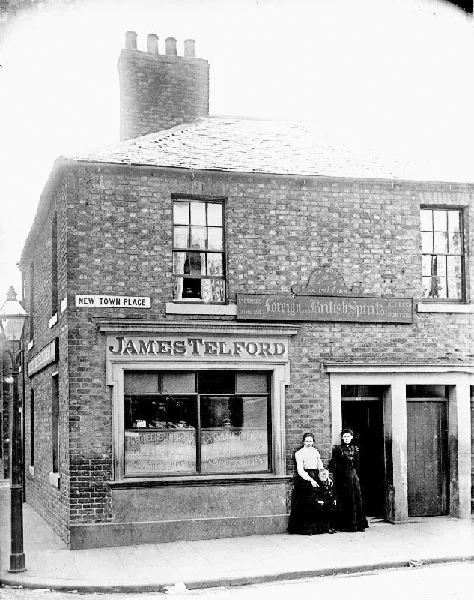
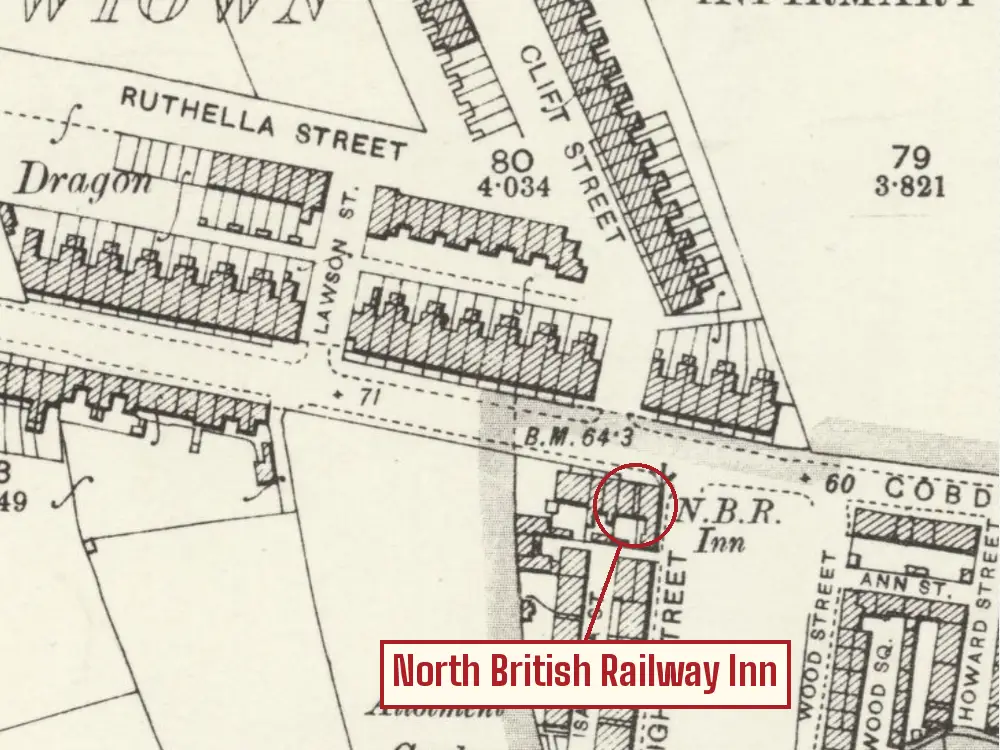
Within ten years it had a new sign. In June 1877 the 'compact INN, with Stable', known as the North British Railway Inn, its spirit vault doing a lucrative business, was auctioned at the Queen's Brewery in Caldewgate, and very probably bought then by the brewery's owners, Joseph Graham & Sons, who had it by 1905 and kept it until 1916. The North British line from Edinburgh had come into the Canal Station in 1862, its goods yard was close by, and the streets round the pub were full of railway families. Joseph Graham kept it in 1884 and Joseph Storey in the 1890s, until the licence passed to Thomas Loftus in September 1897.
The old name never quite went. Kelly's directories of 1894 and 1897 and the licensing report of 1897 call it the Pedestrian Arms, while Bulmer's directories of 1884 and 1901, an inquest of 1895 and the later Kelly's call it the railway inn. James Telford had it around 1900, when it was photographed with his name over the window. In 1905 Joseph Graham, the brewery's architect, enlarged it into the two houses next door and rebuilt the cellar, which flooded; the firm took on the cost of keeping it dry so that the Corporation would not have to.
The Control Board took it over in the week of 14 September 1916, listing it as 'the Pedestrians' Arms (North British Railway Inn), Newtown', with the City Vaults and the Bird in Hand at Stanwix; another record gives October. In November its collecting box, still the railway inn's, raised 10s for the Red Cross's Our Day. By February 1919 the Board's list of houses allowed to open on Sundays had it as the Pedestrian Arms. That October a witness in a court case remembered going one Sunday night from the Green Dragon to 'the North British Railway Inn, now known as the Pedestrian Arms'.
Some local accounts tell it the other way round, with the railway inn first and the Pedestrian Arms after it. One has a beerhouse called the White Whey, or White Ox, or White Cow, on the site from 1847 to 1868, and a new Pedestrian Arms built there in 1921; Denis Perriam, writing in the Cumberland News in 1999, had the North British Railway Inn named after the company that reached the city in 1862 and renamed later. The newspapers of the 1860s have the Pedestrian Arms trading by 1861 and the railway name from the 1870s. They say nothing of a rebuilding in 1921, and in 1986 the Cumberland News called it one of the few scheme houses never modernised after the war.
Under the scheme it had a salaried manager, and in the 1920s that was Mrs Holland, who ran the whist drives and dances at the Dalton Hall in Newtown that raised money for the Infirmary across the road. In 1934 the Pedestrian was one of the ten clubs that founded the State Management bowls league, playing on the scheme's greens at the Turf, the Near Boot, the Horse and Farrier, the Bowling Green and the Rose and Crown at Upperby. In the summer of 1939, losing one match in fourteen, its team took the league's first-division shield for the fourth time. The government told Parliament in 1956 that it had been redecorated, and improvements were approved in 1967.
Bowls stayed in the pub's blood. Joe 'Nobby' Hodgson, a Cumberland and England international, had started as a boy of 14 on the Newtown bowling green, the one the 1924 map shows beside the pub, and the Pedestrian was his local. He was a panel operator at Kingmoor marshalling yard. In July 1965, just back from playing for England in London, he went in on the Sunday night and gave away the medals, badges and ties he had kept all his life, which he had often talked of doing and never done. He collapsed and died at work the next morning, aged 55.
The scheme sold it to Greenall Whitley on 22 May 1973, or 29 May by one record, one of about fifty state pubs the Warrington brewers bought. In January 1981 its regulars passed the hat for Bobby 'Bonzo' Burns, the long-serving manager of the Cumberland Wrestlers, who had been reported dead, until he turned up alive and well. In the summer of 1986 the Cumberland News called the Pedestrian one of Carlisle's oldest pubs, as Greenalls spent £25,000 knocking out its inside walls to make a single service area.
In April 1988 a man who had hijacked an ambulance at Langholm with an air pistol, and made it drive to Carlisle, took the doctor and an ambulanceman into the Pedestrian Arms and held them there while armed police surrounded the pub. The two of them slipped out while he was in the toilet, and when the police went in they found him asleep, with the gun underneath him. He was jailed for six and a half years.
By 1994 people had forgotten where the name came from: a member of the Inn Sign Society asked in the Cumberland News, and wondered whether it was simply an invitation to walk in. In January 1999, the week 911's A Little Bit More went to number one, the singer Lee Brennan's mother was pulling pints at the Pedestrian, and girl fans came to the pub looking for him. In September 2000 a dozen lumps of heavy steel fell on Newtown Road over one lunchtime; one dented the tarmac behind the pub and narrowly missed a delivery man, and the Civil Aviation Authority was asked to find out whether they had come off an aeroplane.
Punch Taverns owned it by 2005. At the end it had a separate bar and lounge and a room for pool and darts. It closed on 30 September 2012 and was demolished in August 2014. The corner plot, 59-61 Newtown Road, has stood empty since. Outline permission for housing came in 2014 and two houses were approved in 2015, but that consent and a later one both lapsed, and in October 2026 the land went up for sale at £80,000, marketed for two three-bedroom houses that would need fresh planning permission.
Sold to Greenall Whitley as part of Group 4, handed over on 22 May 1973. Who bought the rest
Photograph
Sources 44
- carlisle-encyclopaedia.co.uk
- CARLISLE_PUBS_Ver_3.xls (Mike Tuer's pub database)
- Historic England, Countering the 'deadliest of foes': public houses of the Central Control Board and the State Management Scheme, 1916-73 (Clare Howard, Research Report 89-2018): Appendix C, gazetteer of scheme premises
- Carlisle Patriot, 22 February 1867, p. 7: 'Carlisle Town Council: the Public House Closing Act', with the innkeepers' memorial (via British Newspaper Archive)
- Carlisle Journal, 1 November 1867, p. 9: 'Fatal Accident at Canal Station' (via British Newspaper Archive)
- Carlisle Patriot, 10 September 1897, p. 3: 'Licensing Sessions: City of Carlisle' (via Findmypast)
- Cumberland Evening News, 14 September 1916, p. 2: 'Meeting of the Local Committee' (via British Newspaper Archive)
- Bulmer's History, Topography and Directory of East Cumberland (1884), Carlisle: hotels, inns and taverns, beerhouses, and wine and spirit merchants (University of Leicester digital copy)
- Kelly's Directory of Cumberland (London: Kelly and Co., 1894), Carlisle: street directory and public houses (University of Leicester digital copy)
- Kelly's Directory of Cumberland (London: Kelly and Co., 1897), Carlisle: street directory and public houses (University of Leicester digital copy)
- Bulmer's History, Topography and Directory of Cumberland (1901), Carlisle: trades and alphabetical directory (University of Leicester digital copy)
- Kelly's Directory of Cumberland (London: Kelly and Co., 1906), Carlisle: street directory and public houses (University of Leicester digital copy)
- Kelly's Directory of Cumberland and Westmorland (London: Kelly and Co., 1914), Carlisle: street directory and public houses (University of Leicester digital copy)
- Ordnance Survey 25-inch map, Cumberland XXIII.3, revised 1898-99, published 1901, via the National Library of Scotland
- News & Star, 26 October 2026: Former Pedestrian Arms pub site in Carlisle for sale
- Carlisle Examiner, 17 September 1861, p. 2: 'A Publican's Case' (via British Newspaper Archive)
- Carlisle Journal, 8 October 1861, p. 4: 'Sporting Intelligence: Foot Racing' (via British Newspaper Archive)
- Carlisle Examiner, 9 June 1866, p. 3: 'Health Committee' (via British Newspaper Archive)
- Carlisle Examiner, 29 October 1867, p. 2: 'Fatal Railway Accident' (via British Newspaper Archive)
- Carlisle Examiner, 31 December 1867, p. 3: 'Footracing at Parham Beck' (via British Newspaper Archive)
- Carlisle Patriot, 15 June 1877, p. 1: 'Public House for Sale' (via British Newspaper Archive)
- Carlisle Express and Examiner, 20 September 1879, p. 8: visitors at West Silloth (via British Newspaper Archive)
- Carlisle Patriot, 2 August 1895, p. 7: 'Inquests at Carlisle' (via British Newspaper Archive)
- Carlisle Journal, 16 May 1905, p. 6: plans passed for the North British Railway Inn (via British Newspaper Archive)
- The Cumberland News, 16 September 1916, p. 3: 'State Control at Carlisle' (via newspapers.com)
- Cumberland Evening News, 25 November 1916, p. 1: '"Our Day" at Carlisle' (via British Newspaper Archive)
- News and Star, 6 February 1919, p. 2: 'Sunday Drinks: the Selected Houses' (via newspapers.com)
- News and Star, 1 November 1919, p. 2: 'Wigton Man Committed' (via newspapers.com)
- The Cumberland News, 21 February 1925, p. 1: acknowledgement from Mrs Holland, Pedestrian Arms (via newspapers.com)
- News and Star, 17 October 1929, p. 2: 'Whist Drive and Dance' (via newspapers.com)
- News and Star, 28 May 1934, p. 4: 'New Carlisle Bowls League' (via newspapers.com)
- The Cumberland News, 5 August 1939, p. 18: 'State Management: Pedestrian Arms are the Champions' (via newspapers.com)
- The Cumberland News, 16 July 1965, p. 1: 'Joe gave his medals away' (via newspapers.com)
- The Cumberland News, 11 August 1972, p. 9: 'State Scheme sell-off: tenders next month' (via newspapers.com)
- The Cumberland News, 9 January 1981, p. 1: 'Bonzo bounces back' (via newspapers.com)
- The Cumberland News, 25 July 1986, pp. 1 and 3: 'Inns sold for pizza action' and 'County inns sold' (via newspapers.com)
- The Cumberland News, 6 May 1988, p. 11, and 4 November 1988, p. 7: the ambulance hijack and the Pedestrian Arms (via newspapers.com)
- The Cumberland News, 11 February 1994, p. 4: 'City pub sign seeker is hot on the scent of the Pedestrian' (via newspapers.com)
- The Cumberland News, 22 January 1999, p. 3: 'Lee's mum: I'm going into hiding' (via newspapers.com)
- The Cumberland News, 5 February 1999, p. 12: Denis Perriam, 'Any builders in the Bricklayers Arms?' (via newspapers.com)
- The Cumberland News, 22 September 2000, p. 2: metal falls on Newtown Road (via newspapers.com)
- The Cumberland News, 8 July 2005, p. 34: Punch Taverns licensing notice for the Pedestrian Arms (via newspapers.com)
- Ordnance Survey 25-inch map, Cumberland XXIII.3, surveyed 1865, published 1874, via the National Library of Scotland
- Ordnance Survey 25-inch map, Cumberland XXIII.3, revised 1924, published 1925, via the National Library of Scotland
Location from britishlistedbuildings.co.uk. The pin marks the site.
Open question
A date we can't pin down
When did the Pedestrian Arms become the North British Railway Inn? It was the Pedestrian Arms in December 1867 and the railway inn by June 1877. And was the White Whey of 1847-68, which one record puts on the site, an earlier name for the same house?
If you know the answer, or where it might be found (an old photograph, a family story, a document), tell us and it goes into the story above.
Also lost on Newtown Road
3 other lost pubs stood within 250 m of here. See them on the map
Still serving, near where it stood
-
470 maway
-
700 maway
-
800 maway
-
1.1 kmaway