Lost pub · St Nicholas Street
The Golden Fleece Inn
- Built
- First recorded as a pub in 1857
- Gone
- 1936, when the club took it
- There now
- The Carlisle South End Constitutional Club
- Address
- 38 St Nicholas Street
- Where exactly
- Placed from the Ordnance Survey grid reference, NY4066455158, in Historic England's gazetteer of the scheme's premises. The building's use in 2018: recreational (South End Constitutional Club).
A fitting name for a wool and textile town. It stood at 38 St Nicholas Street, or 36 by one record, on the west side just south of Court Street, 'at the foot of Botchergate' as an 1858 sale notice put it. The earliest dated record is October 1857, when William Murray, until then a gardener on London Road, advertised that he had 'entered upon' the inn, with a £3 prize for pigeon shooting from a trap on 9 November; one record has it trading from 1856.
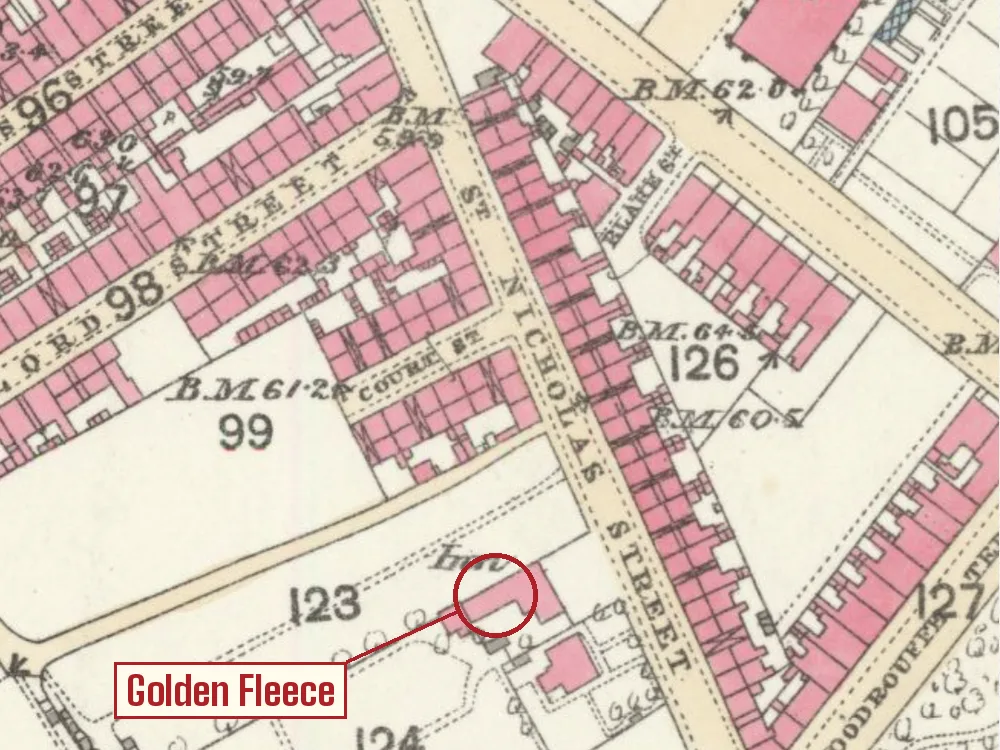
It was a house with land. The 1866 to-let notice lists two front parlours, five bedrooms, a kitchen and back kitchen, a good cellar, two stables, a gig house 'and a very productive Garden, of about an Acre, behind'. The Ordnance Survey's 25-inch map surveyed in 1864 shows the inn set back from the street with the garden and a field behind it, and there was still a field beside it in 1877, when a builder's stock was auctioned there. The owners were the Browns: William Brown of St Nicholas in 1858 and 1859, and John Brown of Welton in 1866.
Murray lasted six months. His furniture and stock were sold under a county court warrant in April 1858, and by July he was a labourer in Union Street, petitioning as an insolvent debtor. Stephen Sharp had the house by June 1858, until the owner let it again from Whitsuntide 1860; by 1861 Sharp was keeping the Buck on Corporation Road, which took the Golden Fleece name at about that time, very probably from him (see the Golden Fleece, Corporation Road).
Joseph Forster, a former grocer and bookkeeper from Lowther Street, had it by May 1861, when he offered its stables to let as warerooms. He went bankrupt in 1863, was discharged that August, and stayed on. His New Year rabbit coursing, for 14-, 16- and 19-inch dogs with silver prizes, held in a field called Birney's meadow and later near Botcherby, drew bigger crowds than any such meeting the city had seen, and by 1865 was 'one of the most important meetings of the kind in the north of England'. Coursing men came back to the Golden Fleece to settle their stakes.
Standing between the railway yards and the St Nicholas crossing, it was where the coroner sat for the district. On 27 December 1858 the inquest was held there on James McGibbon, a 26-year-old who took waggon numbers for the railway clearing house, killed by a Caledonian engine running tender first near the crossing; the jury asked for lights at both ends of tenders. Others followed: James Haddow, a fourteen-year-old engine cleaner crushed between buffers in 1869; Margaret Parker in 1885, whose drunken husband was held on suspicion of poisoning her until the analyst cleared him; a London and North Western shunter killed in the goods yard in 1886; and old people and children from the streets around, to 1905.
In November 1877, during closed hours on a Sunday morning, two plain-clothes constables were shown round the house by the landlord, Mr Phillips, who called one of them 'the biggest scamp in Carlisle'. Upstairs he opened his son's bedroom door, and the son, a commercial traveller with about £300 on him, hit the constable on the nose. 'I think it was a good 'un,' the landlord told the bench. The son was acquitted, to applause in court.
Peter James Peascod kept it from about 1884 to 1886. His servant sued him in 1886, without success, after he sacked her for lighting the kitchen fire before the bar fire; he had also blown out her candle on the stairs, saying he could not afford candles burning in the bedrooms. The bench had allowed him singing in the house, and he moved on to the Old Bush. William Lees kept it in 1891 and 1897, and Thomas Edward Nicholson in 1906.
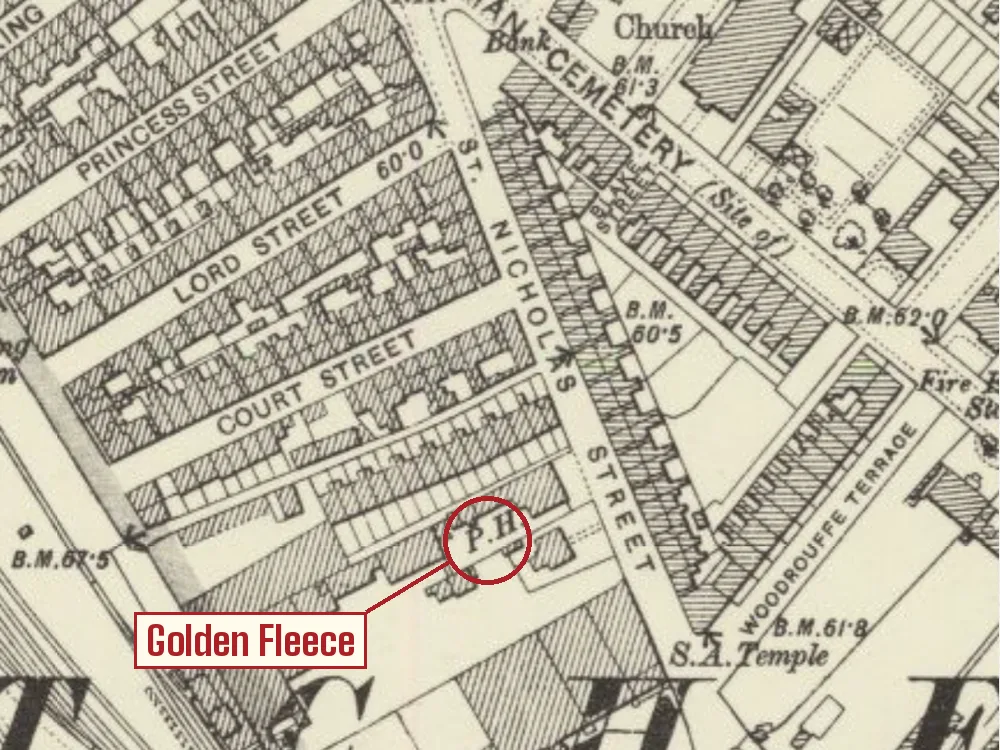
The Maryport Brewery owned it from 1894. In June 1897 it asked the magistrates to let it bring the frontage nineteen feet forward over the waste ground in front, for a larger bar, a smoke room, five bedrooms and an assembly room: 'practically to turn what had been an inn into an hotel'. George Armstrong was the architect. The 25-inch map revised in 1899 still shows the house standing back from the street. That year the Chief Constable gave it as fully licensed and only 45 yards from the White Ox, which was refused a full licence that September; the White Ox's tenant put the distance at 60 or 70 yards.
The state took it in 1916. In 1917 it was run by a salaried manager, Thomas William Sproat, on £3 a week with a free house, coals and goods such as soap; his appeal against call-up failed that August. In 1922, when Colonel Claude Lowther complained that the Board had taken away the well-kept houses of men such as Henry Skelton and John Minns, the Advisory Committee's chairman listed the Golden Fleece among the eleven houses those men had run, and pointed out that it was still licensed under the scheme.
One record ends its life as a pub in 1934; the South End Constitutional Club took the building in 1936. Historic England's gazetteer treats it as later part of the White Ox and closes it in 1935, when Redfern's new Earl Grey opened on 9 July and the scheme shut the Golden Fleece, the St Nicholas and the Queen Adelaide nearby. The Board's sale of 'formerly the White Ox Inn premises' on the street in April 1919 makes that merger hard to credit: the White Ox was a shop by then.
The Cumberland News of 16 April 1992 says drinking on the site has gone on since 1858, and that the directories show the Golden Fleece in business for around three-quarters of a century, closing in about 1934. A few doors along, the Golden Lion survives as Gallagher's: two Golden pubs on one short street, one lost and one still serving.
Photograph
Sources 36
- geograph.org.uk
- CARLISLE_PUBS_Ver_3.xls (Mike Tuer's pub database)
- Historic England, Countering the 'deadliest of foes': public houses of the Central Control Board and the State Management Scheme, 1916-73 (Clare Howard, Research Report 89-2018): Appendix C, gazetteer of scheme premises
- The Cumberland News, 19 April 1919, p. 10: Fred Telford's advertisement of the Central Control Board's auction of fourteen Carlisle properties, Victoria Hotel, 30 April 1919 (via newspapers.com)
- The Cumberland News, 18 November 1922, p. 9: 'Control in Carlisle', letters of Colonel Claude Lowther and G. A. Rimington (via newspapers.com)
- The Cumberland News, 16 April 1992, p. 4: 'Pubs of yesteryear', South End Constitutional Club, on the site of the Golden Fleece (via newspapers.com)
- Carlisle Patriot, 10 September 1897, p. 3: 'Licensing Sessions: City of Carlisle' (via Findmypast)
- Bulmer's History, Topography and Directory of East Cumberland (1884), Carlisle: hotels, inns and taverns, beerhouses, and wine and spirit merchants (University of Leicester digital copy)
- Kelly's Directory of Cumberland (London: Kelly and Co., 1897), Carlisle: street directory and public houses (University of Leicester digital copy)
- Kelly's Directory of Cumberland (London: Kelly and Co., 1906), Carlisle: street directory and public houses (University of Leicester digital copy)
- Carlisle Journal, 16 October and 6 November 1857, p. 4: William Murray's advertisement, Golden Fleece Inn, St Nicholas (via British Newspaper Archive)
- Carlisle Examiner, 20 April 1858, p. 1: sale under a warrant of execution, the effects of Mr Wm. Murray (via British Newspaper Archive)
- Carlisle Journal, 7 May 1858, p. 1: the Golden Fleece Inn, St Nicholas, to let, apply Wm. Brown, the owner (via British Newspaper Archive)
- Carlisle Journal, 11 June 1858, p. 1: apply Stephen Sharp, Golden Fleece Inn, St Nicholas (via British Newspaper Archive)
- Carlisle Journal, 2 July 1858, p. 4: insolvency petition of William Murray (via British Newspaper Archive)
- Carlisle Examiner, 28 December 1858, p. 3: 'Man killed near the St. Nicholas crossing', inquest at the Golden Fleece Inn (via British Newspaper Archive)
- Carlisle Journal, 30 December 1859, p. 1: the Golden Fleece, St Nicholas Street, to let from Whitsuntide 1860 (via British Newspaper Archive)
- Carlisle Journal, 14 May 1861, p. 1: stabling to let, apply Jos. Forster, Golden Fleece Inn (via British Newspaper Archive)
- Carlisle Journal, 6 January 1863, p. 4: 'St. Nicholas New Year's rabbit coursing' (via British Newspaper Archive)
- Carlisle Journal, 7 August 1863, p. 6, and 4 September 1863, p. 4: bankruptcy and discharge of Joseph Forster (via British Newspaper Archive)
- Carlisle Journal, 17 November 1863, p. 4: 'Rabbit coursing match on Burgh Marsh' (via British Newspaper Archive)
- Carlisle Journal, 5 January 1864, p. 4: 'Rabbit coursing' (via British Newspaper Archive)
- Carlisle Journal, 6 January 1865, p. 5: 'Rabbit coursing' (via British Newspaper Archive)
- Carlisle Journal, 10 April 1866, p. 1: 'Public house to let', the Golden Fleece Inn, St Nicholas Street (via British Newspaper Archive)
- Carlisle Patriot, 5 March 1869, p. 5: 'Fatal accident in Carlisle', inquest on James Haddow (via British Newspaper Archive)
- Carlisle Patriot, 22 June 1877, p. 1: sale in a field adjoining the Golden Fleece Inn (via British Newspaper Archive)
- Carlisle Patriot, 23 November 1877, p. 10: 'Alleged assault on a police officer: peculiar case' (via British Newspaper Archive)
- Carlisle Patriot, 4 September 1885, p. 5, and 11 September 1885, p. 3: the Margaret Parker inquest (via British Newspaper Archive)
- Carlisle Patriot, 16 April 1886, p. 6: 'Claim for wages', Kenyon v. Peascod (via British Newspaper Archive)
- Carlisle Patriot, 24 September 1886, p. 3: inquest on a London and North Western shunter (via British Newspaper Archive)
- Carlisle Journal, 6 September 1887, p. 2: 'Application for a free and easy' (via British Newspaper Archive)
- Carlisle Patriot, 17 May 1889, p. 5; Carlisle Patriot, 4 April 1890, p. 5; Carlisle Journal, 10 March 1905, p. 5: inquests at the Golden Fleece (via British Newspaper Archive)
- Carlisle Patriot, 18 June 1897, p. 3: 'Alterations to licensed premises' (via British Newspaper Archive)
- Carlisle Journal, 30 July 1897, p. 8: contractors wanted, alterations to the Golden Fleece Inn, George Armstrong, architect (via British Newspaper Archive)
- Cumberland Evening News, 30 August 1917, p. 1: 'Manager of a state inn' (via British Newspaper Archive)
- Ordnance Survey 25-inch map, Cumberland sheet XXIII.8, surveyed 1864 (published about 1865) and revised 1899 (published 1901), National Library of Scotland
Also lost on St Nicholas Street
6 other lost pubs stood within 250 m of here. See them on the map
Still serving, near where it stood
-
10 maway
-
80 maway
-
130 maway
-
140 maway