Lost pub · Durdar Road
The Black Lion
- Built
- Old inn trading by 1829; Redfern's new building opened 6 May 1929, extended 1969
- Gone
- Closed as a pub 14 July 2024
- There now
- Dora Turkish Cuisine
- Address
- 517 Durdar Road
- Where exactly
- Placed from the Ordnance Survey grid reference, NY4048350998, in Historic England's gazetteer of the scheme's premises. The building's use in 2018: public house (Black Lion).
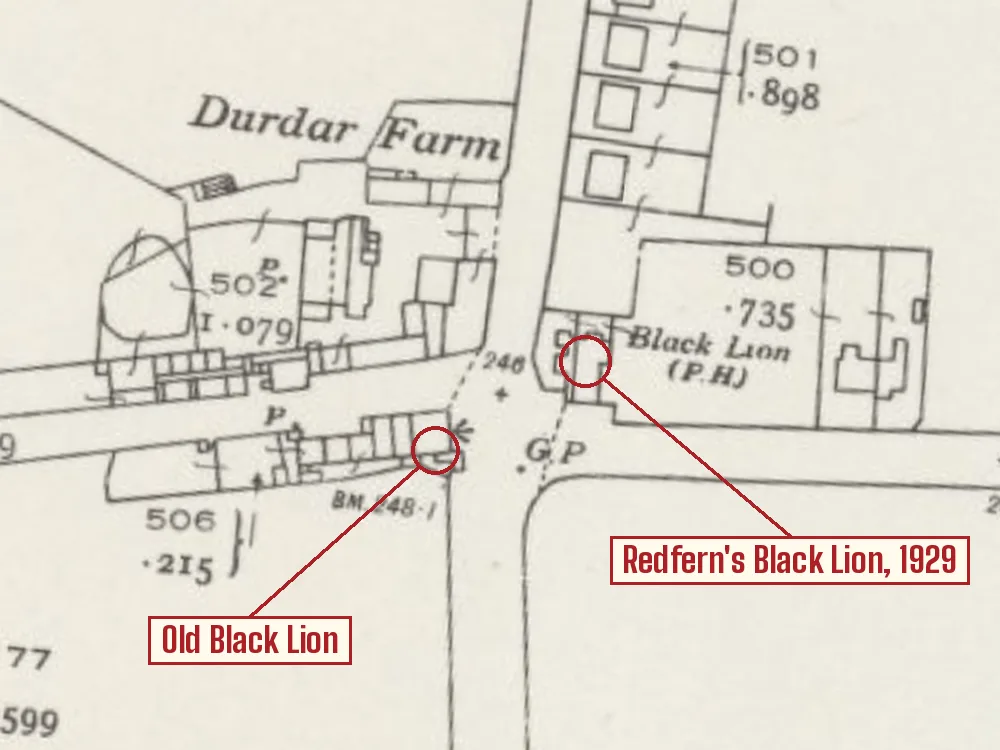
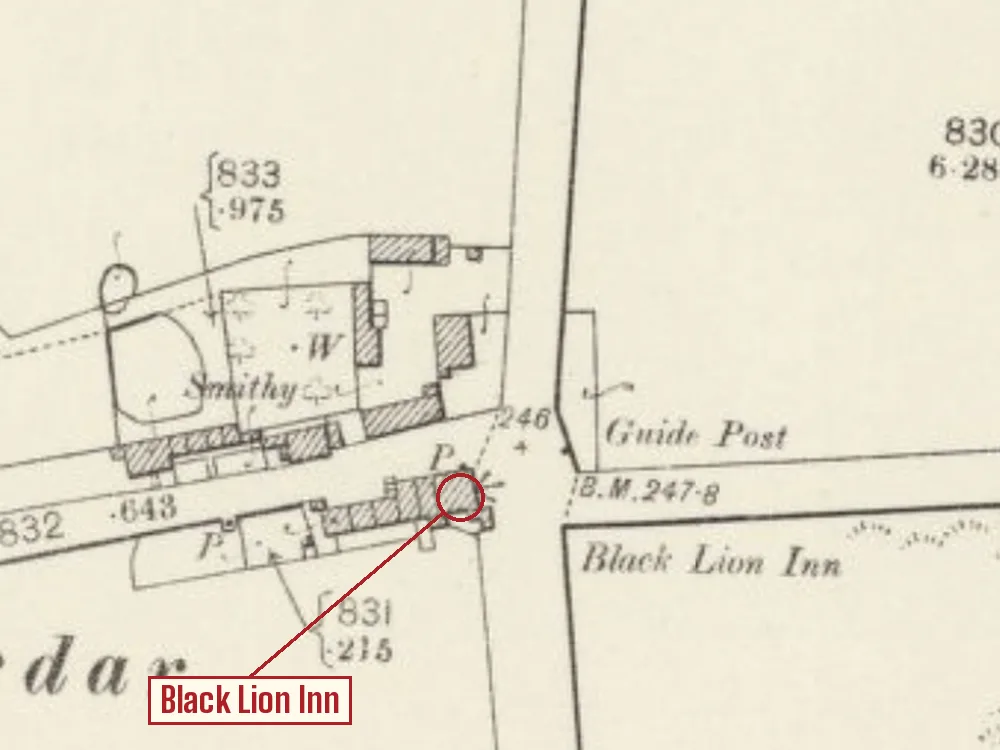
Two Black Lions face each other across the crossroads at Durdar, about three miles south of the Cross. The older one, on the south-west corner, was the village inn for at least a century. The newer one, across the road, is where Harry Redfern first built in the manner that shaped every model pub the State Management Scheme put up afterwards. Neither is a pub now, though the parish record still identifies the place by its pub: a small suburban area based around a crossroads, with a pub, the Black Lion, and a petrol station.
The old inn was an Iredale's house, trading before 1829 and possibly from about 1780. Parson and White's directory of 1829 describes Durdar as 'two farms, a public-house, and several cottages', and gives Thomas Graham as its victualler. He was still there in 1838, when the tithe commissioners met the landowners of Blackhall High and Low in his house, and for the rest of the century the inn was the township's meeting room and saleroom. Roger Cowperthwaite had it by 1859, when a 64-acre estate at Durdar was auctioned there. In 1861 the farmers of the district met in it to give William Nichol, gamekeeper at Blackwell Wood, a silver watch for minding their stock, putting straying cattle right or telling the owners.
Cowperthwaite was less careful with the hours. In November 1865 a constable from Upperby watched four men leave by the front door and two by the back at a quarter to two on a Sunday morning, saw the landlady go into the bar and lock it, and found that 'the table was wet, as if from ale'. It was the landlord's second fine in four years. Two years later two cottages and nine acres at Durdar were sold in the inn, with 133 oaks 'suitable for ship-building'.
Richard Howe, perhaps the Richard Howe who had kept the Red Cat down the road in 1871, did worse. Convicted four times in two years, he had his licence held back a month in 1877 and again in 1879, when the bench advised him to hand it to someone who would run the house properly. By 1881, when the inn was put up for auction with the cottage next door, John McNeil was the tenant and Howe lived in the cottage. McNeil advertised a picnic that July, with dancing from three o'clock.
Durdar's Sunday trade rested on a technicality. A bona fide traveller, someone who had come three miles, could be served when the town pubs were shut, and Durdar is about three miles from the Cross. In December 1883 a constable came in by the back door at a quarter to five on a Sunday and found twelve Carlisle men drinking in the kitchen, one very drunk. The landlady, Jane Ion, said they had not got it all there, and her solicitor that she thought the house was more than three miles out. The bench told her that going 'just three miles for the purpose of drinking' made no one a traveller, fined her £3 and endorsed her licence.
The sales went on: in 1886 Cotton Hall, a house and six acres on the road into town, was knocked down in the inn to its tenant for £605 after brisk bidding from £400. By 1889 Henry Handy had the house, and that August he ran wrestling contests on Saturday evenings. The same month a sergeant and a constable hid near the house on a Sunday morning and watched men slip in at the back. Inside they found Richard Howe, the old landlord, now a joiner, but not the farm labourer who had gone in with him.
Mrs Handy invited a search, then, as the sergeant reached a bedroom, said 'I really must protest against you searching my bed without a warrant.' He looked under it and found the labourer. The men said they had come about some potatoes, and the bench, though it had 'very strong suspicion', dismissed the case.
Handy's own end was worse. At the licensing day of August 1890 the superintendent said his wife had often appealed to the police for protection from him, and the bench held back his licence. His furniture was sold at the inn in September, mahogany sideboard, hair-seated sofa, settles and '24 splendid pewter pints' among it, Mr Handy 'retiring from business'. Days before, he had gone to Cumwhinton, where his wife was living under a separation order, thrown a book at her and threatened to 'finish' her. A warrant was issued, and he was said to have gone to Bristol.
The licence passed to Joseph Martin of the Blue Bell at Carleton, though the superintendent mentioned that his wife, too, had come to the police office that New Year's Day, saying he had turned her out without any clothing. His solicitor advised him to keep on good terms with her, 'or it would prove an unfortunate thing for the house'. Martin passed it on in February 1893 to Edward Cartner, who died within months; his widow, Mary Jane Cartner, kept it until her own death, and in 1902 it went to her daughters, Mrs Potts and Miss E. Cartner. Mrs Eleanor Mark had it in 1906.
Elizabeth Gunn held the licence from about 1909, and in 1912 had new potatoes from her own garden on Whit Sunday, some almost three inches long. In October 1913 the three-mile rule came round again: nine Denton Holme men were found with a pint each at ten past eleven on a Sunday morning. The constable had measured every route, including a footpath over the Maryport and Carlisle Railway with a stile on each side, and none reached three miles. Mrs Gunn said she always asked; she had once held the door in the superintendent's own face until he told her he was the chief. 'Very likely you did,' he said, to laughter. The men were let off on paying costs.
The Central Control Board placed the old Black Lion under its direct management in March 1918, and eleven years later built its replacement across the road. Durdar was the first place Redfern was allowed to work in his favourite Arts and Crafts manner: the English country-house ideal, asymmetrical, deep hipped roof, dormers, high chimneys. He had built houses in that style for Cambridge dons before he came north. The Spinners, the Magpie and the Redfern itself all descend from what he did on Durdar Road; the Apple Tree, designed in 1925, came before it and is a town pub in a different manner.
Redfern was fond of this one. In April 1927 he wrote that he had 'been working on this little building over the holiday, because it interests me very much and I think the result would be a success.' His plans are dated 29 October 1927, and John and Robert Bell of Carlisle built it: two storeys of brick, since painted, under a steep hipped roof of red-brown clay tiles, with a two-bedroomed manager's flat upstairs. It was the scheme's first new country pub, and its first with a tea room that doubled as a smoking room: only a glazed screen divided the two.
A central servery gave counter service to the public bar and table service to the other rooms through a lobby. Each room had its own outside door, big windows and a fire. The public bar and smoking room had brown chairs from Messrs North of City Road, London, and the tea room black Windsor chairs. The plot was big enough for a bowling green, but it only ever got strips of grass, paving and a rose bed.
It opened on 6 May 1929, the first of the three pubs Redfern and J & R Bell put up that year, four months ahead of the Coach & Horses and the Horse and Farrier. The scheme's annual report for the year to 31 March 1929 already lists it as 'completed and opened to the public', which sits awkwardly with the May date, though the report was issued that autumn and seems to have counted it in; it describes an up-to-date country pub with separate accommodation for teas and other meals. The Cumberland News of 8 June 1929 calls it 'a new inn ... lately opened at Durdar'. The old inn across the road became a private house, which it still is.
The scheme extended the new one in 1969, wrapping the east and north sides and moving the main entrance, while the tea room, porch and smoking room were knocked into one bar; the 1972 sale particulars list a public bar, lounge bar, bottle store and cellar. The scheme sold it to John Smith's on 9 May 1973. By 2016 the windows were all uPVC, and Historic England rated the building of low architectural significance, while calling it a close relation of the Wheatsheaf at Abbeytown and the Horse and Farrier at Raffles.
Its last decade was restless. It went up for sale in August 2016 at £225,000, shut for refurbishment from February to October 2017, was taken on by Hawksdale Inns, and was fully refurbished again in 2022 under new owners. It traded well in between: five minutes from junction 42 and along the road from the racecourse, which had moved to Durdar in 1904 when it left the Swifts by the Eden (the Turf in town was the old course's grandstand). It was heaving on race days, and known for using local butchers and suppliers and for an unusually good vegan menu for a country pub.
Then it closed on 14 July 2024, and CAMRA marked it closed long term five days later, seeking new tenants. None came. It is Dora Turkish Cuisine now. One absence says more than any of this. Redfern's other suburban pubs are protected: the Spinners at Cummersdale is listed, so is the Horse and Farrier, so is the Redfern Inn. The Black Lion is not listed. The building where the style began is the only one of them with no statutory protection at all, and it is the one that has stopped being a pub.
Not to be confused with the Black Lion at Hethersgill, out east, which was also on the scheme's roll and is still open, or the Black Lion at the foot of Irishgate Brow in the city, which closed in the 1860s.
Photograph
Sources 42
- CAMRA WhatPub: Black Lion, Durdar
- Pub Gallery: Harry Redfern's Carlisle legacy
- The Carlisle Kid: the original Black Lion, via Geograph
- St Cuthbert Without parish
- The State Management Story
- CARLISLE_PUBS_Ver_3.xls (Mike Tuer's pub database)
- SOLWAY_PUB_DIRECTORY_Excl_Carlisle_Ver1.xls (Solway CAMRA / Stirling's list of Cumberland public houses, 1829-1938)
- Mike Tuer, "Pubs of Carlisle" Day 145, Old Photos of Carlisle and Surrounding Area (Facebook)
- Historic England, Countering the 'deadliest of foes': public houses of the Central Control Board and the State Management Scheme, 1916-73 (Clare Howard, Research Report 89-2018): Appendix C, gazetteer of scheme premises
- Historic England, Countering the 'deadliest of foes': public houses of the Central Control Board and the State Management Scheme, 1916-73 (Clare Howard, Research Report 89-2018): Appendix B, summaries of key State Management public houses
- The State Management Story documents: State Management Districts annual report, year to 31 March 1929
- Carlisle newspaper, 10 June 1941: obituary of R. C. Bell of J & R Bell, builders (via newspapers.com)
- The Cumberland News, 23 March 1918, p. 5: report of the Carlisle Advisory Committee of the Central Control Board (via newspapers.com)
- The Cumberland News, 8 June 1929, p. 10: 'Model inns for the suburbs' (via newspapers.com)
- Carlisle Patriot, 3 October 1890, p. 2: 'County Police Court', the black list (via British Newspaper Archive)
- W. Parson and W. White, History, Directory, and Gazetteer of the Counties of Cumberland and Westmorland (Leeds, 1829), p. 170: Blackwell High: Graham Thomas, vict. Black Lion, Durdar; 'Durdar, two farms, a public-house, and several cottages' (University of Leicester digital copy)
- Kelly's Directory of Cumberland (London: Kelly and Co., 1897), Carlisle: street directory and public houses (University of Leicester digital copy)
- Kelly's Directory of Cumberland (London: Kelly and Co., 1906), Carlisle: street directory and public houses (University of Leicester digital copy)
- Carlisle Journal, 28 April 1838, p. 2: tithe commutation meeting at Thomas Graham's, Black Lion Inn, Durdar (via British Newspaper Archive)
- Carlisle Journal, 23 December 1859, p. 1: estate at Durdar, sale at Mr R. Cowperthwaite's, Black Lion Inn (via British Newspaper Archive)
- Carlisle Examiner, 3 September 1861, p. 3: presentation to William Nichol at the Black Lion Inn, Durdar (via British Newspaper Archive)
- Carlisle Patriot, 4 November 1865, p. 6: Roger Cowperthwaite, Black Lion, Durdar (via British Newspaper Archive)
- Carlisle Journal, 23 August 1867, p. 1: cottages, land and oak timber at Durdar, sale at the Black Lion (via British Newspaper Archive)
- Carlisle Express and Examiner, 15 September 1877, p. 7: county brewster sessions (via British Newspaper Archive)
- Carlisle Express and Examiner, 13 September 1879, p. 2: county brewster sessions, the black list (via British Newspaper Archive)
- Carlisle Journal, 28 January 1881, p. 1: 'Valuable inn and cottage at Durdar' (via British Newspaper Archive)
- Carlisle Journal, 15 July 1881, p. 4: picnic at the Black Lion Inn, Durdar (via British Newspaper Archive)
- Carlisle Express and Examiner, 5 January 1884, p. 2: Jane Ion, Black Lion Inn, Durdar (via British Newspaper Archive)
- Carlisle Patriot, 22 October 1886, p. 1, and 5 November 1886, p. 5: sale of Cotton Hall at the Black Lion Inn, Durdar (via British Newspaper Archive)
- Carlisle Journal, 9 August 1889, p. 4: wrestling contest at the Black Lion Inn, Durdar (via British Newspaper Archive)
- Carlisle Express and Examiner, 31 August 1889, p. 7: 'In search of beer or potatoes?' (via British Newspaper Archive)
- North Cumberland Reformer, 4 September 1890, p. 8, and Carlisle Patriot, 5 September 1890, p. 3: Cumberland Ward licensing day (via British Newspaper Archive)
- Carlisle Journal, 12 September 1890, p. 1: sale of Mr Henry Handy's furniture at the Black Lion, Durdar (via British Newspaper Archive)
- Carlisle Journal, 23 September 1890, p. 3, and North Cumberland Reformer, 25 September 1890, p. 8: temporary transfer; assault on a wife at Cumwhinton (via British Newspaper Archive)
- Carlisle Journal, 30 September 1890, p. 2: adjourned county licensing sessions (via British Newspaper Archive)
- North Cumberland Reformer, 13 November 1890, p. 8: transfer, Henry Handy to Joseph Martin (via British Newspaper Archive)
- North Cumberland Reformer, 2 February 1893, p. 3: licence transfers (via British Newspaper Archive)
- Carlisle Journal, 1 August 1893, p. 4, and North Cumberland Reformer, 3 August 1893, p. 3: licence transfers (via British Newspaper Archive)
- Carlisle Journal, 4 February 1902, p. 3: licence transfers (via British Newspaper Archive)
- Carlisle Journal, 28 May 1912, p. 4: Mrs Gunn's new potatoes (via British Newspaper Archive)
- Carlisle Journal, 4 November 1913, p. 2: 'Denton Holme men summoned: were they bona-fide travellers?' (via British Newspaper Archive)
- Ordnance Survey 25-inch map, Cumberland XXIII.16, revised 1899 and 1938 (National Library of Scotland)
Also lost on Durdar Road
Still serving, near where it stood
-
2.4 kmaway
-
2.8 kmaway
-
2.8 kmaway
-
2.9 kmaway