Etterby, Carlisle
Redfern Inn
The last of the New Model Inns, opened 1 October 1940 and named in tribute to Redfern after ill health stopped him working. His assistant Joseph Seddon designed it.
Sold to Greenall Whitley as part of Group 4, handed over on 22 May 1973. Who bought the rest
Community local on Kingmoor Road, full of darts and pool teams. Well-kept beer, no food.
Part of Punch Pubs & Co
- Today
- See opening hours
- Address
- Kingmoor Road, Etterby, Carlisle CA3 9PS
- Phone
- 01228 549330
History
Opened 1 October 1940
- Built
- 1939-40
- Opened
- 1 October 1940
- Architect
- Joseph Seddon, in Redfern's style
- Listed
- Grade II
- Built for
- RAF Maintenance Unit 14 MU at Kingmoor
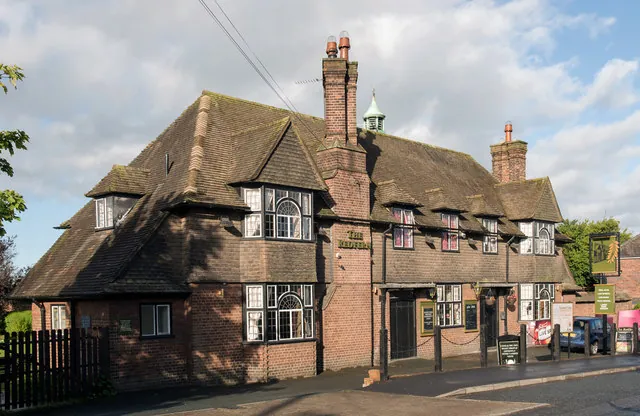
The pub named after the architect, which he did not design, and he said so himself. By 1936 Harry Redfern's health had gone; he had a heart attack that December and his wife died the following May. The job fell to his assistant Joseph Seddon, working in his style and with his input, and the scheme named the result in Redfern's honour. When he finally saw it he said he had fallen in love with the building and would be proud to have designed it, but that all the kudos for that goes to our good Seddon. The plans, dated 15 December 1938, carry Redfern's signature all the same, and a copy of that letter hangs on the pub wall.
It is the odd one out chronologically. Almost every scheme pub was a First World War response; this was a Second World War build, put up in 1939-40 on a green-field site in a residential area to add capacity when the RAF opened Maintenance Unit 14 at Kingmoor and brought around three thousand workers into the district. Three temperance societies objected, the British Women's Total Abstinence Union, the Good Templars and the Rechabites, and the scheme waved them off as a minority. J & R Bell built it, as they had the Spinners, the Cumberland and the Black Lion before it, and it opened on 1 October 1940. Some listings say 1938; the October 1940 opening is the documented date.
It was the last of its line, and the counting finally makes sense here. The listing calls it the sixteenth and last public house built before the Second World War under the scheme. Fourteen and fifteen are both in print elsewhere for the number Redfern designed: sixteen built, fifteen of them his and this one Seddon's, reconciles the figures, and the disagreement has been between people counting different things. Historic England's study uses the same sixteen for the model inns of 1925 to 1940, and counts twenty-seven new pubs built across the scheme's whole life, from 1916 to 1973.
The awkward site is the bowling green's fault, and that is the best thing about this building. It was agreed at the outset that the design must include a green, and there was only one position on the plot where it would go. So the pub was arranged around it: a single-storey verandah tucked into the angle of the rear walls, looking out over the green, with a serving hatch set in it to pass drinks out. The scheme's argument about fresh air and games instead of standing at a bar did not just get a mention in the plans. It decided where the walls went.
Red brick below, red tile-hung above, red tile roofs, Arts and Crafts, seven bays across a roughly symmetrical front with canted bay windows under gables at each end and three dormers between. The plan is still legible: a large public bar on the left, and to the right two more bars radiating from what was a circular hall, the further one originally the tea and smoking room. Wooden panelling to two-thirds height with reeded detail, roaring fires, original door furniture, and a restored carved bar that gets called a masterpiece.
It was listed Grade II on 17 May 2000, list entry 1380323, and CAMRA place its interior on the National Inventory at two stars, of very special national historic interest, which only a handful of pubs in the country hold. They rate it the best preserved of the whole scheme after the Cumberland Inn.
Things have crept in. CAMRA compare the pub against the plan published in Basil Oliver's The Renaissance of the English Public House: the public bar counter has been extended, the wall between the right-hand front room and the one behind it largely removed, some fireplaces replaced. The panelling survives in every room, and a great deal of the door furniture with it. Historic England's survey in 2016 judged the public bar's panelling later work, but found the old smoking room and tea room still panelled, with fireplaces, cornice and the marks of the bell pushes. By then the ground-floor verandah had been enclosed as a kitchen. A 2013 refit stripped and revarnished it all.
The green itself is the loss. Out of use for bowls by 2016, reported sold for housing the same year, and recorded by CAMRA as under threat from development. If it goes, the verandah and its hatch will be looking at somebody's back fence, and the one Redfern pub that was actually planned around its green will have lost the thing that shaped it. The Horse and Farrier had the first of the scheme's greens and the Rose & Crown at Upperby had one too; that pub was demolished in 2013 and is the only Redfern new-build to have been lost outright. Consent for seven houses on it was granted in September 2016.
It was sold into private ownership in 1973. It shut suddenly early in 2015; Punch told Solway CAMRA it was a key part of their business and reopened it that summer, and after another closure it was open again by the turn of the year, when the branch applied to have it listed. Punch hold the freehold now and it is registered as an Asset of Community Value. Paul Creighton held the licence from 2015 to 2020. No food, no cask ale at last survey, and a room full of darts and pool teams.
- Historic interior
- No food
- Pool / darts
- Real ale
- Traditional
Photographs
Opening hours
| Mon | 16:00–midnight |
| Tue | 16:00–midnight |
| Wed | 16:00–midnight |
| Thu | 16:00–midnight |
| Fri | 12:00–midnight |
| Sat | 12:00–midnight |
| Sun | 12:00–midnight |
Hours last checked August 2026, about 2 months ago.
Hours are kept by hand and change without warning. Ring ahead if it matters.
More like this
Nearest to here
-
990 maway
-
1.0 kmaway
-
1.1 kmaway
-
1.1 kmaway
Sources
- Historic England list entry 1380323
- CAMRA National Inventory: two star, of very special national historic interest
- The Carlisle Kid, 2016, via Co-Curate: J & R Bell, the green-field site and the bowling green sale
- The State Management Story: the architect
- Co-Curate: the Redfern, Etterby
- Basil Oliver, The Renaissance of the English Public House (1947), for the original plan
- The State Management Story: the Redfern Inn, with Redfern's own verdict on Seddon
- Historic England list entry text via British Listed Buildings
- Ale Tales (Solway CAMRA), Spring 2015: Pub of the Year and Bar Fly news
- Ale Tales (Solway CAMRA), Summer 2015: Cumbria Pub of the Year, Ale Trail and Bar Fly news
- Ale Tales (Solway CAMRA), Winter 2016: Alan Welsh, Our 40th Anniversary; Pub of the Season; Bar Fly news
- Historic England, Countering the 'deadliest of foes': public houses of the Central Control Board and the State Management Scheme, 1916-73 (Clare Howard, Research Report 89-2018)
- Historic England, Countering the 'deadliest of foes': public houses of the Central Control Board and the State Management Scheme, 1916-73 (Clare Howard, Research Report 89-2018): Appendix B, summaries of key State Management public houses
- Carlisle newspaper, 10 June 1941: obituary of R. C. Bell of J & R Bell, builders (via newspapers.com)
Know more about this one?
History, a story, a correction, or just what it was called before: Redfern Inn is better on this site when locals fill it in.