Lost pub · Crown Street
The Goliah Hotel
- Built
- In local directories from 1855
- Gone
- 2 October 1938
- There now
- Demolished; a car park by 2018
- Address
- 6 Crown Street
- Where exactly
- Placed from the Ordnance Survey grid reference, NY4032355271, in Historic England's gazetteer of the scheme's premises. The building has since been demolished.
A pub on the corner of Crown Street and Robert Street, in Carlisle directories from 1855 and by one record trading from 1850. The Goliah was apparently named after a locomotive on the Newcastle and Carlisle Railway, as the Samson on London Road was named after another. It was also spelled the Goliath at one time, and the Brewery History Society's 1920 roll of scheme pubs spells it that way. John Miller signed the innkeepers' memorial of February 1867 for the Goliah.
In June 1886 the licence passed from T. H. Parker, manager to the Old Brewery Company, to Thomas Watson, huntsman to the Cumberland Foxhounds. In the spring of 1889 Watson won a £5 pigeon-shooting match against Edward Thompson of the Howard Arms at the White Quey, ten birds to eight, and in September 1892 the licence passed from him to Robert Hastings. It was a Maryport Brewery house from 1892. Thomas Edgar kept it in 1897 and James Hewitt in 1906, and there is a photograph of the pub in 1902 in Carlisle: The Archive Photographs.
The scheme acquired it in September 1916, and it was on the Board's first list of reconstructions, seven houses recommended for 'very large alterations' by November 1916.
A contemporary account of the scheme's improved pubs singles it out. Writing while the work was going on, it describes the Goliah as being in one of the poorest parts of the city, adapted for the supply of meals, and fitted with a cookshop for an outdoor trade in food. The Cumberland News of 13 October 1917 confirms the takeaway, listing the Goliath among the Board's houses for workers, with arrangements for the off sale of food on lines the paper compared to a communal kitchen. A state-run takeaway counter, in about 1917, in the district that needed it most. That is the scheme's food policy at its most practical, and it is more interesting than anything it did at the smart end of town.
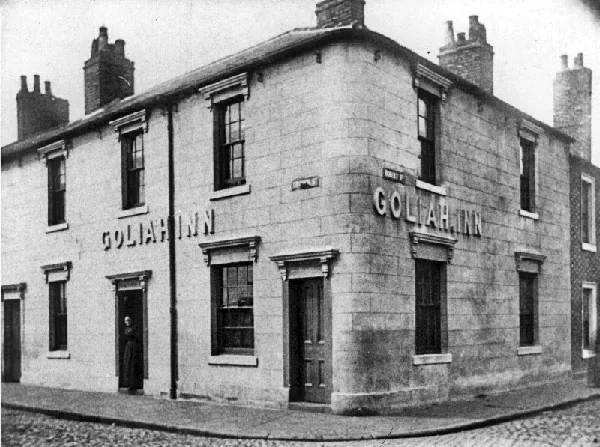
The Cumberland News of 26 July 1991 says it closed in 1917, but only temporarily. A reader, Tony Graham, added a week later that the closure was to modernise the premises, that the main door was then converted to a double door, which can be seen at the far left of the photograph, and that the name changed from Goliah to Goliath at that time. In his young days he was given sixpence to help home the drunks who were not capable of walking properly. The 1991 column says Wilson Stuart's Drink Nationalisation in England and Its Results, published in 1927, named it among the more undesirable city pubs, one of those with eating rooms that admitted children alongside public bars where foul language was to be heard.
In November 1922, answering Colonel Claude Lowther's complaint that the Board had taken away the well-kept houses of the old licensees, men such as 'Bulman and Hewitt', the Advisory Committee's chairman listed the Goliath among the eleven houses they had run, presumably James Hewitt's, and pointed out that it was still licensed under the scheme. It stayed so for another sixteen years. It closed on 2 October 1938, the day before the Cumberland Wrestlers opened on Currock Street to replace it.
It was on the Board's list of houses to open on Sundays from February 1919, 'also open for teas'. When the new Wrestlers was planned in 1937 the scheme said it would then consider closing two other houses in the neighbourhood, and its annual report of 1939 said the improved Wrestlers had made it practicable to close them: the Goliath and the London and North-Western Railway Inn.
Photograph
Sources 18
- The State Management Story
- A contemporary account of Carlisle's improved pubs, via Shut Up About Barclay Perkins
- The Control of the Drink Trade (Longmans, Green & Co., 1919), pp.216-217
- CARLISLE_PUBS_Ver_3.xls (Mike Tuer's pub database)
- Historic England, Countering the 'deadliest of foes': public houses of the Central Control Board and the State Management Scheme, 1916-73 (Clare Howard, Research Report 89-2018): Appendix C, gazetteer of scheme premises
- The Cumberland News, 13 October 1917, p. 5: 'Control Board's restaurant scheme complete' (via newspapers.com)
- The Cumberland News, 4 November 1916, p. 5: 'The Control Board: progress of the Carlisle scheme' (E. C. Sanders's report of 1 November) (via newspapers.com)
- The Cumberland News, 18 November 1922, p. 9: 'Control in Carlisle', letters of Colonel Claude Lowther and G. A. Rimington (via newspapers.com)
- The Cumberland News, 26 July 1991, p. 4: 'Pubs of yesteryear', Goliah Inn, Crown Street (via newspapers.com)
- The Cumberland News, 2 August 1991, p. 4: 'Pubs of yesteryear', Bricklayer's Arms, Caldewgate, with a reader's memory of the Goliah (via newspapers.com)
- Carlisle Patriot, 11 June 1886, p. 3: 'Carlisle Police Court', transfer of licences (via British Newspaper Archive)
- Carlisle Journal, 6 September 1892, p. 3: brewster sessions, transfers and the black list (via British Newspaper Archive)
- Carlisle Journal, 22 February 1867, p. 6: the Public Houses Closing Act and the innkeepers' memorial (via British Newspaper Archive)
- Kelly's Directory of Cumberland (London: Kelly and Co., 1897), Carlisle: street directory and public houses (University of Leicester digital copy)
- Kelly's Directory of Cumberland (London: Kelly and Co., 1906), Carlisle: street directory and public houses (University of Leicester digital copy)
- Carlisle Express and Examiner, 4 May 1889, p. 8: pigeon shooting match (via British Newspaper Archive)
- The Cumberland News, 8 February 1919, p. 9: houses to open on Sundays (via newspapers.com)
- The Cumberland News, 10 July 1937, p. 10, and 2 December 1939, p. 7 (via newspapers.com)
10 other lost pubs stood within 250 m of here. See them on the map
Still serving, near where it stood
-
220 maway
-
250 maway
-
250 maway
-
260 maway