Lost pub · Durdar
The White Quey
- Built
- Trading before 1835; reopened June 1976 after close on sixty years shut
- Gone
- Closed by the Board in the month before 16 May 1917; reopened June 1976; closed again 1 November 2008
- There now
- Approved in 2018 for five homes, two of them in the old inn; the building was still standing in 2019
- Address
- Stoneraise
- Where exactly
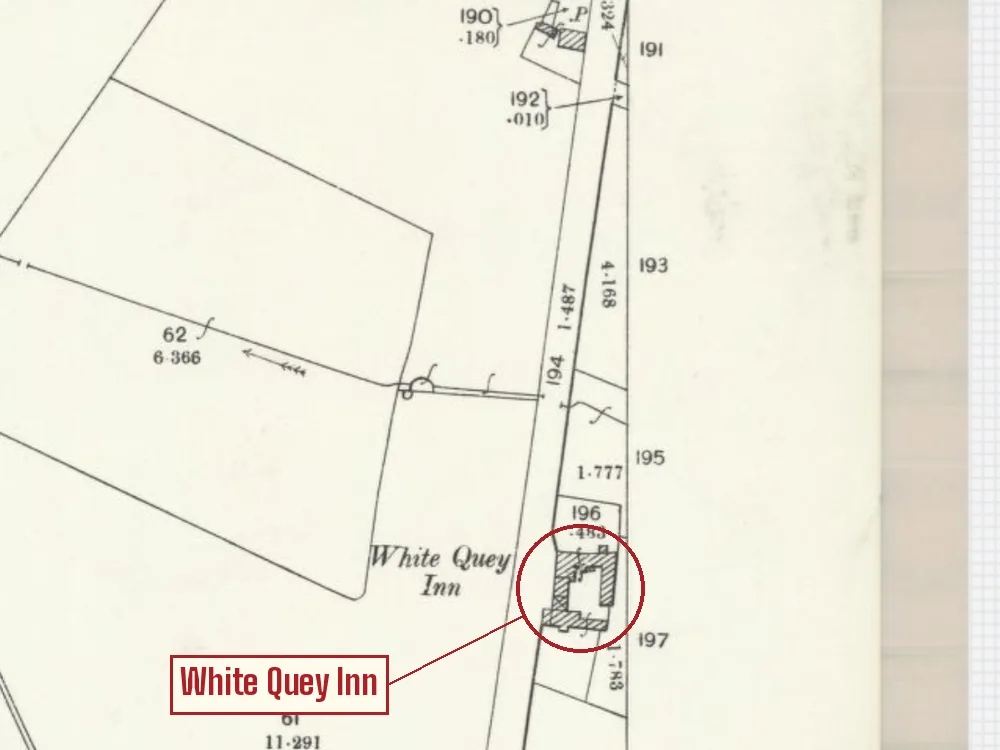
- Placed from the Ordnance Survey grid reference, NY4021449380, in Historic England's gazetteer of the scheme's premises, which matches the inn's place on the east side of the road at Stone Raise on the Ordnance Survey map of 1899.
For close on sixty years a pub at Stoneraise was not allowed to be a pub, and the story told about it goes like this. When the State Management Scheme came in 1916, the landlord of the White Quey would not sell. Rather than let his house pass to the government he shut it, and wrote into his will that the building was never to be used as a public house again. It held until 1975, when Eddie Gash and his wife bought the building and set about undoing it. After a long legal fight the original owner's grandson was found and agreed to lift the restriction, and after eighteen months' work the White Quey reopened in June 1976.
It is a good story, and the records fit it only in part. From the 1870s the house belonged to Iredale's High Brewery. The scheme's general manager's report for 1916 lists the White Quay, Stoneraise, among the Cumberland Ward houses whose freehold the Board had bought, transferred from Iredale's on 25 August 1916, and Historic England's gazetteer of the scheme's premises agrees. The Cumberland News of 8 July 1916 had already listed it among the 68 Cumberland Ward houses the Board was to take over. The Board's Carlisle committee reported in May 1917 that the White Quey had closed in the previous month, with the Crown and Mitre at Crosby-on-Eden and the White Swan at Longtown, without saying who closed it.
So the landlord of 1916 was a brewery's tenant, with no house of his own to sell, and from 25 August 1916 the building itself belonged to the state. Whoever wrote the ban is more likely to have been someone who owned the building after the Board was done with it. Who that was, between 1917 and 1975, is not known, and nothing yet settles how the legend and the records fit together.
The name is local. A quey is a heifer, a young cow that has not yet calved, and it is northern farming dialect, which is why it is said white why and not white key. The papers spelled it both ways, the White Quey and the White Whey, for the same house and the same landlord, and now and then translated it outright: the Carlisle Harriers met at 'the White Cow Inn, Stoneraise' in January 1845, and the Post Office directory of 1873 has the 'White Cow, Thomas Wood, Blackwell high'. The Brewery History Society's list of Iredale's houses spells it White Quay and names a second White Quay on St Cuthbert's Street in the city.
It was an inn well before the papers took much notice of it. Thomas Peascod, who died at Stoneraise in April 1835 aged 79, was 'formerly of White Quey Inn', and two years later a sale of 800 larch trees in Rattenrow Wood was advertised as 'within a short distance of the White Whey Public House'. By February 1839 Josiah Phillips had it, and land was being auctioned at his house. He kept it for twenty years and more: innkeeper, farmer of the inn's land and more at Rattenrow, and a cork cutter by trade. His two-year-old daughter Jemima died there in 1848, and he died there himself on 6 August 1859, aged 63.
In his time it was the meeting place for the Carlisle Harriers and the Cumberland Stag Hounds, and the room where small Dalston properties were sold at six in the evening. After him a Miss Phillips kept it, and in November 1866 'that desirable inn and farm', with 47 acres, was to let through Mr Heskett of Plumpton Hall. Thomas Wood took it at Candlemas 1867. That October a trotting match for £24 was run from the Crown Inn at Broadfield to Mr Wood's door, Mr Parker's Bonny against Mr Mossop's Comet of Dearham.
In 1868 the estate of the late J. Westray Wilson came up for auction, and Lot 2 was 'White Quey, near Durdar: a Public House, and upwards of 41 Acres of Land; let to Mr Thomas Wood at £75 per year'. It failed to reach its reserve at £2,000 and was sold soon after to Colonel Salkeld for £2,050. Three years later the Colonel was on the licensing bench when his tenant, cautioned during the year for selling drink in illegal hours, had his licence renewed.
By September 1877 the house was Iredale's. Joseph Iredale of the High Brewery advertised 'that desirable roadside INN, capable of doing a good business', with stable and garden, about 35 acres and two newly built cottages, about three miles from Carlisle. In April 1878 a painter's apprentice, up in court for leaving his master, complained that he had been sent to the White Quey and that Mr Iredale had objected to him being there too long and ordered him away. The court laughed and sent him back to work. After that the tenancy changed every few years, always at Candlemas and always as an inn and farm of about 34 acres.
Being the biggest room for miles around, it was where the coroner sat. Inquests were held there on a farm servant from Sprunston in 1869 and, in 1881, on a six-month-old child from the same farm, whose death the jury found to be murder. It was also where the district came for its fun. In August 1885 some sports were held near the White Quey, and at ten at night a farmer's son from Rattenrow left the pub and ran into a crowd of twenty or thirty young men from Cummersdale. When a sergeant and a constable came to his help the crowd dragged both into the ditch and out again, tore off the sergeant's cape and knocked his helmet 'out of all shape'. Two Cummersdale labourers were fined £5 each.
In the spring of 1889 two city landlords came out to shoot pigeons at the White Quey for £5 a side: Edward Thompson of the Howard Arms on Lowther Street and Thomas Watson of the Goliath on Crown Street. Eleven birds each at 25 yards' rise; a large crowd made Watson favourite at 6 to 4 on, and he won by ten birds to eight.
Cummersdale came back in February 1893. A constable found nine men from there drinking in the White Quey on a Sunday, every one of whom said he was going nowhere. Only a genuine traveller could be served on a Sunday, and the High Court had just ruled that a man who walked three miles merely to get a drink was not one. The Cummersdale constable said it was less than three miles. The bench said it was bound to convict, fined William Jackson five shillings as a test case and asked the papers to make the ruling known. The police took no action against the landlord.
Michael Garnett kept it in the 1880s, leaving in 1887 for the Golden Fleece at Carleton; James Fisher followed, then William Salkeld from 1893, Brown in the 1900s and William Mark by 1913. Until about 1898 the road out from Durdar crossed a ford on the way; in 1901 the council put two water troughs by the road near the White Quey for horses and cattle.
In August 1913 William Mark was fined 10s for selling whisky at a quarter past eight on a Sunday morning to William Westmorland, a Blackhall farmer and milk dealer. A constable eight yards off had watched him call three times at the shut door, and Mrs Mark come out with a glass. The defence was milk: Westmorland, sixteen gallons short for his customers, had called to see whether the inn had any to spare, and Mrs Mark said she always gave him a drink for nothing, as was 'customary in the country'. 'On this morning there was no milk,' the superintendent replied; 'it was all whisky.' Westmorland, a farmer for fifty-three years and never before summoned, said he never drank beer.
After 1976 it is remembered as a family pub, with a soft play barn and a play bus in the car park, which sounds like the Charlie Chalk era: Whitbread fitted those crèches into its Brewers Fayre houses from 1992. CAMRA records it as an independent pub rather than a chain house, so either it was leased to Whitbread for a spell or the memory belongs to another pub. CAMRA has it closing on 1 November 2008; a planning report of 2018 says 2006. Permission was given in 2012 and 2014 to turn it into houses, and in 2018 for five homes on the site, two of them in the old inn, which was still standing in 2019. A pub that outlasted a ban of close on sixty years managed thirty-two once it was lifted.
Photograph
Sources 44
- The State Management Story: the history
- CAMRA WhatPub: White Quey, Durdar
- The Carlisle Kid: the former White Quey, 2019, via Geograph
- Brewers Fayre and the Charlie Chalk Fun Factory
- Brewery History Society: list of Iredale's High Brewery pubs
- SOLWAY_PUB_DIRECTORY_Excl_Carlisle_Ver1.xls (Solway CAMRA / Stirling's list of Cumberland public houses, 1829-1938)
- Historic England, Countering the 'deadliest of foes': public houses of the Central Control Board and the State Management Scheme, 1916-73 (Clare Howard, Research Report 89-2018): Appendix C, gazetteer of scheme premises
- The Cumberland News, 8 July 1916: 'First State tavern: to be opened by Lord Lonsdale', with the list of licensed houses in the Cumberland Ward and Longtown divisions (via newspapers.com)
- The Cumberland Evening News, 23 August 1913, p. 3: 'Stoneraise landlord fined' (via newspapers.com)
- The Cumberland News, 19 May 1917 (the running head is misprinted 12 May; page number not legible): Carlisle Advisory Committee report of Wednesday 16 May, 'State Purchase: extension to West Cumberland' (via newspapers.com)
- Post Office Directory of Durham, with the principal towns of Northumberland, Cumberland and Westmorland (London: Kelly and Co., 1873), Carlisle: street directory and publicans (University of Leicester digital copy)
- Kelly's Directory of Cumberland (London: Kelly and Co., 1897), Carlisle: street directory and public houses (University of Leicester digital copy)
- Kelly's Directory of Cumberland (London: Kelly and Co., 1906), Carlisle: street directory and public houses (University of Leicester digital copy)
- Carlisle Patriot, 24 January 1845, p. 3: Carlisle Harriers' meets (via British Newspaper Archive)
- Carlisle Journal, 2 May 1835, p. 3: death of Thomas Peascod (via British Newspaper Archive)
- Carlisle Journal, 7 October 1837, p. 2: wood for sale, Rattenrow (via British Newspaper Archive)
- Carlisle Journal, 9 February 1839, p. 1: land for sale at the White Quey Inn (via British Newspaper Archive)
- Carlisle Journal, 7 August 1841, p. 2: farm to let, Josiah Phillips, innkeeper (via British Newspaper Archive)
- Carlisle Journal, 28 February 1846, p. 3: hunting appointments (via British Newspaper Archive)
- Carlisle Patriot, 22 April 1848, p. 3: death of Jemima Phillips (via British Newspaper Archive)
- Carlisle Journal, 22 August 1851, p. 2: game notice, Josiah Phillips of the White Whey Inn (via British Newspaper Archive)
- Carlisle Journal, 9 August 1859, p. 4: death of Josiah Phillips (via British Newspaper Archive)
- Carlisle Journal, 30 August 1861, p. 1, and 14 October 1864, p. 1: sales at the White Whey Inn (via British Newspaper Archive)
- Carlisle Journal, 16 November 1866, p. 8: inn and farm to let (via British Newspaper Archive)
- Carlisle Journal, 8 October 1867, p. 1: trotting match (via British Newspaper Archive)
- Carlisle Patriot, 18 September 1868, p. 1, and 6 November 1868, p. 5: sale of the late J. Westray Wilson's estates (via British Newspaper Archive)
- Carlisle Patriot, 26 February 1869, p. 5: inquest at the White Quey (via British Newspaper Archive)
- Carlisle Patriot, 15 September 1871, p. 7: the Brewster Sessions (via British Newspaper Archive)
- Carlisle Patriot, 21 September 1877, p. 1: White Quey Inn to let, Joseph Iredale (via British Newspaper Archive)
- Carlisle Express and Examiner, 20 April 1878, p. 7: master and servant cases (via British Newspaper Archive)
- Carlisle Journal, 12 July 1881, p. 2: the child murder at Sprunston (via British Newspaper Archive)
- Carlisle Patriot, 28 August 1885, p. 3: a lively scrimmage near Durdar (via British Newspaper Archive)
- Carlisle Patriot, 11 February 1887, p. 3: transfers of licences (via British Newspaper Archive)
- Carlisle Journal, 19 August 1887, p. 1: White Quey Inn and farm to let (via British Newspaper Archive)
- Carlisle Express and Examiner, 4 May 1889, p. 8: pigeon shooting match (via British Newspaper Archive)
- Carlisle Journal, 28 February 1893, p. 4, and North Cumberland Reformer, 2 March 1893, p. 2: the bona fide traveller question (via British Newspaper Archive)
- Carlisle Journal, 15 September 1893, p. 6: revision of the voters' lists (via British Newspaper Archive)
- Carlisle Journal, 24 May 1898, p. 2: the Durdar and Millbeck fords (via British Newspaper Archive)
- East Cumberland News, 2 November 1901, p. 6: rural district council, water troughs (via British Newspaper Archive)
- Carlisle Journal, 11 September 1908, p. 1: White Quey Inn and farm to let (via British Newspaper Archive)
- Kelly's Directory of Cumberland (London: Kelly and Co., 1894, 1910 and 1914), Carlisle: public houses (University of Leicester digital copy)
- Carlisle City Council Development Control Committee, 27 April 2018: application 18/0131, Former White Quey Inn, Stoneraise
- Ordnance Survey 25-inch map, Cumberland sheet XXX.3, revised 1899, via the National Library of Scotland
- Central Control Board (Liquor Traffic), Carlisle and District: general manager's report, 1916, p. 4: Cumberland Ward petty sessional division, list of licensed premises the freehold of which has been acquired (via The State Management Story)
Open question
An unsolved mystery
Who shut the White Quey in 1917, and who wrote the ban on its ever being a pub again? The Board bought the freehold from Iredale's on 25 August 1916, so its landlord was a tenant. Who owned the building between 1917 and 1975? And did it reopen in June or July 1976?
If you know the answer, or where it might be found (an old photograph, a family story, a document), tell us and it goes into the story above.
Still serving, near where it stood
-
3.0 kmaway
-
3.2 kmaway
-
3.4 kmaway
-
3.4 kmaway