Lost pub · Castle Street
The Quarter of Mutton
- Gone
- Licence refused in 1898, and the owners' appeal failed that October
- There now
- Unknown
- Address
- Brown's Lane, Castle Street
- Where exactly
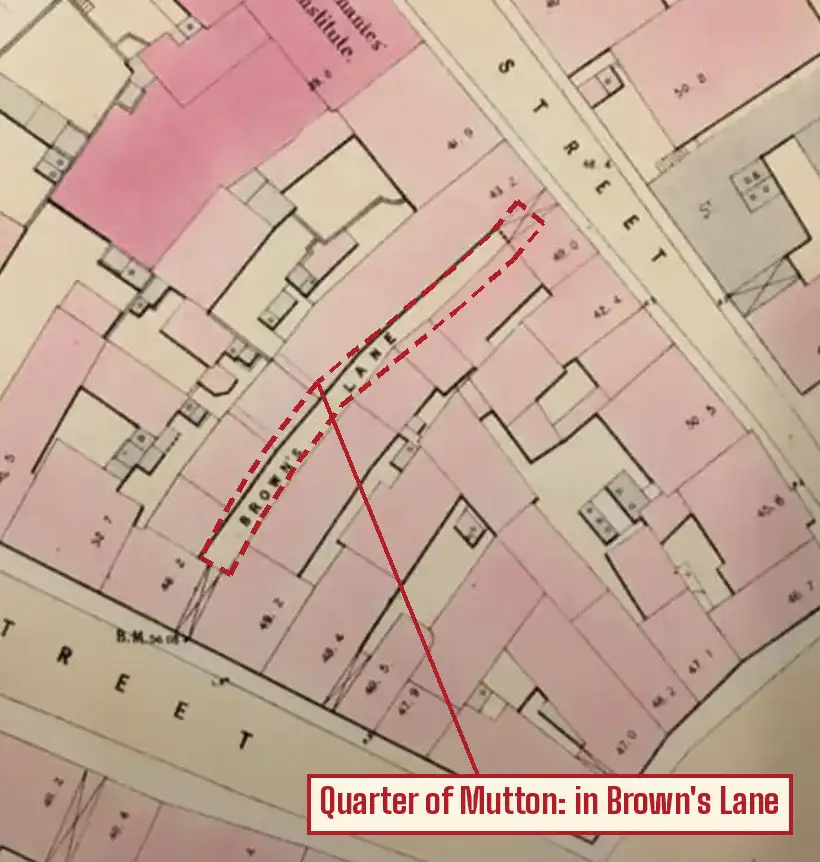
- Brown's Lane ran from Castle Street through to Fisher Street, opposite the Covered Market, and is named on the Ordnance Survey's 1865 town plan. Which building in the lane was the inn isn't known, so the pin marks the lane, and the position is approximate.
The Quarter of Mutton was a small, old-fashioned house in Brown's Lane, the narrow lane from Castle Street through to Fisher Street: a kitchen with a little bar in one corner, a smoke room sixteen feet by six, and two small bedrooms and an attic above. It was trading by 1822, and Parson and White's directory of 1829 has Edward Storey keeping it, with the lane called Nanson's Lane. It was the pub of the potato market, held in Castle Street on Wednesdays and Saturdays, and for at least fifty years it was also a betting house.
In August 1846 Thomas Murray advertised that his five-shilling sweep on the St Leger was 'fast filling'. In the 1850s it was an Orange house: on 5 November 1856 part of the city's Orangemen met there for a spread laid on by 'Brother Robinson', with game sent by G. H. Head of Rickerby House, and on 12 July 1858 two lodges took their refreshments from Mr Johnston.
Mrs Wharton had it in July 1859, when John Glaister of Thurstonfield came in drunk with six sovereigns. She offered to mind them, 'as she had often done before'; he refused, so she put them back in his breast pocket and went to cook him a beef steak. George Bell, a nailor, sat down beside him, and the next time she looked in she saw Bell 'rise up from the prosecutor and rush out of the house', the pocket hanging out. In court Glaister remembered nothing except that 'Mrs. Wharton would tell them all about it', and Bell went free for want of evidence. In November 1863 the coroner sat at the Quarter of Mutton on a Castle Street housekeeper who had burned to death at her master's fire.
Joseph Bulmore kept it for about fifteen years from the early 1860s. In February 1867 he was fined 5s for allowing card playing, though his solicitor offered to bring every player to court to swear there had been no gambling, and that month he signed the innkeepers' memorial against earlier closing. In July 1875 the police raided the house for betting, and the city magistrates refused to renew his licence. He won it back on appeal at Sessions, and in June 1877 the Queen's Bench quashed only the order making the magistrates pay his costs.
The house was auctioned in April 1878 as 'old-established and well-accustomed', and Bulmore seems to have bought it: in 1890 it had been 'for many years very successfully carried on by the owner', and in 1898 Joseph and Robert Bulmore of Lowther Street owned it. Thomas Welsh, or Walsh, had it by December 1878.
John Mitchell Thwaites took it in 1881 or 1882, after failing as a woollen manufacturer at How Mill. He started with £20 lent to his wife by her father and some furniture his creditors let her have for £15. It paid for four years. In 1886 he identified his brother, who had dropped dead in Botchergate reading a newspaper, and in April 1887 his son Charles, aged two, was knocked down by a waggon in Castle Street among a crowd of market people, slightly hurt. By 1889 the takings were under £7 a week, and in May he went bankrupt, blaming 'bad trade, excessive rent, and sickness in family'. Asked whether he had lost £100 betting, he said: 'No, not a quarter of it.' He died at the inn in January 1890, aged 44.
His widow Elizabeth carried on, and in August 1890 the house was put up for auction, 'within a few yards of the New Market'. There was one bid of £500, and it was withdrawn. Public houses, the North Cumberland Reformer remarked, seemed 'a drug in the Carlisle property market'. John Walker, a barman at Hope's in Lowther Street, took the licence that December with about £45 of capital and went bankrupt in 1893, blaming 'heavy rents and bad trade'.
Henry Smethurst followed, and that August the police came in to find six men drinking and Henry Charnley asleep in a chair. The landlord pulled his ear, but he 'only growled and swore', and someone greeted the police with 'Here come a couple of slops.' The landlord, said a constable, 'almost shook Charnley through the partition'. A defence witness was a teetotaller who went to pubs 'to drink lemonade to pass the time away'. Charnley was fined 5s and the case against Smethurst was dismissed, to cheers in court.
Smethurst was a bookmaker. The police had taken on some new men, unknown in the town, and two of them went in in plain clothes, drank beer and put shillings on horses, while the barman, George Adams, asked 'some one in an inner room' for the prices.
At half past seven on 6 October 1897 Inspector Eckford's men raided the Quarter of Mutton at the same moment as another squad raided the White Ox in St Nicholas. It was the first raid of its kind in the city for twenty-two years, since the Quarter of Mutton's own in 1875, and a rumour that one was coming had been laughed off. They shut the doors and arrested everybody, three schoolboys among them, and took betting books, 68 telegrams, tickets for the Netherby Cup initialled 'H.S.Q.M.', and a cipher in the barman's pocket book in which 'Goose' meant 40s.
Smethurst came back in the middle of it. 'Who's there?' asked the constable inside. 'The boss.' 'Let him come in.' 'You'll find nothing wrong here,' said Smethurst. He was fined £50 and costs; his books showed he sometimes cleared £40 or £50 a day. The evidence mentioned bets carried to the Quarter of Mutton by a runner under the initials 'W.W.', and William Wannop of the Green Market wrote to the Journal to give 'a flat contradiction to the rumours' that he was the man.
The Old Brewery Company, which leased the house, asked for the licence to go to William Lockhart of Kirkpatrick, but the bench refused, and the brewery gave up the tenancy at Whitsuntide 1898. That September the magistrates objected to renewal: nineteen fully licensed houses and a beerhouse stood within 500 feet, the house was too small, and it was disorderly and had been used for gambling. T. R. D. Wright, Recorder of Pontefract, argued that a Betting Act conviction should count for no more than if the tenant had been convicted 'of bigamy or of letting his dog run about without a muzzle'. William Bell, a hairdresser in the lane, said he might go in twenty times a day, 'but not always for drink, sometimes for change'. On 26 September the bench took three minutes to refuse.
The Bulmores appealed to the Cumberland Quarter Sessions, where on 19 October 1898 counsel for the justices called the house 'a perfect nest of gambling'. A line of market farmers from Kingmoor, Whinnow, Cargo, Rockcliffe, Thursby and Drumburgh said it was the handiest house for the potato market, and Thomas Reay, a potato dealer who had used it since 1862, said he stood more in need of it now than when he was younger. The chairman observed that 'you could not get many farmers in a room not much larger than a railway carriage'. The appeal was dismissed with costs, and the licence ceased. In 1911 a Carlisle Journal writer listed the Quarter of Mutton among the city's old inns 'now extinct'.
The Carlisle Encyclopaedia and Mike Tuer's database also give it as the Shoulder of Mutton and, earlier, the Seven Stars. Every newspaper report from 1846 to 1898 calls it the Quarter of Mutton.
Photograph
Sources 44
- Carlisle Encyclopaedia, "Q" page
- CARLISLE_PUBS_Ver_3.xls (Mike Tuer's pub database)
- Carlisle Patriot, 22 February 1867, p. 7: 'Carlisle Town Council: the Public House Closing Act', with the innkeepers' memorial (via British Newspaper Archive)
- Carlisle Journal, 31 December 1878, p. 3: 'Subscriptions by brewers, publicans, &c.' (via British Newspaper Archive)
- Carlisle Journal, 22 August 1846, p. 1: Doncaster St Leger sweep, Thomas Murray, Quarter of Mutton (via British Newspaper Archive)
- Carlisle Journal, 7 November 1856, p. 5: 'The fifth of November' (via British Newspaper Archive)
- Carlisle Journal, 9 October 1857, p. 1: public house to let, the Quarter of Mutton (via British Newspaper Archive)
- Carlisle Patriot, 17 July 1858, p. 5: 'The 12th of July in Carlisle' (via British Newspaper Archive)
- Carlisle Journal, 15 July 1859, p. 8: petty sessions, George Bell and John Glaister (via British Newspaper Archive)
- Carlisle Journal, 10 November 1863, p. 3, and 13 November 1863, p. 9: 'Horrible death in Castle Street' (via British Newspaper Archive)
- Carlisle Patriot, 15 February 1867, p. 6: 'Playing at cards', Joseph Bulmore (via British Newspaper Archive)
- Carlisle Journal, 22 February 1867, p. 6: the Public Houses Closing Act and the innkeepers' memorial (via British Newspaper Archive)
- Carlisle Patriot, 29 June 1877, p. 4: 'A Carlisle appeal case', J. Bulmore (via British Newspaper Archive)
- Carlisle Journal, 1 January 1878, p. 1: retriever dog for sale, Joseph Bulmore (via British Newspaper Archive)
- Carlisle Journal, 12 April 1878, p. 1: the Quarter of Mutton for sale by auction (via British Newspaper Archive)
- Carlisle Journal, 27 January 1882, p. 6: Licensed Victuallers' Association annual dinner (via British Newspaper Archive)
- Carlisle Patriot, 19 November 1886, p. 6: 'Sudden death in Carlisle', Frederick Thwaites (via British Newspaper Archive)
- Carlisle Journal, 26 April 1887, p. 5: 'Narrow escape in Castle Street' (via British Newspaper Archive)
- Carlisle Journal, 28 May 1889, p. 2: 'Bankruptcy of Carlisle tradesmen' (via British Newspaper Archive)
- Carlisle Patriot, 7 June 1889, p. 7: 'Mr John M. Thwaites, innkeeper, Carlisle' (via British Newspaper Archive)
- Carlisle Journal, 14 June 1889, p. 6: 'John M. Thwaites, innkeeper', public examination (via British Newspaper Archive)
- Carlisle Journal, 21 January 1890, p. 4: death of John M. Thwaites (via British Newspaper Archive)
- Carlisle Patriot, 8 August 1890, p. 1: 'Public house in the centre of Carlisle for sale' (via British Newspaper Archive)
- North Cumberland Reformer, 28 August 1890, pp. 4 and 5: the Quarter of Mutton auction (via British Newspaper Archive)
- North Cumberland Reformer, 2 October 1890, p. 2, and 4 December 1890, p. 6: transfer of the licence (via British Newspaper Archive)
- Carlisle Journal, 16 December 1890, p. 3: licensing, Thwaites to Walker (via British Newspaper Archive)
- Carlisle Patriot, 25 September 1891, p. 6: 'Public houses in Carlisle sixty years ago', reprinting the 1829 Parson and White directory list (via British Newspaper Archive)
- North Cumberland Reformer, 20 July 1893, p. 2: 'Failure of a Carlisle innkeeper', John Walker (via British Newspaper Archive)
- Carlisle Journal, 29 August 1893, p. 2: 'Charge against a Carlisle publican' (via British Newspaper Archive)
- North Cumberland Reformer, 7 September 1893, p. 2: transfers, Walker to Smethurst (via British Newspaper Archive)
- Carlisle Journal, 8 October 1897, p. 5: 'Betting raids in Carlisle' (via British Newspaper Archive)
- Carlisle Journal, 26 October 1897, pp. 2 and 3: the betting-house prosecutions and 'The Quarter of Mutton case' (via British Newspaper Archive)
- North Cumberland Reformer, 13 November 1897, p. 2: 'License transfers', Smethurst to Lockhart (via British Newspaper Archive)
- Carlisle Journal, 6 September 1898, pp. 2 and 3: city licensing sessions, magistrates' objections (via British Newspaper Archive)
- East Cumberland News, 10 September 1898, p. 3: 'Carlisle brewster sessions' (via British Newspaper Archive)
- Carlisle Journal, 27 September 1898, p. 3: 'The Quarter of Mutton', adjourned licensing sessions (via British Newspaper Archive)
- North Cumberland Reformer, 1 October 1898, p. 4: 'The Quarter of Mutton' (via British Newspaper Archive)
- North Cumberland Reformer, 15 October 1898, p. 5: Quarter Sessions licensing appeals (via British Newspaper Archive)
- Carlisle Journal, 21 October 1898, p. 6: 'The Quarter of Mutton, Castle Street', the appeal (via British Newspaper Archive)
- North Cumberland Reformer, 22 October 1898, p. 7: 'The Quarter of Mutton', the appeal (via British Newspaper Archive)
- Carlisle Journal, 5 December 1911, p. 4: 'Old inns in Carlisle' (via British Newspaper Archive)
- North Cumberland Reformer, 9 October 1897, p. 4: 'Betting raid on two public houses in Carlisle' (via British Newspaper Archive)
- Carlisle Journal, 26 October 1897, p. 3: letter, 'The betting raid', W. Wannop (via British Newspaper Archive)
- Ordnance Survey 1:500 town plan of Carlisle, surveyed 1865, via the National Library of Scotland
Open question
An unsolved mystery
Were the Quarter of Mutton and the Shoulder of Mutton one pub under two names, or two neighbours? Every newspaper report from 1846 to 1898 says Quarter of Mutton. And was Nanson's Lane, where the 1829 directory puts it, an older name for Brown's Lane?
If you know the answer, or where it might be found (an old photograph, a family story, a document), tell us and it goes into the story above.
Also lost on Castle Street
77 other lost pubs stood within 250 m of here. See them on the map
Still serving, near where it stood
-
30 maway
-
40 maway
-
50 maway
-
60 maway