Morton, Carlisle
Royal Scot
Opened 31 March 1960, built by Laing to a design by the Home Office's chief architect. By this point a Carlisle pub was a government building.
Sold to Greenall Whitley as part of Group 4, handed over on 23 May 1973. Who bought the rest
Big Morton local with a separate bar and restaurant, a large car park and a kids' play area. Live entertainment at weekends, bingo and quiz midweek, football on the big screen.
Part of Star Pubs (Heineken UK)
- Today
- See opening hours
- Address
- Langrigg Road, Morton, Carlisle CA2 6DX
- Phone
- 07932 592155
History
Opened 31 March 1960
- Opened
- 31 March 1960
- Architect
- H A Metayers, Chief Architect, Home Office
- Builder
- John Laing
- Era
- Late scheme, after Redfern
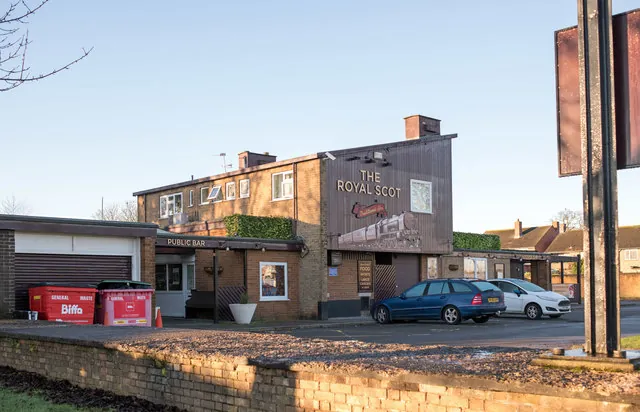
On 31 March 1960 the Mayor of Carlisle pulled the first pint at a new pub in Morton and handed it to a retired major general, under a scale model of a railway engine. The Royal Scot is the one that shows what the State Management Scheme became. Harry Redfern had been retired for the best part of twenty years, or since 1949 by Historic England's reckoning, and dead for ten, and the scheme's pubs no longer looked anything like his interwar model inns.
It was built by Laing, to a design by H A Metayers, Chief Architect at the Home Office: by this point a Carlisle pub was a government building, drawn by a government architect. The plans, drawn in October 1958, name A Ball as architect in charge and M A Brooks as assistant, and it cost £29,198. Laing, who started out in the Carlisle area before becoming one of the biggest builders in Britain, photographed their own projects, and their shot of the brand new state inn survives in Historic England's John Laing Photographic Collection, catalogued as 'the exterior of The Royal Scot state inn seen from the north-west', probably 1960, in a volume titled Examples Of Different Building Contracts Run From The Carlisle Office.
The brief was three rooms, all bigger than those at the Inglewood Forest and the Arroyo: a public bar on one side of a two-storey service block, a men's smoking room and a mixed smoking room on the other, with no way through between them. The off-sales had its own door and a display window in the middle of the front. The walls were red, yellow and black brick, with weatherboarding above and a mono-pitch roof over the manager's flat. The mixed room had a saw-tooth run of windows and an internal garden with plants, a pool and a fountain. Mechanical extraction cleaned and cooled the air and electric elements warmed the floors.
Low partitions and blocks of seating broke the rooms up for a more 'intimate atmosphere', the opposite of the open, well-supervised rooms the scheme had preached since 1916. A bowling green was considered and dropped as too much expense for too few bowlers. A children's playground was proposed instead, the board objected, and the land was left open; it has a kids' play area now, so that argument was won eventually. The Brewers' Journal called the outside 'simple, almost austere, but effective'. Set it beside the Apple Tree or the Redfern and you can see the whole arc: Arts and Crafts craftsmanship in the twenties and thirties, plain municipal utility by the sixties.
The name has two stories. British Rail Magazine's June 1960 issue reported that the pub took its name and its sign from the LMS 'Royal Scot' locomotive rather than the London-to-Scotland express of the same name, with an original BR headboard displayed inside and a scale model of the engine presented on permanent loan by Major General Sir John Kennedy. At the opening, it said, the Mayor, W B Hunter, pulled the first pint and served it to Sir John himself.
Historic England's survey tells it differently: the name came from the London Euston to Glasgow express, the mayor was W J Hunter, and the model was on permanent loan from the British Transport Commission. H. B. Wilson's official history of the scheme also sides with the express, 'some of whose drivers were Carlisle men', and has the model on loan from British Rail. The survey has the pub formally opened by G W B Shepherd, the scheme's general manager, who retired the same day. The mayor called it the 'king-pin of state houses in the whole area', and Shepherd's successor, J N Adams, hoped for the kind of public house service 'in which a man can bring his wife'.
Extensions went out the back in about 1988 and again in 2001. By 2016 the saw-tooth window, the internal garden, most partitions and both original bar counters had gone, the bottle store had become a kitchen, and the lounge fireplace was a 1988 fake. The public bar still did its original job in roughly its original place. Historic England rated it perhaps the best of the post-war scheme pubs as built, and of relatively low significance as it now stands.
It's a games pub and always has been: a very large bar with three dartboards, a pool table and three big screens, plus a lounge and function room, and six darts teams, two pool teams and a football team, which for an estate local is going some. It is registered as an Asset of Community Value, which gives the community first refusal if it ever goes up for sale. That matters on an estate like this: Star Pubs, who hold it now, reckon 4,322 adults live within a ten minute walk and 15,129 within twenty, with almost no competition bar the Reiver about three quarters of a mile off.
It has not had an easy few years. David and Michelle Hammond-Whalley took it on early in 2013 and put in two handpumps. CAMRA's record shows a change of licensee in December 2016, another by 2023, a closure, and a reopening on 19 August 2024 under new management, and Star Pubs have been advertising it for a tenant with a refurbishment attached. For a pub with six darts teams, losing it would be a loss worth minding.
- Beer garden
- Family friendly
- Food
- Historic interior
- Live music
- Live sport
- Quiz night
Photographs
Opening hours
| Mon | 16:00–23:00 |
| Tue | 16:00–23:00 |
| Wed | 16:00–23:00 |
| Thu | 12:00–23:00 |
| Fri | 12:00–23:00 |
| Sat | 12:00–23:00 |
| Sun | 12:00–22:00 |
Hours last checked August 2026, about 2 months ago.
Hours are kept by hand and change without warning. Ring ahead if it matters.
More like this
- Beer garden pubs in Carlisle
- Family friendly pubs in Carlisle
- Food pubs in Carlisle
- Historic interior pubs in Carlisle
- Live music pubs in Carlisle
- Live sport pubs in Carlisle
- Pub quiz nights in Carlisle
- All pubs in Morton
Nearest to here
-
560 maway
-
940 maway
-
950 maway
-
1.2 kmaway
Sources
- The State Management Story
- Historic England: John Laing Photographic Collection JLP01/01/117/34
- CAMRA WhatPub
- Cumberland Council licensing register
- British Rail Magazine, Vol 11 no 6, June 1960, p173: the opening, the headboard and Sir John Kennedy's model engine
- Ale Tales (Solway CAMRA), Spring 2013: Bar Fly news and Pub of the Season
- Ale Tales (Solway CAMRA), Summer 2024: Bar Fly news and Pub of the Season
- Historic England, Countering the 'deadliest of foes': public houses of the Central Control Board and the State Management Scheme, 1916-73 (Clare Howard, Research Report 89-2018): Appendix B, summaries of key State Management public houses
- The State Management Story documents: H. B. Wilson, History of the Carlisle State Management Scheme 1916-1974 (Home Office, about 1975)
Know more about this one?
History, a story, a correction, or just what it was called before: Royal Scot is better on this site when locals fill it in.