Harraby, Carlisle
Arroyo Arms
Built 1958 for the new Harraby estate, one of only five the scheme put up after the war. Named for a Peninsular War battle honour the Border Regiment won by capturing the French 34th's drums.
Sold as the Arroyo to Greenall Whitley as part of Group 2, handed over on 2 April 1973. Who bought the rest
Proper Harraby local on Edgehill Road. Darts, fair prices, and regulars who'll talk to you.
- Today
- See opening hours
- Address
- 121 Edgehill Road, Carlisle CA1 3SB
- Phone
- 01228 318158
History
Opened 23 August 1958
- Built
- 1958, for the new Harraby estate
- Opened
- 23 August 1958, by Major John Gibbon
- Named after
- Battle of Arroyo dos Molinos, 28 October 1811
- Privatised
- Sold to Greenall Whitley, 2 April 1973
On 28 October 1811, at Arroyo dos Molinos in Spain, in the Peninsular War, the British 34th Regiment found itself facing the French 34th Line Infantry, beat them, and took six of their side-drums and the drum-major's staff. The 34th (Cumberland) Regiment of Foot, later the Border Regiment, was the only British regiment ever to carry Arroyo as a battle honour, and the drums are still paraded by its successors. In 1958 the State Management Scheme named a new pub in Harraby after the battle, on the suggestion of the wife of G W B Shepherd, its general manager.
It is a scheme pub from the very end of the story rather than the famous 1920s stretch. Only five pubs were built by the scheme in Carlisle between 1945 and 1971, all on greenfield sites serving new housing estates, and the Arroyo is one of them. Talk of a Harraby pub began in 1953, when Colonel W A Ford was lined up to design it, but restrictions on building and materials slowed everything, and the site was only identified in 1955 and bought early in 1956. The Inglewood Forest nearby, built in 1953 and since demolished, had done well enough to justify a second.
It was a Home Office design: H A Metayers, the department's chief architect, with R A Greaves as architect in charge and M A Brooks assisting. John Laing and Sons built it, on an initial estimate of £17,830, and the London firm of Douglas Reed and Son were consultants, as they were later for the Border Terrier and the Border Reiver.
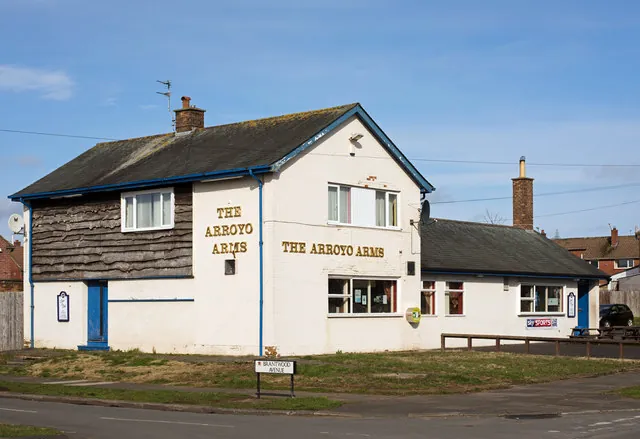
It was small by the scheme's standards: a public bar entered from Brantwood Avenue, an off-sales shop and a smoking room entered from Edgehill Road, and a service area between them. The smoking room was for men and women together, the first time the scheme had planned one without a men's-only smoking room beside it. The public bar had fixed benches and a small darts alley. Women's lavatories off it were discussed and put off until needed. The general manager had the public bar counter lengthened by 16 feet, which quietly dropped the scheme's old war on perpendicular drinking.
An old water course crossed the site, so the cellar went at ground level rather than risk a flooded vault, cooled electrically, a first for the scheme. It was sized for a week's trade, reckoned at 12 barrels or 350 gallons, which the assistant general manager thought too small. Heal's of London furnished it, the smoking room in black and gold and the public bar in green and yellow. The smoking room had a brick inglenook with a blue slate fireback, there for 'a pleasant intimate feeling' while electric storage heaters did the real work. A mosaic of a jug and bottle marked the off-sales. The Builder and the Architectural Journal both wrote it up in 1958.
It opened on 23 August 1958 by the date most often cited, or 23 June by Historic England's survey, which points to a letter from Major John Gibbon dated 24 June and a Cumberland News report of 27 June. Gibbon did the honours, in the company of the Border Regiment. The sign was a model military drummer, cast in aluminium, a free-standing drummer boy, by an unnamed master sculptor at the Kingston School of Art. The scheme's jubilee supplement of 1966, which dates the pub to 1956, describes him as an English drummer boy in English uniform, but with a French hat and carrying a French drum.
He vanished from the estate years ago and was assumed lost, until he turned up safe in the Museum of Military Life at Carlisle Castle, a couple of miles away. Framed Border Regiment badges once hung on the walls and behind the bar; they have gone too.
When the scheme was wound up the pub was sold to the Greenall Whitley Group on 2 April 1973. The two rooms were knocked into one, probably around 1984, when the stained-glass screens behind the benches went in, and the windows have since been replaced in uPVC. In 2016 Historic England's survey found the fireplace, parts of the bench seating and the full-height Shanks urinals probably original, and the outside much as built, and rated the pub a real departure for the scheme: smaller, plainer, domestic in scale.
It has been a community boozer ever since. It sponsors a local football team and runs karaoke and poker nights. No real ale.
- Cheap pint
- Historic interior
- Pool / darts
- Traditional
Photographs
Opening hours
| Mon | 13:00–23:30 |
| Tue | 13:00–23:30 |
| Wed | 13:00–23:30 |
| Thu | 13:00–23:30 |
| Fri | 13:00–23:30 |
| Sat | 11:00–midnight |
| Sun | 11:00–midnight |
Hours last checked August 2026, about 2 months ago.
Hours are kept by hand and change without warning. Ring ahead if it matters.
More like this
- Cheap pint pubs in Carlisle
- Historic interior pubs in Carlisle
- Pool / darts pubs in Carlisle
- All pubs in Harraby
Nearest to here
-
640 maway
-
650 maway
-
780 maway
-
1.3 kmaway
2 lost pubs stood within 400 m of here. See what used to be around it
Sources
- The State Management Story
- Geograph: The Carlisle Kid
- CAMRA
- National Army Museum: 34th (Cumberland) Regiment
- CAMRA WhatPub
- Historic England, Countering the 'deadliest of foes': public houses of the Central Control Board and the State Management Scheme, 1916-73 (Clare Howard, Research Report 89-2018): Appendix B, summaries of key State Management public houses
- Historic England, Countering the 'deadliest of foes': public houses of the Central Control Board and the State Management Scheme, 1916-73 (Clare Howard, Research Report 89-2018)
- The State Management Story documents: Evening News supplement, Half a Century of the State Management Scheme, 12 October 1966
Know more about this one?
History, a story, a correction, or just what it was called before: Arroyo Arms is better on this site when locals fill it in.