Lost pub · Aglionby
The Sportsman Inn
- Gone
- Licence given up for £300 compensation, July 1906
- There now
- Not established
- Address
- Aglionby, on the Brampton road east of Carlisle
- Where exactly
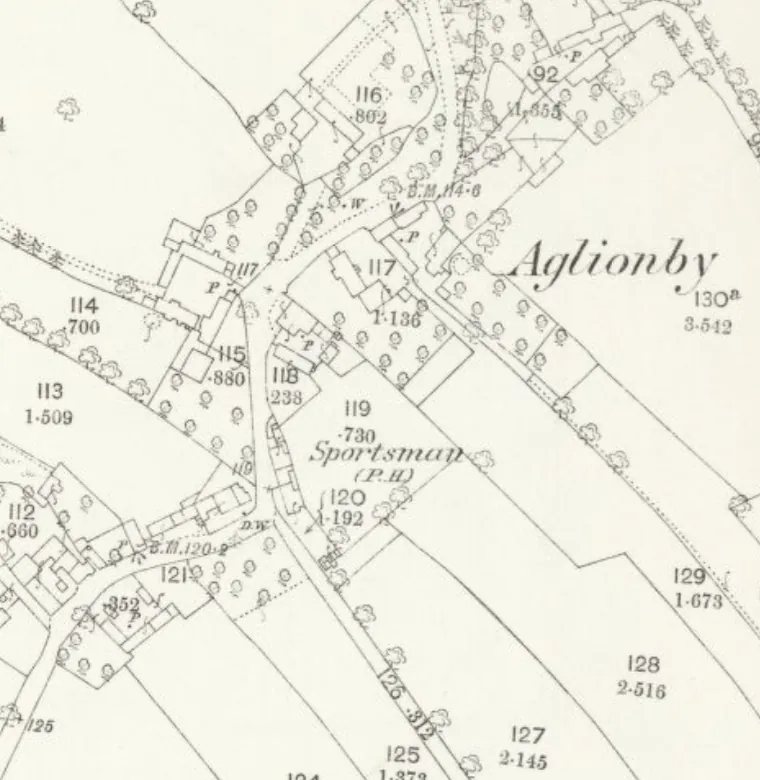
- The Ordnance Survey's 25-inch map of 1861 to 1863 marks it on the lane running south from the middle of Aglionby towards the main road. The pin marks the hamlet, not the building, so the position is approximate.
An Iredale's house in the hamlet of Aglionby, on the Brampton road just east of the city, in the directories from 1855 to 1906. Thomas Graham kept it in December 1855, when he held his sparrow shooting there on Christmas Eve. About forty men entered, 'including some of the crack shots of the day', the betting was brisk, and John Bond of Aglionby won with ten birds from his large 'Lancaster gun', which the Carlisle Journal thought 'more calculated for making a breach in the fortress of Sebastopol than killing little cock sparrows'.
Jeremiah Irwin of Stanwix was second with nine. Afterwards the company went back to Graham's for roast beef and plum pudding, with Bond in the chair. The Ordnance Survey's 25-inch map, surveyed between 1861 and 1863, marks it as the Sportsman (P.H.), on the lane that runs south from the middle of the hamlet towards the main road, and the map's revision of the 1890s still names it the Sportsman Inn.
In August 1887 the licence passed temporarily from Mary Douglas to D. Hall of Carlisle, on the application of Mr Wannop. By 1901 a Mrs Ward held it, and that year hers was one of only three licences in the Cumberland Ward held over at the annual licensing sessions, because of a conviction during the year; the others were the Tam o' Shanter at Little Bampton and the Greyhound at Thurstonfield.
At the adjourned sessions in September all three were renewed, with a warning from the chairman, Mr T. Horrocks, to be very careful. It ended under the Licensing Act of 1904. In July 1906 the county Compensation Authority heard that it belonged to the trustees of J. G. Iredale and was let to G. P. Hodgson at £12 a year; he sold about 23 barrels of beer a year at 2d a glass ('very good beer', said one of the parties, to laughter).
The valuer W. L. Tiffen, who knew Aglionby well, described a thatched house with walls partly of clay, 'a very snug old-fashioned public-house, much used by the villagers', and an architect said £20 had lately been spent on it at the justices' request. Compensation was fixed at £300, £12 of it for the tenant. Aglionby had the Waterloo Inn too, by Powmaughan Bridge at the western end of the hamlet.
One local list gives the Waterloo's name to this 1855 to 1906 house, but the other lists the two side by side, and the Waterloo went on trading for a century after this one is last heard of, so they look like two different houses.
Photograph
Sources
- Carlisle Journal, 28 December 1855, p. 5: 'Sparrow Shooting', the Sportsman inn, Aglionby (via British Newspaper Archive)
- Carlisle Journal, 23 August 1887, p. 2: 'Temporary Licence Transfer', the Sportsman Inn, Aglionby (via British Newspaper Archive)
- Carlisle Journal, 24 September 1901, p. 2: 'Adjourned Licensing Sessions, Cumberland Ward' (via British Newspaper Archive)
- SOLWAY_PUB_DIRECTORY_Excl_Carlisle_Ver1.xls (Solway CAMRA / Stirling's list of Cumberland public houses, 1829-1938): Sportsman, Aglionby, 1855-1906, an Iredale Brewery pub; Waterloo, Aglionby, from 1858
- CUMBERLAND_PUBS_4.xls: lists the 1855-1906 Iredale house at Aglionby as the Waterloo
- Ordnance Survey 25-inch map, Cumberland sheet XXIV.1, surveyed 1861 to 1863, published about 1864, via the National Library of Scotland
- Carlisle Journal, 27 July 1906, p. 6: 'Compensation for licences: meeting of the Cumberland Authority' (via British Newspaper Archive)
Open question
What we don't know yet
Does any of the building of the Sportsman at Aglionby, a thatched house with walls partly of clay when it closed in 1906, survive on the lane south of the hamlet?
If you know the answer, or where it might be found (an old photograph, a family story, a document), tell us and it goes into the story above.
Also lost in Aglionby
Still serving, near where it stood
-
360 maway
-
1.3 kmaway
-
1.5 kmaway
-
2.3 kmaway