Little Bampton, Carlisle
Tam O'Shanter
Number 209 on the scheme's 1920 roll, as the Tam o' Shanter, Little Bampton, near Wigton.
Sold in 1973 as a tenanted house for £4,300. Who bought the rest
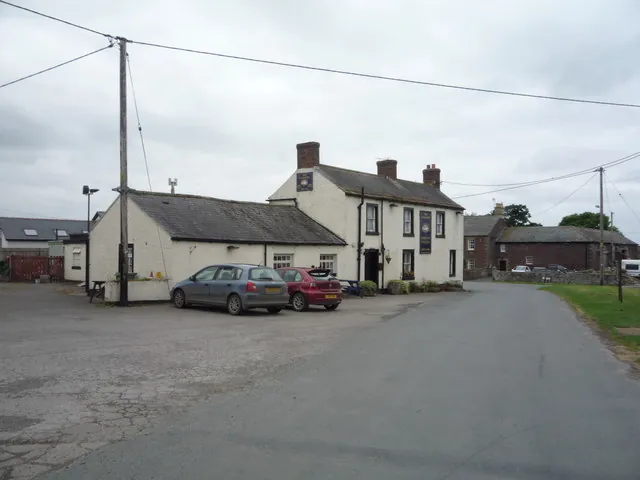
The hamlet's only public building, a village pub out on the Solway plain west of the city. Home cooking on Friday evenings and Sunday lunchtimes.
- Today
- See opening hours
- Address
- Little Bampton, Wigton CA7 0JQ
History
- Dates from
- The early nineteenth century
- State pub
- Number 209 on the 1920 roll
- Village
- About forty houses, no church, no hall
In January 1966 the Tam o' Shanter at Little Bampton was the State Management Scheme's test case. It was losing money, though the building was in reasonable order, and instead of a salaried manager it was let to a tied tenant. The State Management Districts Council knew this was a radical departure from disinterested management. It worked: the profits rose, and the council decided that any loss-making pub whose manager left could go the same way.
Little Bampton is a hamlet of about forty houses on the Solway plain, eight miles west of Carlisle and six from Wigton. There is no church and no village hall, so the pub is the place the village meets, and CAMRA describe it simply as the focal point of the hamlet. It dates back to the early nineteenth century. The name is Burns's, from the poem of 1790, but the story told locally attaches it to an old-time whisky smuggler who rowed his liquor across the Solway from Scotland. Nothing is written down to settle which came first.
The scheme reached further west than most people imagine. The Cumberland News of 19 May 1917 lists the Tam o' Shanter among five houses put under the Board's direct management in the previous month, and the scheme's roll of 1920 has the Tam o' Shanter, Little Bampton, near Wigton, at number 209, on the same roll as its neighbours the Wellington at Great Orton and the Rose & Crown at Kirkbampton.
It is a small, friendly local with a dog-friendly bar and home-made food on a weekly menu, served on Friday evenings and Sunday lunchtimes, when it fills up quickly. No cask ale at CAMRA's last visit. In 1901 its licence, held by Edward Bell, was one of three in the Cumberland Ward held over at the annual sessions because of a conviction during the year; it was renewed at the adjourned sessions that September, with a warning to be very careful.
- Food
- Dog friendly
- Traditional
Photographs
Opening hours
| Mon | Unknown |
| Tue | Unknown |
| Wed | Unknown |
| Thu | Unknown |
| Fri | Unknown |
| Sat | Unknown |
| Sun | Unknown |
No regular hours are published. Diners report food on Friday evenings, about 5 to 8, and Sunday lunchtimes, about 12 to 3, and say to book. Ring before a special trip.
Hours are kept by hand and change without warning. Ring ahead if it matters.
More like this
Nearest to here
-
5.2 kmaway
-
6.2 kmaway
-
6.3 kmaway
-
6.4 kmaway
Sources
- Brewery History Society: the 1920 roll of Carlisle & District State Management Scheme pubs, no. 209
- CAMRA WhatPub: Tam O'Shanter, Little Bampton
- Food Standards Agency: Tam-O-Shanter, Little Bampton, pub/bar/nightclub
- Use Your Local: Tam O Shanter Inn, food times from diners' reviews
- Wikishire: Little Bampton
- Mike Tuer, "Pubs of Carlisle" Day 223, Old Photos of Carlisle and Surrounding Area (Facebook): early nineteenth century; the smuggler story
- Historic England, Countering the 'deadliest of foes': public houses of the Central Control Board and the State Management Scheme, 1916-73 (Clare Howard, Research Report 89-2018)
- The Cumberland News, 19 May 1917 (the running head is misprinted 12 May; page number not legible): Carlisle Advisory Committee report of Wednesday 16 May, 'State Purchase: extension to West Cumberland' (via newspapers.com)
- Carlisle Journal, 24 September 1901, p. 2: 'Adjourned Licensing Sessions, Cumberland Ward' (via British Newspaper Archive)
Open question
What we don't know yet
What hours does the Tam O'Shanter at Little Bampton keep beyond its Friday and Sunday food, and which of the two phone numbers in circulation is right?
If you know the answer, or where it might be found (an old photograph, a family story, a document), tell us and it goes into the history above.