Lost pub · Denton Holme
The Nelson Bridge Inn
- Gone
- Closed 7 March 1971
- There now
- Demolished in 1977; a vacant plot by 2018
- Address
- Denton Crescent
- Where exactly
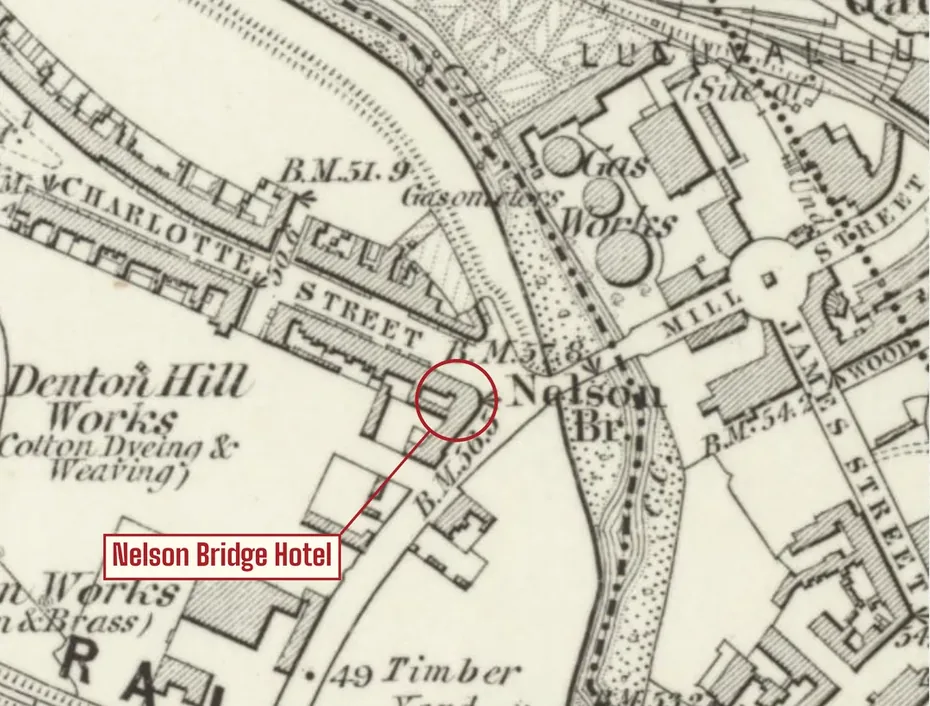
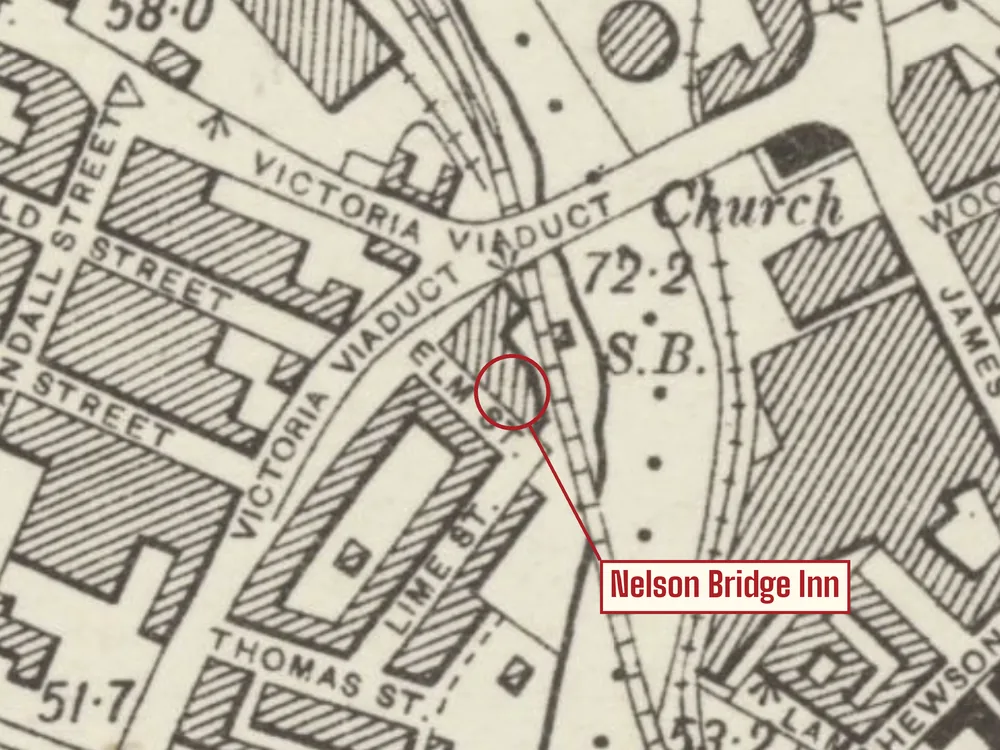
- Placed from the Ordnance Survey grid reference, NY3994555393, in Historic England's gazetteer of the scheme's premises, which marks the later inn on the corner of Elm Street and Denton Crescent. The first hotel, of 1854 to 1876, stood a little to the north, on the corner of Charlotte Street at the western end of the old Nelson Bridge, ground now under the Victoria Viaduct. Both buildings have gone.
The Nelson Bridge opened up Denton Holme. Its foundation stone was laid on 25 June 1852 before several thousand people at the end of Mill Street, and it took the name of the Mayor, Thomas Nelson, the builder who had driven the scheme through. That November the corner plot at its western end, with frontages to the bridge, Denton Street and Charlotte Street, was put up for sale. By December 1854 William Hetherington had the Nelson Bridge Hotel on it, 'near the Central Railway Station', and in March 1855 he invited his friends and the public to a cellar opening and hunt: the Carlisle Harriers met at the door at nine, and dinner was on the table at five. The directories caught up with it in 1858.
Hetherington was a dealer as much as an innkeeper, and the hotel had the stables and sheds to match. He sold 160 Cheviots and 260 half-breds at one sale in 1857, showed 900 sheep at Carlisle market in 1864, and held an auction of 600 blackfaced Highland ewes at the inn in 1866. He bred horses too: six young ones he had reared himself, all prize-winners at shows in Cumberland and the neighbouring counties, went under the hammer on the Sands in July 1866, and his grey filly Fancy Girl was sold at the Royal Show at Carlisle in 1880. His greyhound Pretty Boy won the Oglebird Stake at Brougham in 1857. His brother Moffat, a Carlisle butcher, stabled horses at the inn.
The animals were forever getting out. In April 1866 Hetherington was reprimanded for letting his horses stray in Denton Street, and the case brought out that a single policeman covered Newtown, Parham Beck, Milbourne Street, Charlotte Street and Denton Holme, 'now in itself a small but growing town'. Thomas Nelson was on the bench. In June the Patriot headed its report 'Mr Hetherington's Horses Again': a mare and foal had been caught eating 'Mr Nelson's grass' over a low paling, Mr Nelson was again on the bench, and Hetherington protested that there were five places where nobody would fence against him. In 1870 he was fined 10s a head for five cattle with foot-and-mouth disease on the Bitts.
It was the meeting place of a new suburb. Building plots in Denton Holme were auctioned there; the Duke Street Adult School held its Christmas Eve supper there in 1860; in January 1871 the 2nd Cumberland Artillery Volunteers came on from a married-against-single shoot at Cummersdale to a dinner at which the losers paid for a large bowl of punch; and by 1901 the Licensed Victuallers held their committee meetings there. In 1858 the Tories tried at the last minute to get Hetherington to stand for Caldewgate Ward, 'but he would not listen to the voice of the charmer'. In 1870 a solicitor told the licensing bench that it and the inn at the end of Caldew Bridge were the only public houses in a neighbourhood of 2,400 people.
Hemmed in by railway yards, it was also where the coroner sat. Inquests there included John Little, a North British pilot guard killed in the Canal Goods Yard in 1868, and William Irving, a Caledonian platelayer found dying on the line on New Year's morning 1870. Others were for children of the streets around it: a twelve-year-old from Dobson's Court, Charlotte Street, found dead in bed in his clothes and clogs in 1866; a boy of ten who fell from the railway wall in 1891; and two in 1898, a toddler drowned in the unfenced dam course by Colville Terrace and a boy fatally hurt by a railway lorry near the Charlotte Street goods yard gate.
Then the railways wanted the ground. In May 1876 Hetherington's licence was moved for the time being to four private houses at the end of Denton Street and Elm Street, his solicitor explaining that part of the hotel was to come down for railway extensions and the four houses would soon have to go too. The Victoria Viaduct, finished in 1877, replaced the old road over Nelson Bridge; an account of its cost put 'Nelson Bridge Hotel and numerous cottages adjoining, compensations, &c.' at about £20,000, out of nearly £140,000. The inn's lasting home was a former grocer's shop on the corner of Elm Street and Denton Crescent, a short row against the railway wall. Inn and Hotel were both used, before the move and after it.
William Hetherington died at the hotel on 20 February 1884, aged 69, six weeks after his granddaughter May Hetherington McCreesh, the three-year-old daughter of Isabel and John McCreesh of Preston, had died there. His second son, William, died there in 1890. The family kept it on: a Miss Hetherington of the hotel was on a visitors' list at the Waverley Hotel in August 1884, an Edith MacCreesh gave it as her address in 1901, and that year an 84-year-old widow died there, at 'the residence of her niece'. The council was less taken with the place: Hetherington had refused in 1872 to turn his privies into water closets, and in 1895-96 the owners were ordered to provide a proper urinal.
The Central Control Board took the house over in the autumn of 1916 and kept the family on. Its management agreement with Miss Margaret Hetherington, dated 30 April 1917, survives with an inventory of the bar: a nineteen-foot mahogany-topped counter, fifteen feet of fixed seating, four large metal spittoons, leaded window screens, panelling to the snug, a four-pull beer engine with one handle broken, a walnut overmantel with a regulator clock, a mirrored back fitting, china kegs with brass taps, and a Polyphon, the clockwork disc musical box, with its records. That is more than sixty years in one family, from 1854 to 1917 at least.
Under the scheme it was number thirty-eight on the 1920 roll and a small, friendly railwaymen's pub on the corner where Denton Holme began, remembered for its characters and its draught Bass, with children calling in for crisps and pop. Its managers included Robert 'Bonzo' Burns, who went on to the Cumberland Wrestlers; Robert Norris, who moved on to the Railway Hotel; and David and Dorothy Hill, later of the Spinners Arms at Cummersdale.
Time was called on Sunday 7 March 1971, the scheme's first closure after the Home Office announced that it would be wound up and its pubs sold. The acting general manager, John Marker, said the manager was leaving for a post outside the scheme and that the customers could be served by another scheme pub nearby. He also said it had been going since 1908, and the Cumberland News called it a pub of 62 years' standing; neither fits a house the Hetheringtons had kept since 1854, and where 1908 came from is not known. The building was demolished in 1977, and by 2018 the corner was a vacant plot.
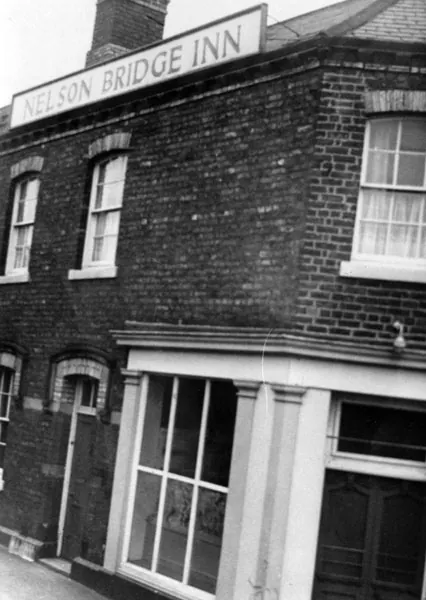
In November 1991 the Cumberland News asked its readers for a photograph. One came in January 1992 from Mr W. Tickner, who explained why so few existed: the inn stood so close to the wall of the bridge that it was hard to get far enough back to take it with its name in. In March 1992 the same column appealed for a portrait of Thomas Nelson himself, born near Annan and Mayor in 1852, who gave his name to the bridge and to Nelson Street.
Photograph
Sources 46
- breweryhistory.com
- CARLISLE_PUBS_Ver_3.xls (Mike Tuer's pub database)
- Historic England, Countering the 'deadliest of foes': public houses of the Central Control Board and the State Management Scheme, 1916-73 (Clare Howard, Research Report 89-2018): Appendix C, gazetteer of scheme premises
- The Cumberland News, 8 November 1991, p. 4: 'Pubs of yesteryear', Oddfellow's Arms, Crown Street, with a request for a Nelson Bridge Inn photograph (via newspapers.com)
- The Cumberland News, 31 January 1992, p. 4: 'Pubs of yesteryear', The Nelson Bridge Inn (via newspapers.com)
- The Cumberland News, 13 March 1992, p. 4: 'Pubs of yesteryear', 'Enthusiast seeks picture of Nelson', Allan Farish's appeal for a portrait of Thomas Nelson, builder (via newspapers.com)
- Carlisle Patriot, 22 February 1867, p. 7: 'Carlisle Town Council: the Public House Closing Act', with the innkeepers' memorial (via British Newspaper Archive)
- The Cumberland News, 7 October 1916, p. 5: 'The Carlisle Experiment: Reconstruction of Inns' (via newspapers.com)
- The Cumberland News, 7 August 1987, p. 6: 'A new look for the village pub' (via newspapers.com)
- Carlisle Express and Examiner, 6 May 1876, p. 8: 'Transfer of licences' (via British Newspaper Archive)
- Carlisle Journal, 2 July 1852, p. 4: 'Laying of the foundation stone of the Nelson Bridge' (via British Newspaper Archive)
- Carlisle Journal, 19 November 1852, p. 2: building site in Denton Holme near the Nelson Bridge for sale (via British Newspaper Archive)
- Carlisle Journal, 15 December 1854, p. 1: Moffat Hetherington's horses, to be seen at the Nelson Bridge Hotel (via British Newspaper Archive)
- Carlisle Journal, 9 March 1855, p. 5: 'Cellar opening and hunt, at the Nelson Bridge Hotel' (via British Newspaper Archive)
- Carlisle Journal, 23 November 1855, p. 1: houses to let adjoining the Nelson Bridge Hotel, Charlotte Street (via British Newspaper Archive)
- Carlisle Patriot, 27 June 1857, p. 6: Moffat Hetherington v. John Harrison (via British Newspaper Archive)
- Carlisle Examiner, 22 September 1857, p. 4: sheep sales (via British Newspaper Archive)
- Carlisle Patriot, 31 October 1857, p. 8: coursing, Pretty Boy (via British Newspaper Archive)
- Carlisle Journal, 2 November 1858, p. 2: municipal election, Caldewgate Ward (via British Newspaper Archive)
- Carlisle Journal, 13 January 1860, p. 8: petty sessions, Mary Hetherington's evidence (via British Newspaper Archive)
- Carlisle Journal, 4 January 1861, p. 5: Duke Street Adult School and Reading Room (via British Newspaper Archive)
- Carlisle Journal, 23 September 1864, p. 11: Carlisle cattle market (via British Newspaper Archive)
- Carlisle Examiner, 24 March 1866, p. 4: 'Found dead in bed' (via British Newspaper Archive)
- Carlisle Journal, 27 March 1866, p. 1: ewes for sale at the Nelson Bridge Inn (via British Newspaper Archive)
- Carlisle Journal, 10 April 1866, p. 4, and Carlisle Examiner, 10 April 1866, p. 2: horses straying in Denton Street (via British Newspaper Archive)
- Carlisle Journal, 22 June 1866, p. 1: stud of young horses for sale (via British Newspaper Archive)
- Carlisle Patriot, 26 June 1866, p. 3: 'Mr Hetherington's Horses Again' (via British Newspaper Archive)
- Carlisle Patriot, 25 February 1868, p. 2: 'A pilot guard killed in Carlisle' (via British Newspaper Archive)
- Carlisle Express and Examiner, 7 January 1870, p. 6: 'Fatal accident on the North Eastern Railway' (via British Newspaper Archive)
- Carlisle Express and Examiner, 27 August 1870, p. 6: applications for spirit licences (via British Newspaper Archive)
- Carlisle Patriot, 23 September 1870, p. 7: foot-and-mouth disease (via British Newspaper Archive)
- Carlisle Patriot, 6 January 1871, p. 4: 2nd Cumberland (Carlisle) Artillery Volunteers (via British Newspaper Archive)
- Carlisle Patriot, 16 February 1872, p. 5: Carlisle Health Committee (via British Newspaper Archive)
- Carlisle Patriot, 24 August 1877, p. 6: 'The new Carlisle viaduct' (via British Newspaper Archive)
- Carlisle Express and Examiner, 31 July 1880, p. 4: sales at the Royal Show (via British Newspaper Archive)
- Carlisle Journal, 4 January 1884, p. 3, and Carlisle Express and Examiner, 23 February 1884, p. 5: deaths at the Nelson Bridge Hotel (via British Newspaper Archive)
- North Cumberland Reformer, 25 July 1890, p. 8: death of William Hetherington (via British Newspaper Archive)
- North Cumberland Reformer, 30 July 1891, p. 5: 'Two boys killed in Carlisle' (via British Newspaper Archive)
- North Cumberland Reformer, 13 August 1898, p. 5, and Carlisle Journal, 12 August 1898, p. 5: the Denton Holme drowning (via British Newspaper Archive)
- North Cumberland Reformer, 5 November 1898, p. 2: 'The Viaduct fatality' (via British Newspaper Archive)
- Carlisle Journal, 9 August 1901, p. 4, and 23 August 1901, p. 3: Licensed Victuallers' Association; death of Elizabeth Stephenson (via British Newspaper Archive)
- Central Control Board (Liquor Traffic), management agreement with Miss Margaret Hetherington for the Nelson Bridge Inn, 30 April 1917, with inventory: photographs posted by David Barnes to the Facebook group 'Old photos of Carlisle and surrounding area', 10 March 2023
- Mike Tuer, 'Pubs of Carlisle Day 72', the Nelson Bridge Inn, and readers' recollections in the comments: Facebook group 'Old photos of Carlisle and surrounding area', 14 March 2022
- Ordnance Survey six-inch maps, Cumberland sheet XXIII (surveyed 1865-67) and XXIII.NE (revised 1898-99), National Library of Scotland
- Carlisle Express and Examiner, 16 August 1884, p. 5: Waverley Hotel visitors (via British Newspaper Archive)
- East Cumberland News, 15 June 1901, p. 6: visitors, Liddle Terrace (via British Newspaper Archive)
Open question
An unsolved mystery
The scheme said in 1971 that the Nelson Bridge Inn had been going since 1908, and the Cumberland News called it a pub of 62 years' standing, yet the Hetherington family kept it from 1854 until at least 1917. What happened in 1908: a new licence, a rebuilding, a new manager?
If you know the answer, or where it might be found (an old photograph, a family story, a document), tell us and it goes into the story above.
Also lost in Denton Holme
1 other lost pub stood within 250 m of here. See them on the map
Still serving, near where it stood
-
330 maway
-
340 maway
-
350 maway
-
360 maway