Lost pub · Old Sandsfield
The Lady Lowther
- Gone
- Taken over by the Control Board in 1917, by one record; gone by 1930
- There now
- A house: the former inn was standing in 2000
- Address
- Old Sandsfield, Burgh by Sands
- Where exactly
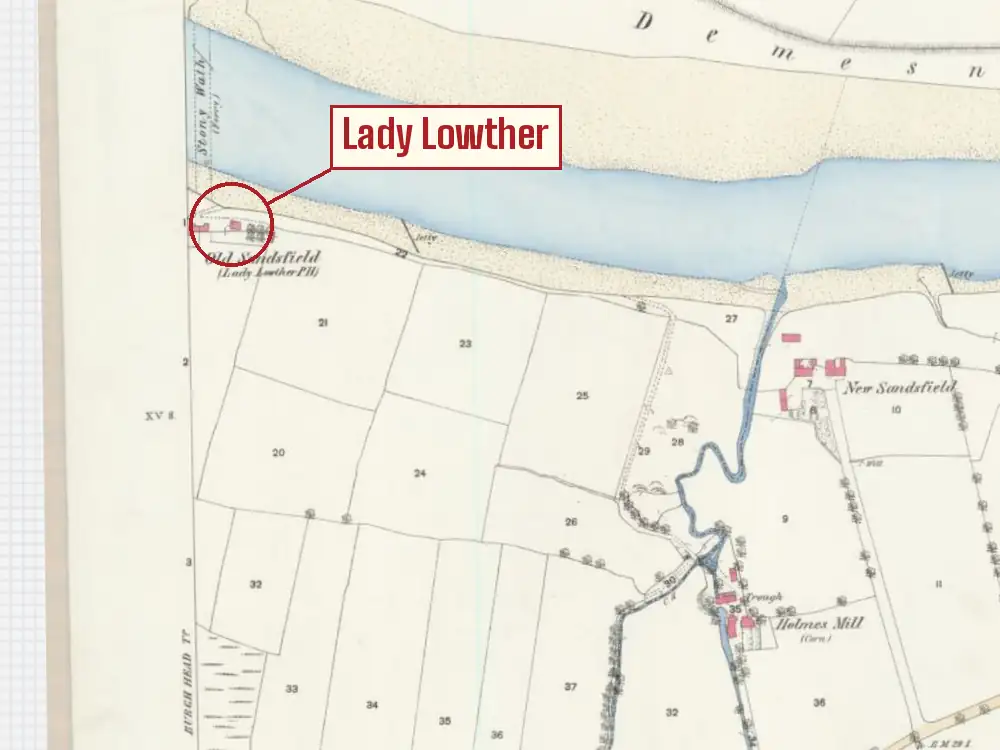
- Placed from the Old Cumbria Gazetteer's grid reference for Old Sandsfield, NY 3317 6165. The Ordnance Survey's 25-inch map surveyed in 1865 letters 'Old Sandsfield (Lady Lowther P.H.)' at the west edge of sheet XVI.5, on the south bank of the Eden.
The inn at Old Sandsfield stood alone at the east end of Burgh Marsh, on the bank of the Eden where the river widens into the Solway, and the tide ruled it. When the tide was up the way to the house could be cut off, and customers sometimes had to wait for it to go down before they could leave. Beside it the Stony Wath crossed the river to Rockcliffe: a ford at low water, with a ferry. Before the canal and Port Carlisle were made in the 1820s this was Carlisle's harbour, where ships from Liverpool unloaded at the warehouses, and the papers still called it 'the port of Carlisle'.
When the farm called Old Sandsfield House was offered to let in 1801, it came with warehouses, 'the Advantage of Shipping', a free fishery, 'a famous Salt Well (Spa)' and healthy sea bathing. In May 1802 William Room, Walter Scott and Co. opened it 'in the public line', with rooms for sea-bathers, and promised that the medicinal springs, long neglected, would be opened again and might rival Gilsland Spa. Its ball room was crowded that spring.
On the night of Monday 24 March 1817 over two hundred men and a few women gathered at Belle Vue, near Newtown, and marched on Sandsfield with bludgeons and some fire-arms, looking, it seems, for flour. They broke into James Davidson's public-house and the warehouses, found two boxes of soap, and drank what ale and spirits the house had. Another party went to 'the public-house at Old Sandsfield', demanded the warehouse keys of Joseph Nixon, the landlord, and found 'nothing of value, except ale and spirits, which they drank without ceremony', before moving on to the corn mill at Monkhill. A week later the proprietors of Burgh Marsh held a general meeting at Joseph Nixon's.
By 1838 Mrs Margaret Nixon had it: 'a well accustomed public house' on the banks of the Eden, 'immediately adjoining the well known Pasture of Burgh Marsh', with a dwelling house 'occupied as an Inn' and about 35 acres. Her stock and furniture were sold in January 1839, and by the end of May John Scott was the landlord. The Carlisle Patriot thought the 'old port of Carlisle', almost deserted since the canal opened, might come back as a resort for riders and bathers and for visitors to the monument to Edward I on the marsh. Scott had built a pleasure boat that would also work as a ferry and called it the Lady Lowther, 'in honour of the noble and highly respected proprietor of that old established Sandsfield inn'.
The paper does not name the proprietor. The Lowthers, Earls of Lonsdale, were lords of the barony of Burgh, which would explain the compliment, but that is a guess. The name was already known on the river: a vessel called the Lady Lowther traded between Liverpool and the port of Carlisle from at least 1805 until October 1814, when she was wrecked in a storm off Seaton Point, near Workington, 'richly laden with a cargo of merchant's goods'. Whether the inn took its sign from Scott's boat, from the ship or from the family is not recorded, but the Ordnance Survey's surveyors of 1865 lettered the house 'Old Sandsfield (Lady Lowther P.H.)', with the Stony Wath ferry crossing the river beside it.
Rebecca Davidson kept it in the 1860s. At the start of 1866 her servant, Ann Edger, was charged with stealing a bottle of rum and a pound of butter from her; the constable from Burgh found them in the girl's box, and she said she had bought the rum at vaults in the Green Market. In 1869 the farm was to let again, 'a good Dwelling House, kept as an Inn', to be shown by John Percival of Burgh, the Burgh Marsh Field Reeve, and that summer a witness in a fishing case told the court that Lord Lonsdale's fishermen got their refreshment there. In February 1878 the licence passed from William Lightfoot to William Percival, and in June 1881 to Thomas Percival.
Thomas Percival did not last. On 26 December 1887 a constable found him lying on a settle in his own house so drunk and violent that his wife and family dared not stay with him. The court heard that the owners, the Burgh Marsh Committee, were doing all they could to be rid of him, and he was fined 20s and costs.
A fortnight later he was sold up. On 11 January 1888 Robert Dalton sold on the premises, 'under Distress for Rent and by instructions of the Owner', the stock, crop, implements, household furniture and boat of 'Mr. Thomas Percival, Publican and Farmer': five milch cows, three horses, 28 pigs, ploughs, a threshing machine, geese, ducks and fowls, and 'all the household furniture and bar utensils'. That September the farm and public house at Sandsfield, in the parish of Burgh, was offered to let from Candlemas 1889.
In 1891 the marsh owners offered the public-house and farm to let again, with 48 acres and wintering for twenty cattle on the marsh, and George Johnston, head ploughman at Midtown, Burgh, took it. In February 1902 the licence passed from Johnston to John Connell of the Lowther Castle Inn at Drumburgh, who was still there ten years later.
In February 1912 its licence was opposed as no longer needed: the parish was losing people, and there were six licensed houses within three miles. Superintendent Graham described an inn on level land at the east end of the marsh, where anyone coming could be seen half a mile off, with no water but a stream or the river and practically no trade in winter; the Burgh constable had called nine times in a month and found no customers, and said it was often impossible, when the tide was up, to reach the inn without trespassing. A Burgh butcher added that sometimes no one could leave it till the tide went down. John Barrowdale, whose family had been marsh proprietors for eight generations, thought it a convenience for men going to the marsh.
For the marsh committee, Mr Lightfoot called it 'an inn of an exceptional character', not a house where people 'soaked' on Saturday nights. John Connell said it was a free house, doing a small trade from May to October with farmers come to look at their stock, parties visiting the monument and the odd sportsman or fisherman, and in winter only an occasional shooter. The bench sent it to the compensation authority, which renewed the licence in May 1912. That November a party meant to cross the Eden by punt at night and 'stay at the Lady Lowther Inn'; the punt capsized and Edgar Stanley Foster of Carr's biscuit works was drowned.
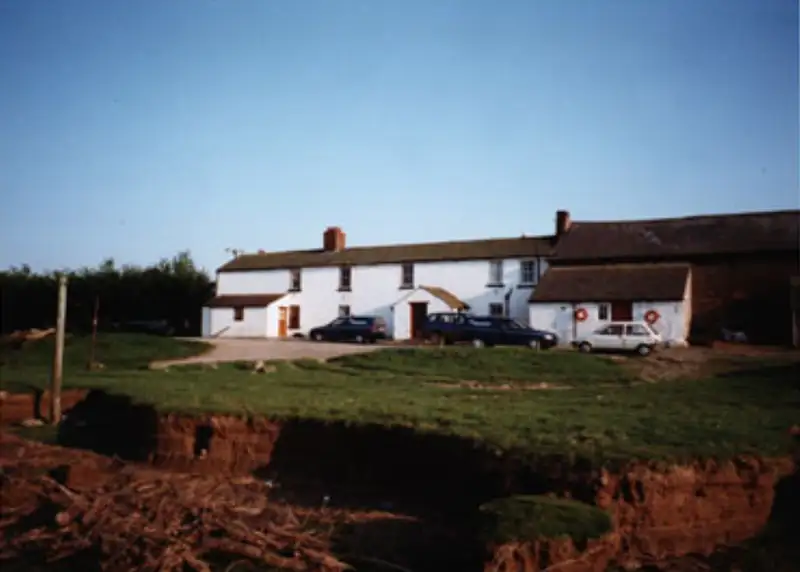
In February 1914 the licence-holders of the Lady Lowther and of the inn at Drumburgh traced two of the dogs that had killed ten sheep on Burgh Marsh. No later notice of the inn has been found. Mike Tuer's records have the Control Board taking it over in 1917 and the pub gone by 1930. The Board's register of the houses it took over lists a 'Ship' at Sandsfield, closed in 1917, which Historic England could not find on any map; as the Lady Lowther had been the only house on the marsh in 1912, it may be this house under the wrong name, but nothing settles it. In 2000 the house was still standing at Old Sandsfield, whitewashed, with lifebelts on the outbuildings and the river bank wearing away in front of it.
Photograph
Sources 32
- Carlisle Journal, 8 August 1801, p. 3: 'Old Sandsfield-House' to let (via British Newspaper Archive)
- Carlisle Journal, 10 April 1802, p. 2: the ball room at Old Sandsfield House (via British Newspaper Archive)
- Carlisle Journal, 22 May 1802, p. 1: 'Old Sandsfield House', William Room, Walter Scott and Co. (via British Newspaper Archive)
- Carlisle Journal, 20 April 1805, p. 3: shipping intelligence, Port of Carlisle (the Lady Lowther, Milroy, from Liverpool) (via British Newspaper Archive)
- Carlisle Journal, 15 October 1814, p. 3: 'Shipping News', loss of the Lady Lowther, of Port Carlisle (via British Newspaper Archive)
- Carlisle Patriot, 22 March 1817, p. 1: meeting of the proprietors of Burgh Marsh at Joseph Nixon's, Sandsfield (via British Newspaper Archive)
- Carlisle Patriot, 29 March 1817, p. 2: the disturbances at Carlisle and Sandsfield (via British Newspaper Archive)
- Carlisle Journal, 30 June 1838, p. 2: 'Eligible tithe-free farm, and well accustomed public house', Old Sandsfield, to let (via British Newspaper Archive)
- Carlisle Patriot, 12 January 1839, p. 1: sale of Margaret Nixon's farming stock and furniture, Sandsfield (via British Newspaper Archive)
- Carlisle Patriot, 1 June 1839, p. 2: 'Old Sandsfield' (via British Newspaper Archive)
- Carlisle Journal, 2 January 1866, p. 3: 'Robbery by a servant at Sandsfield' (via British Newspaper Archive)
- Carlisle Patriot, 10 September 1869, p. 1: 'Farm to let', Old Sandsfield (via British Newspaper Archive)
- Carlisle Patriot, 30 July 1869, p. 6: the Eden fishery case (via British Newspaper Archive)
- Carlisle Journal, 12 February 1878, p. 2: licence transfers (via British Newspaper Archive)
- Carlisle Express and Examiner, 11 June 1881, p. 6: licence transfers (via British Newspaper Archive)
- Carlisle Journal, 10 January 1888, p. 7: 'A drunken publican' (via British Newspaper Archive)
- Carlisle Journal, 11 September 1891, p. 8: 'Public-house and farm at Sandsfield, Burgh-by-Sands, to let' (via British Newspaper Archive)
- Carlisle Journal, 23 October 1891, p. 4: 'Incidental notes' (via British Newspaper Archive)
- Carlisle Journal, 4 February 1902, p. 3: licence transfers (via British Newspaper Archive)
- Newcastle Daily Chronicle, 26 February 1906, p. 11: Cumberland Ward adjourned licensing sessions (via British Newspaper Archive)
- Carlisle Journal, 27 February 1912, p. 6: 'Lady Lowther, Sandsfield', adjourned licensing sessions (via British Newspaper Archive)
- Whitehaven News, 9 May 1912, p. 5: 'The Compensation Authority: six licences renewed' (via British Newspaper Archive)
- Penrith Observer, 26 November 1912, p. 8: 'Another Eden catastrophe' (via British Newspaper Archive)
- Carlisle Journal, 27 February 1914, p. 7: 'Sheep worrying on Burgh Marsh' (via British Newspaper Archive)
- The Cumberland News, 28 December 1912, p. 7 (via newspapers.com)
- Ordnance Survey 25-inch map, Cumberland XVI.5, surveyed 1865, published 1880, via the National Library of Scotland
- Old Cumbria Gazetteer: Old Sandsfield, Burgh by Sands
- CUMBERLAND_PUBS_4.xls (Cumberland pubs database)
- Historic England, Countering the 'deadliest of foes': public houses of the Central Control Board and the State Management Scheme, 1916-73 (Clare Howard, Research Report 89-2018): Appendix C, gazetteer of scheme premises ('Ship', Sandsfield, location unknown)
- Cumbria Image Bank, ct50305: 'Former Lady Lowther Sandsfield, near Carlisle 2000 Closed 1912' (photograph by Dennis Irwin)
- Carlisle Journal, 6 January 1888, p. 1: 'Sandsfield, near Burgh': Robert Dalton's sale under distress for rent, 11 January (via British Newspaper Archive)
- Carlisle Journal, 14 September 1888, p. 1: farm and public house at Sandsfield, parish of Burgh, to let (via British Newspaper Archive)
Open question
A date we can't pin down
When did the Lady Lowther at Old Sandsfield close? One record has the Control Board taking it over in 1917 and the pub gone by 1930, and a caption on a photograph of 2000 says it closed in 1912, but its licence was renewed in May 1912 and it still had a licence-holder in February 1914.
If you know the answer, or where it might be found (an old photograph, a family story, a document), tell us and it goes into the story above.
More lost pubs nearby
- The Packhorse Inn, Burgh by Sandsgone 1936
- The Lowther Arms, Burgh by Sandsgone 1917
- The Ship Inn, Rockcliffegone 1916
- The Mounsey Arms, Rockcliffe
Still serving, near where it stood
-
2.7 kmaway
-
2.8 kmaway
-
3.3 kmaway
-
3.9 kmaway