City Centre, Carlisle
The Caledonian
Sold to Whitbread in 1973 for £175,100, against £26,265 for the Turf the same year. It came as a lot with the Red Lion Hotel next door, now the County.
Sold in 1973 as “Red Lion Hotel, Wine Stores and Caledonian Hotel, Botchergate” to Whitbread for £175,100. Who bought the rest
Big old-fashioned boozer near the station, part of Amber Taverns. Twelve screens showing Sky and TNT plus two racing channels, so there's always something on. Cheap, busy, quick service. Toilets are up the stairs.
Part of Amber Taverns
- Today
- See opening hours
- Address
- 17 Botchergate, Carlisle CA1 1QP
- Phone
- 01228 512917
Also known as Caledonian and Lancaster Railway Hotel, CA1, Bar Code
History
Opened 4 March 1847
- Opened
- 4 March 1847
- Opened by
- Thomas Scarrow, a Cumberland artist
- Listed
- Grade II
- Sold for
- £175,100 to Whitbread, 1973
The man who opened the Caledonian is usually called the Cumberland artist Thomas Scarrow. His own family remember him rather differently: a Carlisle councillor and alderman with 'a rich history of many wives and trouble with the law'. The pub has a better founder than the one on the label, and a name that is not what it seems either.
It is named for a railway, not a country. The Caledonian Railway opened its route from Carlisle to Scotland in 1847 and the hotel took its name the same year: the Lancaster for the line south, the Caledonian for the line north, both meeting at the new Citadel station up the road. The Carlisle Journal reported the opening on 6 March 1847; the scheme's own archive gives the 4th, which is probably the paper catching up two days later. Co-Curate dates the first reference to 1852, five years adrift of the newspaper.
The artist looks like a case of mistaken identity. The Scarrow family history, which is thorough, places an artist called Thomas Scarrow in a Cockermouth branch of the family. The Carlisle Scarrows were yeoman farmers from Scarrowhill near Cumwhitton who worked their way north through Wetheral into the city, where a Thomas Scarrow ran the White Hart Inn in the latter part of the eighteenth century. It was a Scarrow innkeeper's licence of 1812 that set a descendant researching the trade, and that research is where fourteen of the lost pubs in this archive come from.
His son, the one who opened this pub, was a Carlisle councillor from 1836, sat on the Watch Committee for eight years, and was an Alderman of the city from 1839 to 1844. An alderman, a publican, and a man the family remember for his marriages and his court appearances: better than an artist. He did not keep it long. The Carlisle Journal of 1 December 1848 carries the Caledonian and Lancaster Hotel at the head of Botchergate for sale, twenty-one months after it opened.
By the 1858 directory it was the Caledonian Hotel under J. Birney, and the 1861 census has James Birney, fifty-two, innkeeper and farmer, born at Lazonby. Even the address wandered: the early records put it at 12 Botchergate, the 1858 directory at 9, and it is 17 today. In September 1886 the Chief Constable told the bench he had found the hotel 'divided into two portions, and occupied by two tenants', which he wanted the magistrates' view on; the tenant, Mr Armstrong, had Mr Wannop for him, and the matter was put back three weeks. In 1891 T. Armstrong was hotel keeper.
In 1892-93 the whole front of the basement was gutted and made into a bar running round the premises, with three new doors, one to Botchergate and two to Mary Street, one of them leading from the stable yard into a bar that had been a back kitchen. The Chief Constable thought the back doors 'very objectionable'. In 1897 it had a wholesale bottle department, and the magistrates refused, for a second year, to let it sell drink by retail. It was sold to the Maryport Brewery Company on 24 July 1899. In September 1894 Thomas Nicholson of the Caledonian Hotel was on the black list, his licence held over to the adjourned sessions.
The scheme took it in August 1916, improved it in 1957, and sold it to Whitbread in 1973 for £175,100, against £26,265 for the Turf the same year. It was a substantial city-centre lot that included the former Red Lion Hotel next door, and it shows how wildly the scheme's pubs were valued when they went.
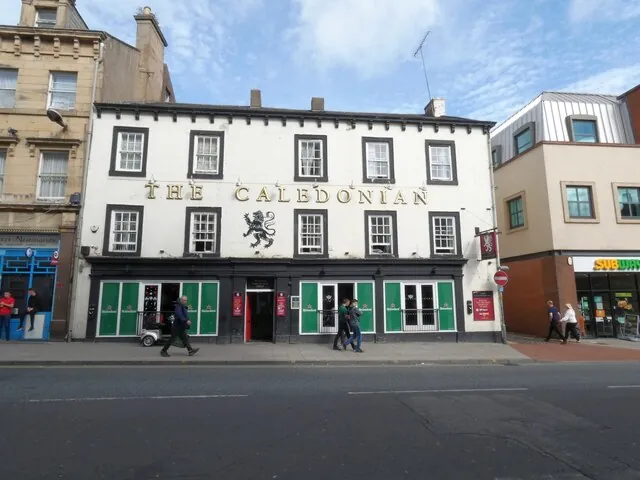
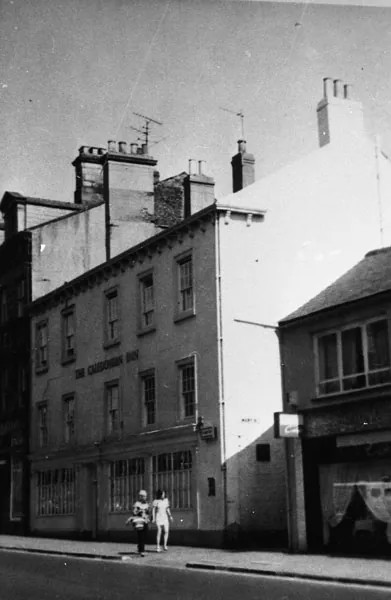
That neighbour is tangled up in the building itself. The Caledonian is Grade II listed, early nineteenth century with later alterations: painted stucco on a chamfered plinth, a stone-bracketed metal gutter, graduated green slate roof, three storeys and five bays at the junction with Mary Street. The listing suspects the top floor is an addition to an original two-storey building, and it is right to: that floor is in separate ownership and forms part of the County Hotel next door, put up in 1894-6 as the Red Lion Hotel for Samuel Boustead (Bousfield in its listing) to designs by J. Murchie, and renamed the County only in 1990. So a late Victorian hotel owns the upper floor of a pub seventy years older.
The early 2000s bar boom gave it an identity crisis. Between about 2000 and 2006 it traded as CA1, the postcode, and then Bar Code, a pun; neither stuck. The old name came back in August 2006 after a £250,000 refurbishment, under a 27-year-old licensee, Simon Barton, once manager of Casa across the road. It lasted until December 2008, when he shut it with the loss of fourteen jobs, blaming high rent, supermarket beer, the credit crunch and the smoking ban: 'Carlisle has become a two-night town'. Its owners, Pub Enterprises, were by then advertising it to let. Amber Taverns bought it early in 2014 and refurbished it.
- Cheap pint
- Historic interior
- Live sport
- Traditional
Photographs
Opening hours
| Mon | 10:00–23:00 |
| Tue | 10:00–23:00 |
| Wed | 10:00–23:00 |
| Thu | 10:00–23:00 |
| Fri | 10:00–midnight |
| Sat | 10:00–00:30 |
| Sun | 10:00–23:00 |
Hours last checked August 2026, about 2 months ago.
Hours are kept by hand and change without warning. Ring ahead if it matters.
More like this
- Cheap pint pubs in Carlisle
- Historic interior pubs in Carlisle
- Live sport pubs in Carlisle
- All pubs in City Centre
Nearest to here
-
20 maway
-
30 maway
-
40 maway
-
40 maway
Lost on Botchergate
- BrewDog Carlisle gone 2026
- Buzz Bingo gone 2021
- The Crown gone 2021
- The Las Vegas Strip gone 2018
- The Earl Grey gone 2010
- Terminal gone 2010
- Mood gone 2008
- The Albion Tavern gone 1992
70 lost pubs stood within 400 m of here. See what used to be around it
Sources
- The State Management Story: Caledonian
- Carlisle Encyclopaedia: Caledonian Inn, with the Carlisle Journal citations
- The Scarrow family history
- Thomas Scarrow, Carlisle councillor and alderman 1836-1845
- S. Davidson, Carlisle Breweries and Public Houses 1894-1916, p.79
- Historic England list entry 1208808
- Historic England list entry 1208782, the County Hotel, formerly the Red Lion
- Historic England photograph record: the Doulton billiard room and the 1893 plans
- Co-Curate: the Caledonian
- Ale Tales (Solway CAMRA), Spring 2014: Bar Fly news
- Historic England, Countering the 'deadliest of foes': public houses of the Central Control Board and the State Management Scheme, 1916-73 (Clare Howard, Research Report 89-2018): Appendix C, gazetteer of scheme premises
- Carlisle Patriot, 10 September 1897, p. 3: 'Licensing Sessions: City of Carlisle' (via Findmypast)
- Carlisle Patriot, 10 September 1886, p. 3: 'Carlisle Brewster Sessions' (via British Newspaper Archive)
- North Cumberland Reformer, 7 September 1893, p. 2: 'Brewster Sessions' (via British Newspaper Archive)
- The Cumberland News, 12 December 2008, p. 16: 'Last orders at Botchergate pub' and 'New club bucks trend and opens' (via newspapers.com)
- North Cumberland Reformer, 8 September 1894, p. 2: brewster sessions, the black list (via British Newspaper Archive)
Open question
An unsolved mystery
Was the Caledonian opened by an artist? The State Management Story calls its founder the Cumberland artist Thomas Scarrow. The Scarrow family history puts an artist of that name in a Cockermouth branch, while the Carlisle Thomas Scarrow was an innkeeper, councillor and Alderman of the city. Two men, one name, and the wrong one may have ended up on the pub.
If you know the answer, or where it might be found (an old photograph, a family story, a document), tell us and it goes into the history above.