Lost pub · Micklethwaite
The Brisco Arms
- Gone
- Closed by the Control Board; on its list of closures by February 1919
- There now
- A house, Brisco House
- Address
- Micklethwaite, on the old Carlisle to Wigton road
- Where exactly
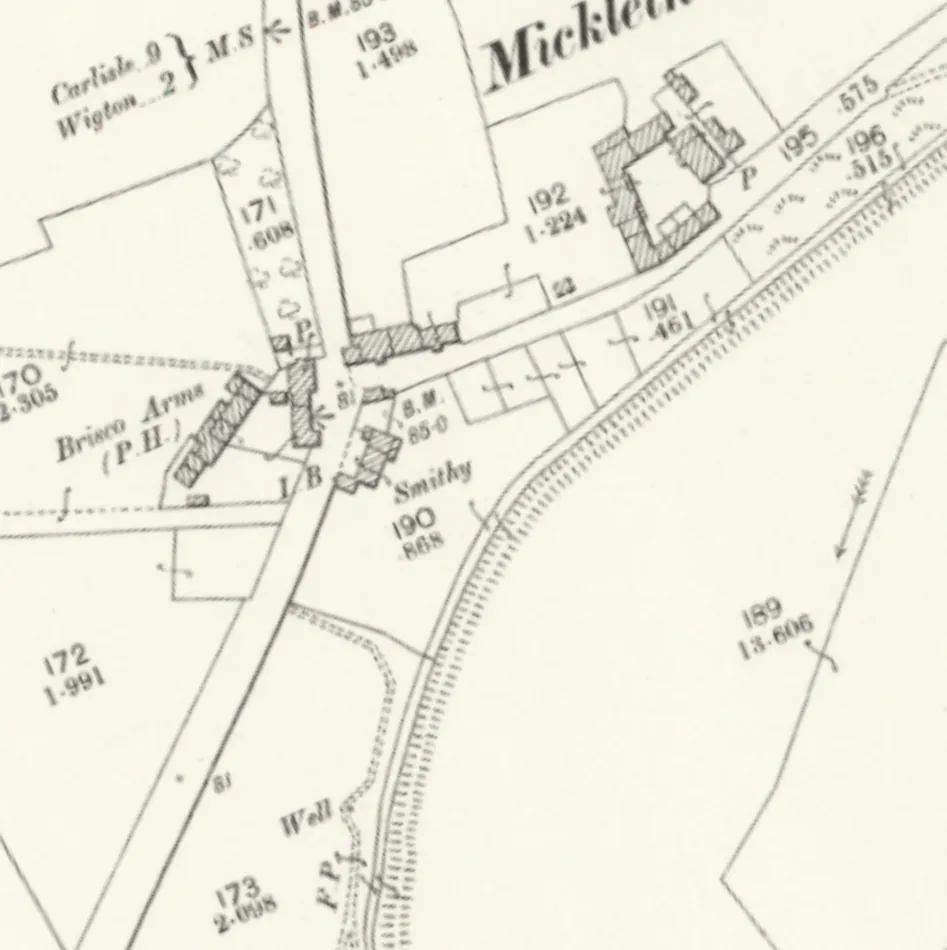
- Placed from the Ordnance Survey grid reference, NY2838350370, in Historic England's gazetteer of the scheme's premises. The 25-inch map of about 1900 marks the Brisco Arms (P.H.) here, on the west side of the crossroads, opposite the smithy. The building's use in 2018: residential (Brisco House).
A roadside inn at Micklethwaite, on the Carlisle to Wigton road nine miles out and two short of Wigton, where a lane crosses at the hamlet. The Ordnance Survey's 25-inch map of about 1900 marks the Brisco Arms (P.H.) on the west side of the crossroads, with the smithy across the lane and the milestone just north. It belonged to the Briscos of Crofton Hall, whose estate surrounded it, and its name was theirs. Older notices give its address as Aikton, the next parish; Mike Tuer's database files it under Aikton too, and there is no sign of a second Brisco Arms there. It is in the directories from 1847.
In March 1864 the 'old-established and well-accustomed' inn, with stable, byre and loose box, was put up for auction, with Joseph Stoddart as tenant. That year or the next Sir Robert Brisco had the magistrates withhold its licence until he could find somebody to run it better. The trouble, the police said later, had been a tenant called Wright, in whose time the house was known for wrestling for belts and quoiting; that was why he was dismissed. The licence stayed in abeyance for the best part of eight years, though the building kept its name: Jane Ellwood, 34, died 'at the Brisco's Arms Inn, Aikton' in November 1870.
In 1872 Sir Robert found his man, Miller Irving, for many years a servant of his at Crofton Hall, and the Wigton bench granted the licence as a renewal, over the objection of Sir Wilfrid Lawson of Brayton, the most famous temperance campaigner in the country, and after what the Carlisle Patriot called 'some little exchange of temper' between the two baronets.
Then the arguing started. The new Licensing Act of 1872 made a fresh licence need confirming at Quarter Sessions, and Lawson held that this was a fresh licence, not a renewal. In August 1873 the bench agreed and refused to renew it, though every ratepayer in the parish but one, who was away, had signed in support. Irving went on selling under his Excise licence, so Lawson's steward, Robert Norman, laid an information against him for having 'Brisco Arms, Miller Irving, Licensed Retailer of Ale and Foreign Spirits' painted over his door.
The Wigton bench said it was a matter for the Excise and would not hear it, so Lawson went to the Court of Queen's Bench, which on 25 November 1873 ordered the magistrates to hear the case; their own counsel admitted he could not support their refusal on any ground. The Patriot was scathing about 'the essentially trumpery nature of the war which this wealthy landed magnate has carried on for more than a year with an obscure innkeeper'.
When the case came on in January 1874 Sir Robert, who was chairing the bench, had to step down from it because the inn was on his estate. Irving said the exciseman had sent him to Carlisle for his licence and he had thought himself quite right; he had taken the sign down for two days and then put it back. The bench adjourned its decision for a month, and then nothing more was heard: the reports of the Wigton sittings in February and March 1874 do not mention it, and it seems to have been allowed to drop.
In August 1874 Irving tried again, this time for a new licence, done properly. Sir Robert left the chair once more, and Irving produced a memorial from the parish of Thursby, saying he had not had a single refusal. Lawson objected, as he said he always did, on the ground that there were plenty of public houses already; the nearest, Irving admitted, was within a mile, but not in the parish. A magistrate raised the wrestling and quoiting, Irving said there had been nothing of the kind since he came, and the bench granted the licence by four votes to three. He kept the Brisco Arms until he died there on 12 January 1880, aged 39, 'for many years a faithful and respected servant of Sir Robt. Brisco, Bart., of Crofton Hall'.
After Irving it carried on as the village inn. It was a saleroom in 1884, and in June 1885 a Carlisle grocer, J. B. Carlyle, stopped there to bait his pony, which bolted, kicked him senseless and pitched his lad over a hedge; he was carried into the inn and the doctor fetched from Wigton. Its keepers came and went: John James, then Richard Kerr in 1888; William Brayton, then John Murray of Dalston in 1903; Thomas Brown, whose wife Sarah caught a collier pocketing a bottle of lime-juice cordial in the bar in 1905 and locked him in, before the neighbours shut him in the coalhouse; then William James Burn of Bellingham, who in 1906 served a farm labourer from a mile away who claimed to be a traveller.
The Briscos sold it in September 1908, lot 1 in the second sale of the Crofton estate, an inn, cottage and nearly six acres let at £43 a year, with the Micklethwaite smithy as lot 2. In February 1909 the licence went from James Brown to John Carrick of Mealsgate, who was the innkeeper a month later when a farmer who had called in during a sale at the next farm was found frozen in the gutter outside the hamlet the next morning. The Control Board closed it, and in February 1919 the Wigton Advertiser listed the Brisco Arms among fourteen houses the Board had shut in the Wigton division, with the Horse and Farrier at Thursby. The building is a house now, Brisco House.
Photograph
Sources
- Historic England, Countering the 'deadliest of foes': public houses of the Central Control Board and the State Management Scheme, 1916-73 (Clare Howard, Research Report 89-2018): Appendix C, gazetteer of scheme premises
- Carlisle Patriot, 12 March 1864, p. 1: 'Public house, &c, at Aikton, for sale' (via British Newspaper Archive)
- Carlisle Express and Examiner, 26 November 1870, p. 5: deaths, Jane Ellwood at the Brisco's Arms Inn, Aikton (via British Newspaper Archive)
- Wigton Advertiser, 13 September 1924, p. 2: its report of the Wigton Brewster Sessions of August 1874, reprinted (via British Newspaper Archive)
- Carlisle Express and Examiner, 30 August 1873, p. 5: 'Brewster Sessions: the Micklethwaite licensing case' (via British Newspaper Archive)
- Carlisle Patriot, 5 September 1873, p. 6: Wigton, Brewster Sessions (via British Newspaper Archive)
- Carlisle Patriot, 10 October 1873, p. 4: 'Sir W. Lawson and Miller Irving' (via British Newspaper Archive)
- Wigton Advertiser, 31 January 1874, p. 4: Wigton Petty Sessions, 'The Micklethwaite licensing case' (via British Newspaper Archive)
- Carlisle Journal, 15 February 1884, p. 8: 'Property at Aikton' (via British Newspaper Archive)
- Carlisle Patriot, 5 June 1885, p. 4: 'Serious accident to a Carlisle tradesman' (via British Newspaper Archive)
- Wigton Advertiser, 17 November 1888, p. 4: Wigton Petty Sessions, transfers of licences (via British Newspaper Archive)
- Wigton Advertiser, 19 December 1903, p. 4: 'Licence transfers' (via British Newspaper Archive)
- Wigton Advertiser, 10 June 1905, p. 4: 'Locked in a coal-house' (via British Newspaper Archive)
- West Cumberland Times, 15 November 1905, p. 2: 'Licence transfers at Wigton' (via British Newspaper Archive)
- Wigton Advertiser, 16 December 1905, p. 4: 'Public-house changes' (via British Newspaper Archive)
- Wigton Advertiser, 1 December 1906, p. 4: 'Not a bona-fide traveller' (via British Newspaper Archive)
- Carlisle Journal, 11 September 1908, p. 1: 'The Crofton Estate, 2nd sale', E. J. Castiglione and Sons (via British Newspaper Archive)
- Carlisle Journal, 5 February 1909, p. 5: 'Licensing Sessions: Wigton' (via British Newspaper Archive)
- Carlisle Journal, 5 March 1909, p. 5: 'Wigton farmer's death on the road' (via British Newspaper Archive)
- Wigton Advertiser, 22 February 1919, p. 3: 'More houses to go?' (via British Newspaper Archive)
- Ordnance Survey 25-inch map, Cumberland, second edition (about 1900), via the National Library of Scotland
- SOLWAY_PUB_DIRECTORY_Excl_Carlisle_Ver1.xls (Mike Tuer's pub database)
- Wigton Advertiser, 29 August 1874, p. 4: 'Wigton Brewster Sessions', the Micklethwaite licensing case (via British Newspaper Archive)
- Carlisle Express and Examiner, 17 January 1880, p. 5: deaths, Miller Irving at the Brisco Arms (via British Newspaper Archive)
- Carlisle Express and Examiner, 20 December 1873, p. 6: 'The Micklethwaite licensing case', from the Wigton Advertiser (via British Newspaper Archive)
- Wigton Advertiser, 21 February 1874, p. 4: Wigton Petty Sessions, 17 February 1874 (via British Newspaper Archive)
- Wigton Advertiser, 28 March 1874, p. 4: Wigton Petty Sessions, 24 March 1874 (via British Newspaper Archive)
Still serving, near where it stood
-
4.2 kmaway
-
4.3 kmaway
-
5.4 kmaway
-
5.6 kmaway