Thursby, Carlisle
The Ship Inn
A scheme pub, sold to Scottish & Newcastle on 17 April 1973.
Sold to Scottish & Newcastle as part of Group 1, handed over on 17 April 1973. Who bought the rest
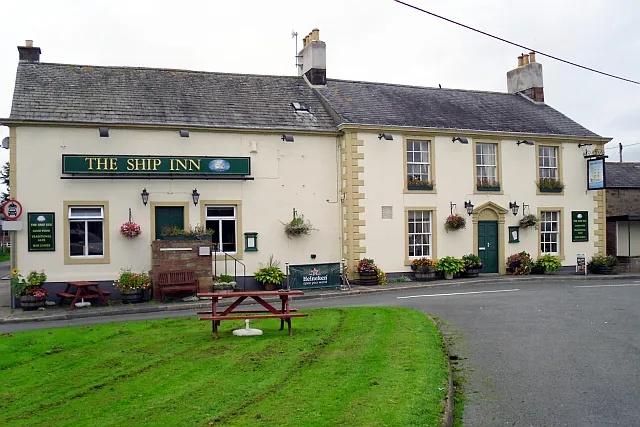
Country pub on the green, popular with locals and with motorhomes stopping over. Dominoes still played.
Part of Star Pubs (Heineken UK)
Closed since 31 January 2022. Star Pubs have a £490,000 refurbishment planned to bring it back as a village pub with food, sport and entertainment. Tell us if it reopens.
- Today
- See opening hours
- Address
- Church Lane, Thursby, Carlisle CA5 6PE
- Phone
- 01228 710600
History
Opened 18th century
- Building
- 18th century, Grade II listed
- Birthplace of
- Sir Thomas Bouch, 25 February 1822
- Closed
- 31 January 2022
- Sold
- To Scottish & Newcastle, 17 April 1973
Sir Thomas Bouch was born in this pub on 25 February 1822, and there is a plaque on the wall to say so, though even the date is disputed: the 22nd, 23rd and 25th are all in print. He built the first train ferry in the world and about two hundred and seventy miles of railway, and he was knighted for the Tay Bridge, which fell down. The Ship is an eighteenth-century Grade II listed inn on Church Lane at the edge of the green at Thursby, shut since January 2022.
It is a Ship Inn in a landlocked village miles from navigable water, which looks wrong for the place. Every other Ship Inn that turns up is on a coast, a harbour or a river. What Thursby had was Bouch's father, William Bouch, a captain in the mercantile marine, who came ashore and kept this pub. He and Elizabeth Sanderson had four children, and he died when Thomas was sixteen. The inn is eighteenth century and Bouch was here by 1813, so either he took a pub already called the Ship or the name came in with him. A retired sea captain running a pub called the Ship nowhere near the sea is either a fine coincidence or the whole explanation, and the sources do not say which.
Thomas's career started in the village. A lecture by his first teacher, Joseph Hannah of Thursby, on the raising of water in ancient and modern times, made such an impression that the boy went straight to reading books on mechanics. From that he went to Liverpool at eighteen, then to the Lancaster and Carlisle Railway, then to the Stockton and Darlington, and by 1849 he was running the Edinburgh and Northern, where he built the train ferry across the Forth.
Then the Tay Bridge. In December 1879 it was swept away in a storm with the loss of seventy-five lives. The inquiry found the bridge badly designed, badly built and badly maintained, and Bouch died at Moffat within the year, while the inquiry was still sitting. He is remembered for the one thing that fell down.
He was not the only engineer this pub produced. His elder brother William, born at Thursby in 1813, was apprenticed to Robert Stephenson, served in the Russian Navy, and became locomotive engineer of the Stockton and Darlington. And it was Thomas who found the premises at Woodbank near Upperby for the firm he set up with his brother, John Cowans and Edward Pattinson Sheldon. That firm became Cowans, Sheldon and Co, the Carlisle crane makers, who are why there was a pub on London Road called the Cranemakers. Two sons of a village pub, and one of Carlisle's great industries traced back to the bar.
With Telford at the Metal Bridge and Brassey at the Scott & Brassey, that gives this site three great engineers of the canal and railway age.
The Board took the Ship over in 1918, the year it shut the village's other pub, the Horse and Farrier, a few yards away. Historic England's gazetteer has it altered in 1934-5 so that it could serve food, and improved again in 1961-2, when the scheme bought the property next door and put in new public rooms, a new servery and new lavatories. It was sold to Scottish & Newcastle on 17 April 1973, the same buyer and the same day as the Harraby Inn, and is now on the Star Pubs estate.
When it was open it kept up to three changing real ales from the Heineken guest list, served food, and still had dominoes being played. There is a campsite at Crofton and a reasonable bus service, which is how a fair few of its customers arrived.
Star Pubs are advertising it for a tenant, and the listing is unusually frank about what running a village pub involves. They put the estimated annual turnover at £598,543 against an annual rent of £54,140, describe a £490,000 refurbishment, and note that there are 747 adults within a short walk. That last figure is the whole problem and the whole opportunity in one number: no competition for miles, and 747 people to build a trade on.
- Food
- Traditional
Photographs
Opening hours
| Mon | Unknown |
| Tue | Unknown |
| Wed | Unknown |
| Thu | Unknown |
| Fri | Unknown |
| Sat | Unknown |
| Sun | Unknown |
Hours are kept by hand and change without warning. Ring ahead if it matters.
More like this
Nearest to here
-
1.4 kmaway
-
3.4 kmaway
-
4.3 kmaway
-
4.7 kmaway
Lost in Thursby
- The Horse and Farrier gone 1918
- The Fox and Hounds gone 1909
1 lost pub stood within 400 m of here. See what used to be around it
Sources
- Historic England list entry 1312458
- The State Management Story
- CAMRA WhatPub
- Star Pubs: the tenancy listing and its figures
- Thomas Bouch: his father kept the Ship Inn
- Dictionary of National Biography, 1885-1900: Bouch, Thomas
- Grace's Guide: Thomas Bouch and Cowans, Sheldon
- Historic England, Countering the 'deadliest of foes': public houses of the Central Control Board and the State Management Scheme, 1916-73 (Clare Howard, Research Report 89-2018): Appendix C, gazetteer of scheme premises
Open question
An unsolved mystery
Did the Ship Inn at Thursby get its name from a sea captain, or did the sea captain pick a pub already called the Ship? William Bouch, a captain in the mercantile marine, kept the inn and his son Sir Thomas Bouch was born in it in 1822. The building is eighteenth century and the family were in the village by 1813, so the order is unresolved.
If you know the answer, or where it might be found (an old photograph, a family story, a document), tell us and it goes into the history above.